I once blanked so hard in an on-site that I forgot what a hash table was. Like, the actual concept. I'd been writing code for eight years. I'd implemented a hash table the previous month in a side project. The interviewer asked me to describe one, and I felt my brain go completely empty in a way I'd never experienced before. Twenty seconds of silence. I could feel my face going red.
I didn't get the offer, but the interviewer was nice about it on the way out. He told me the thing I'd needed to hear, which was: it happens to everyone, and most people make the blank worse by panicking about the blank. The blank is recoverable. The panic about the blank is what ends interviews.
If you're reading this because you've blanked, or because you're afraid you will, here is the actual playbook. It's mostly two things: a small set of moves to make in the moment, and a mindset shift about what blanking actually means.
What blanking actually is
Blanking is not a sign that you don't know the answer. It's a sign that your working memory has temporarily seized — usually because some combination of cortisol, social pressure, and self-monitoring has pushed the part of your brain that handles retrieval offline for a few seconds.
The thing you should know is: it does not last. Even in extreme cases, the freeze is usually 5-20 seconds. The mistake people make is trying to power through with whatever's left, which makes the freeze longer because you're now multitasking between trying to answer and trying to stop freezing.
The single most useful move you can make is buying time without making it weird. The rest of this post is how to do that.
The lines that buy time without sounding lost
Interviewers can tell when you're stalling. What they're forgiving about is structured stalling — pausing in a way that signals "I'm thinking, not panicking." A few stock lines, internalized so you can say them automatically, do most of the work.
This is the universal opener. It works for behavioral, technical, and system design. It signals composure. It also gives you 5-10 seconds without saying anything else, during which your brain often unfreezes on its own.
Use this when the question caught you off guard and you literally need to reason in real-time. It's not stalling — it's asking permission to do the right thing, which is reason out loud instead of presenting a finished answer.
This is a stall disguised as clarification. It's also genuinely useful — half the time the interviewer will rephrase, which gives you another angle on the question. The other half of the time, asking the question forces you to think about it, and your brain unsticks.
Only works if you're mid-problem and they introduced a side question. But powerful when it applies — you maintain forward momentum on something you can answer, and you've publicly committed to circling back, which forces you to actually return to it (and now your brain has had two minutes to chew on it in the background).
The honest move. It's much, much better than inventing something wrong. Interviewers are generally not testing whether you have facts memorized — they're testing whether you can reason. Acknowledging the gap and then demonstrating reasoning often scores higher than a confident wrong answer.
The two-step recovery move
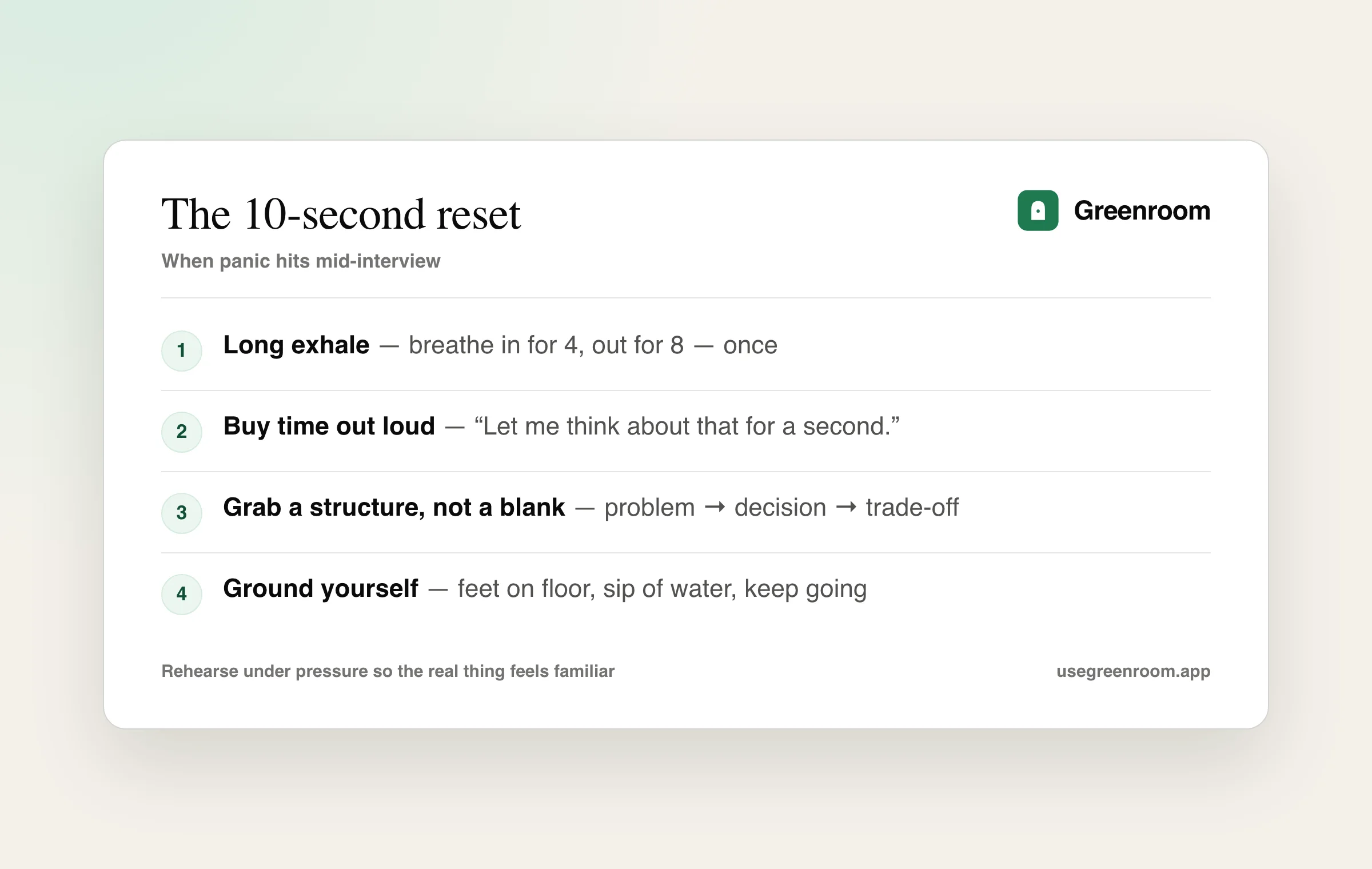
When you feel the blank coming, do these two things in this order:
1. Breathe out
Sounds stupid. Try it anyway. Most people, when they panic, hold their breath without realizing it, which makes the panic worse. A single deliberate exhale resets your nervous system enough to get the next sentence out. You can do this in less than two seconds, and the interviewer won't notice.
2. Say one of the lines above out loud
Don't decide which one in the moment — pick a favorite ahead of time. Mine is "let me take a second to organize how I want to answer that." Yours might be different. The point is that under pressure, you don't want to choose between five options. You want one rehearsed line that comes out automatically.
This two-step is a routine. The first time you do it in a real interview, it'll feel like you're stalling. By the third or fourth time, you'll realize it's actually a structured way to take a moment, which is what every senior person does in real meetings.
What absolutely not to do
Don't apologize for blanking
"Oh sorry, I'm totally blanking right now, sorry." This does three bad things at once: signals lack of composure, calls attention to the blank, and adds time you can't use for thinking. If you must say something to fill the space, use one of the lines above. Not an apology.
Don't ramble to fill silence
Silence feels much longer when you're in it than when you're listening to it. Three seconds of silence sounds like an eternity inside your head; from the interviewer's side, it sounds like someone thinking. Trust the silence. Rambling — adding sentences that aren't going anywhere — is much more damaging than a five-second pause.
Don't catastrophize the moment
The internal monologue that comes with blanking is usually some version of "this is over, I've ruined it, they're writing 'reject' right now." It's almost always wrong. One bad minute does not end an interview. The way you recover from the bad minute is most of what the interviewer remembers. Senior interviewers have all blanked in their own interviews and know it's part of the process.
Don't invent confident-sounding nonsense
This is the failure mode that actually loses interviews. A 30-second blank, recovered well, is forgivable. A confidently delivered wrong answer that you double down on is much worse. Interviewers are extremely good at detecting bluffing. The honest "I'm not sure, but here's my best guess" beats the confident wrong answer every time.
How to make blanking less likely in the first place
Mock under realistic pressure, not just realistic content
The reason people blank in real interviews more than in practice is that the practice didn't feel like an interview. You were on your couch, you knew the answer, you could pause. The thing to practice isn't the answer — it's the conditions. Camera on. Voice. Strangers if you can manage it. Pressure simulation is the variable that transfers.
Have anchor moves you can fall back on
An anchor move is a thing you can do at any time, in any interview, when you need to occupy your brain with something concrete. For technical interviews, mine is "let me write out the inputs and outputs first" — I can do that in any problem, it gets me started, and it usually unsticks me. For system design, mine is "let me list the functional requirements." For behavioral, mine is "let me back up — what's the context here?" Find your anchor moves. Practice them until they're automatic.
Reduce the number of new decisions you make on the day
Decision fatigue contributes to blanking more than people realize. The night before, lay out your clothes, prep your space, decide what you're eating. Reduce the number of micro-choices you have to make on the morning of, so your cognitive battery is fully available for the interview itself. This is dumb-sounding advice that genuinely matters.
The reframe that helps the most
Blanking is part of how brains work under pressure. It is not a moral failing, it is not evidence you're unqualified, and it is not something you can fully eliminate. The senior engineers I know all have stories about times they froze. The difference between people who pass interviews and people who don't isn't that one group blanks and the other doesn't. It's that one group has rehearsed the recovery and the other hasn't.
Pick your line. Practice your exhale. Trust the silence. Come back from the moment instead of avoiding it.
For the less extreme version of this — where you have not blanked, you simply do not know — see what to do if you don't know the answer in an interview.
Frequently asked questions
What should I say when I blank in an interview?
Buy time honestly: "Let me think about that for a moment" or "Let me restate the problem to make sure I have it right." Both sound composed, slow your physiology down, and usually restart retrieval within seconds.
Is blanking in an interview an automatic fail?
No — interviewers see it constantly and mostly grade the recovery, not the blank. A calm reset followed by a structured answer often reads better than a fast, rambling one.
Why do I blank on things I know well?
Acute stress narrows working memory and temporarily blocks retrieval — it's physiology, not a knowledge gap. That's why the answer arrives five minutes after the question moved on.
How do I stop blanking from happening?
Make the situation un-novel: rehearse out loud, under time pressure, with follow-ups, until interviews stop feeling like a threat. Practicing recovery itself — deliberately pausing and restarting — is the most underrated drill.