The recruiter's email says "Tuesday the 3rd, 11am," and you do the maths: fourteen days. Fourteen days feels like a luxury for exactly one evening. On that evening you buy a course, bookmark three YouTube playlists, open a fresh Notion page titled "INTERVIEW PREP 🔥", and go to bed feeling like a person with a plan.
On day nine you realise the plan was mostly the Notion page. You have watched four hours of "top 50 interview questions" at 1.5x speed, nodded at every answer, and said precisely none of them out loud. The interview is in five days, and the only thing you have rehearsed is opening the playlist.
This guide is how to prepare for an interview in 2 weeks without that day-nine panic. The short version: two weeks is plenty of time, as long as you spend the first week building your material and the second week saying it out loud. Most people spend both weeks reading, which is why day thirteen still feels like day one.
The 2-week interview preparation plan, in one sentence
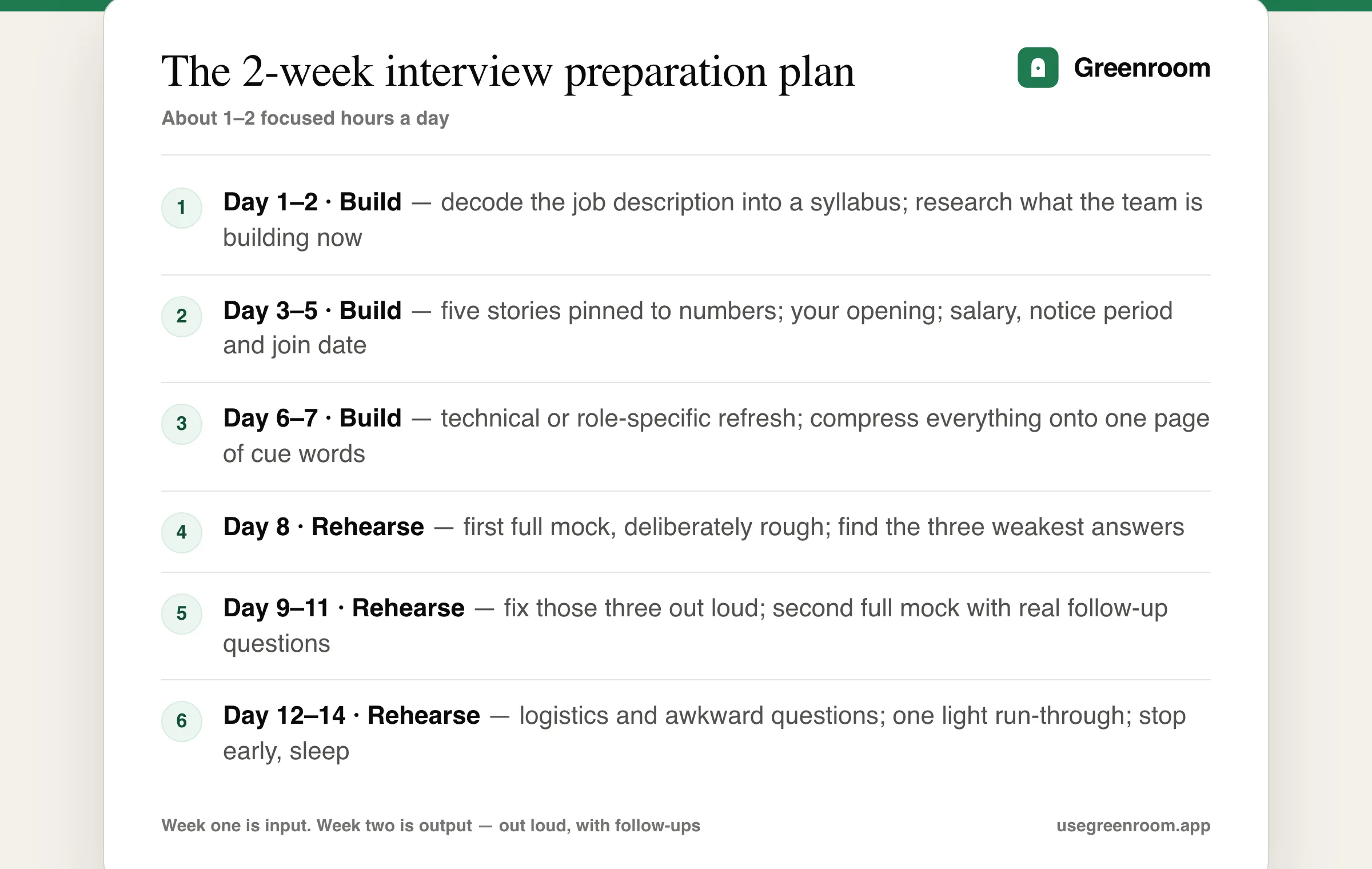
Week one: build — research, stories, numbers, and the technical refresh. Week two: rehearse — out loud, under follow-up questions, with feedback. The split matters more than the hours. I learned it the slow way: I walked out of interviews I had "prepared" for, knowing the answers had been in my head and simply never made it out of my mouth. That gap — prepared on paper, frozen in the room — is the reason I built Ari, the AI interviewer behind Greenroom.
Why front-load the building? Because rehearsal needs something to rehearse. And why leave a full week for speaking? Because the skill an interview tests — producing a clear answer under mild pressure, live — only improves through repetition spread over several days. The forgetting curve Hermann Ebbinghaus described in the 1880s, and the spacing research collected in Make It Stick, point the same way: five short sessions across five days beat one long session the night before.
Week one: build the material (days 1–7)
Day 1 — Decode the job description
Print it, or paste it somewhere you can mark up. Highlight every skill, tool and behaviour it names, then sort them into three piles: things you have clearly done, things you have partly done, and gaps. That list is your syllabus. Everything in the next thirteen days should trace back to it — which immediately rules out about three of those four YouTube playlists.
Day 2 — Research the company properly
Not the founding year. What the team is building now, what they have said publicly about their challenges, and how the interview loop usually runs — Glassdoor reviews and the company's engineering blog are better sources than generic listicles. Our guide on how to research a company before an interview covers where to look and what to ignore.
Days 3–4 — Write your five stories
Most behavioural questions pull from a small set: a conflict, a failure, a time you led, a time you went beyond your role, and a hard decision. Pick one real story per slot from your last two or three years, and pin each one to a number — the latency you cut, the hours you saved, the bug count that fell. Write each as a title and two lines, not a full essay. If you need a worked structure, our tell me about a time you failed guide shows one story built end to end.
Day 5 — Your opening and your numbers
Draft your answer to "tell me about yourself" as three beats: where you are now, the one thing you are proudest of, and why this role. Then write down the answers to the questions candidates fumble because they sound casual: current salary, expected range, notice period, earliest joining date. Rehearsing "what are you expecting?" feels silly. Hesitating on it in the room feels worse.
Days 6–7 — Technical refresh (if the role has one)
For a software role, use these two days for the fundamentals the job description actually names, not the whole of computer science. Two or three medium problems a day in the relevant pattern, plus one system design or architecture question if you are mid-level or above. If your gap is large — months of DSA rather than days — two weeks will not close it, and our guide on how long to prepare for coding interviews is the honest place to start. For non-technical roles, spend these days on the role-specific scenario questions from day one's gap list.
End of week one: compress everything into a single page of cue words — stories, numbers, company facts, two questions to ask. Our guide to interview preparation notes shows exactly what that page looks like. That page is your script for week two, except it is deliberately not a script.
Week two: rehearse out loud (days 8–14)
Day 8 — First full mock, badly
Run one complete mock interview — opening, three or four behavioural questions, one technical or role-specific question, your questions at the end. It will be rough. That is the point: day eight's job is to find out which lines on your one-page sheet do not turn into sentences yet. Record it, or use something that gives you feedback, and write down the three weakest moments.
Days 9–10 — Fix the three weakest answers
Not all of them. The three. Say each one out loud five or six times, deliberately varying the wording so you are remembering the point, not the paragraph. If an answer keeps running past two minutes, cut a detail, not the number.
Day 11 — Second full mock, with follow-ups
This is the most important session of the fortnight. The real interviewer will not accept your first answer and move on — they will ask "why that approach?" or "what would you do differently?" A friend can do this if you brief them to push back rather than be kind. Our guide on how many mock interviews to do before the real one covers why two to four spaced sessions is usually the useful range.
Day 12 — Logistics and the weird questions
Test your camera, audio and connection if the interview is virtual; plan the route and timing if it is in person. Then practise the awkward ones: "why are you leaving?", "explain this gap", "do you have other offers?" — short, honest, rehearsed answers.
Day 13 — Light run-through
One relaxed pass through your one-page sheet, out loud. No new material. If something new appears in your head on day thirteen, it goes in a list for after the interview, not into your answers.
Day 14 — The day before
Stop by early evening. Sleep is now worth more than any extra hour of prep. The week-before-interview checklist covers the final 48 hours in more detail, including what to deliberately stop doing.
How many hours a day to prepare for an interview
For most people, one to two focused hours a day is enough for this plan, which makes it workable alongside a full-time job. Freshers with free time can stretch week one's technical days to three or four hours, but the rehearsal sessions in week two should stay short — forty-five to sixty minutes of speaking is more tiring than it sounds, and quality drops after that. If you are juggling a job, our guide on preparing for interviews while working full-time covers how to fit the sessions around work. And if the fourteen days somehow shrink to one, there is a one-day version too.
Where each prep option fits in a two-week plan
- YouTube "top 50 questions" videos — fine on day one to see the shape of likely questions. Past that, watching someone else answer trains you to recognise good answers, not produce your own.
- GeeksforGeeks, LeetCode and Glassdoor — the right tools for week one's technical refresh and company research. They supply questions; they do not test whether you can explain your answer while someone interrupts.
- A senior's WhatsApp PDF of "asked questions" — useful as a list of topics. Their answers belong to their experience, and borrowed stories collapse on the first follow-up.
- ChatGPT — good for decoding a job description on day one and tightening your story drafts on days three to four. Typing to it is still writing practice, though, and week two is about speaking.
- A friend running mocks — excellent if they will push back instead of saying "that was great!" Hard to schedule three times in one week.
- Greenroom — this is where week two lives. Ari, the AI interviewer, asks the questions out loud, follows up on what you actually said, and scores the answer, so days eight and eleven do not depend on anyone's calendar. The honest tradeoff: Ari does not know this specific company's panel and is not a substitute for a mock with someone who has sat on that exact loop. It is a cheap way to get the out-loud repetitions in — not a shortcut past week one.
If you are already on day 9
Skip whatever is left of week one except the one-page sheet. Build that tonight, then run a full mock tomorrow. Five days of rehearsal on rough material beats five more days of polishing material you have never said aloud. You can close the YouTube tab now. It will be fine without you.
Frequently asked questions
Is 2 weeks enough time to prepare for an interview?
For most interviews, yes. Two weeks is enough to research the company, build five strong stories, refresh role-specific skills and rehearse out loud several times. The exception is a large technical gap, such as months of data structures and algorithms you have never studied, which two weeks will not close on its own.
How many hours a day should I prepare for an interview?
One to two focused hours a day is enough for most people, which makes a two-week plan workable alongside a full-time job. Freshers can spend three to four hours on technical refresh days, but spoken rehearsal sessions work best kept to around forty-five to sixty minutes.
What should I do in the first week of interview preparation?
Build your material. Decode the job description, research the company, write five behavioural stories pinned to real numbers, draft your opening answer and salary and notice-period responses, and refresh the technical skills the role names. End the week by compressing it all onto a single page of cue words.
How do I prepare for an interview in 14 days if I work full time?
Keep the same build-then-rehearse structure but cap each day at about an hour on weekdays, and move the two full mock interviews and the longest technical sessions to the weekend. Short daily sessions spread across the fortnight work better than cramming everything into the last few evenings.
How many mock interviews should I do in 2 weeks?
Two to four full mock interviews, spaced a few days apart, is a useful range. Run the first one rough at the start of week two to find your weakest answers, fix those specifically, then run a second mock with follow-up questions a few days later.
What should I do the day before the interview?
Do one light run-through of your one-page notes out loud, check your logistics, and stop preparing by early evening. Do not add new material on the last day, and prioritise sleep, which helps recall more than an extra hour of revision.