Arjun's Flipkart interview was going fine until the interviewer casually mentioned Big Billion Days. "During the sale, this events table gets about 40x its normal write volume for six days straight. Your pipeline design from five minutes ago — does it survive that, or does it fall over on day two?" Arjun's "it should be fine" answer did not survive the follow-up. Neither did the next three answers, each patched live on a shared screen while the interviewer nodded slowly and asked "and then what happens downstream?"
That's the shape of a Flipkart data engineer interview: everything is graded against India's biggest retail traffic spike, not against a textbook-average day. I built Greenroom after freezing in exactly this kind of live, follow-up-heavy round — so this guide covers the real SQL, data modeling and pipeline questions Flipkart asks, plus a prep plan that treats "explain it out loud under a follow-up" as the actual skill being tested.
The Flipkart data engineer interview process
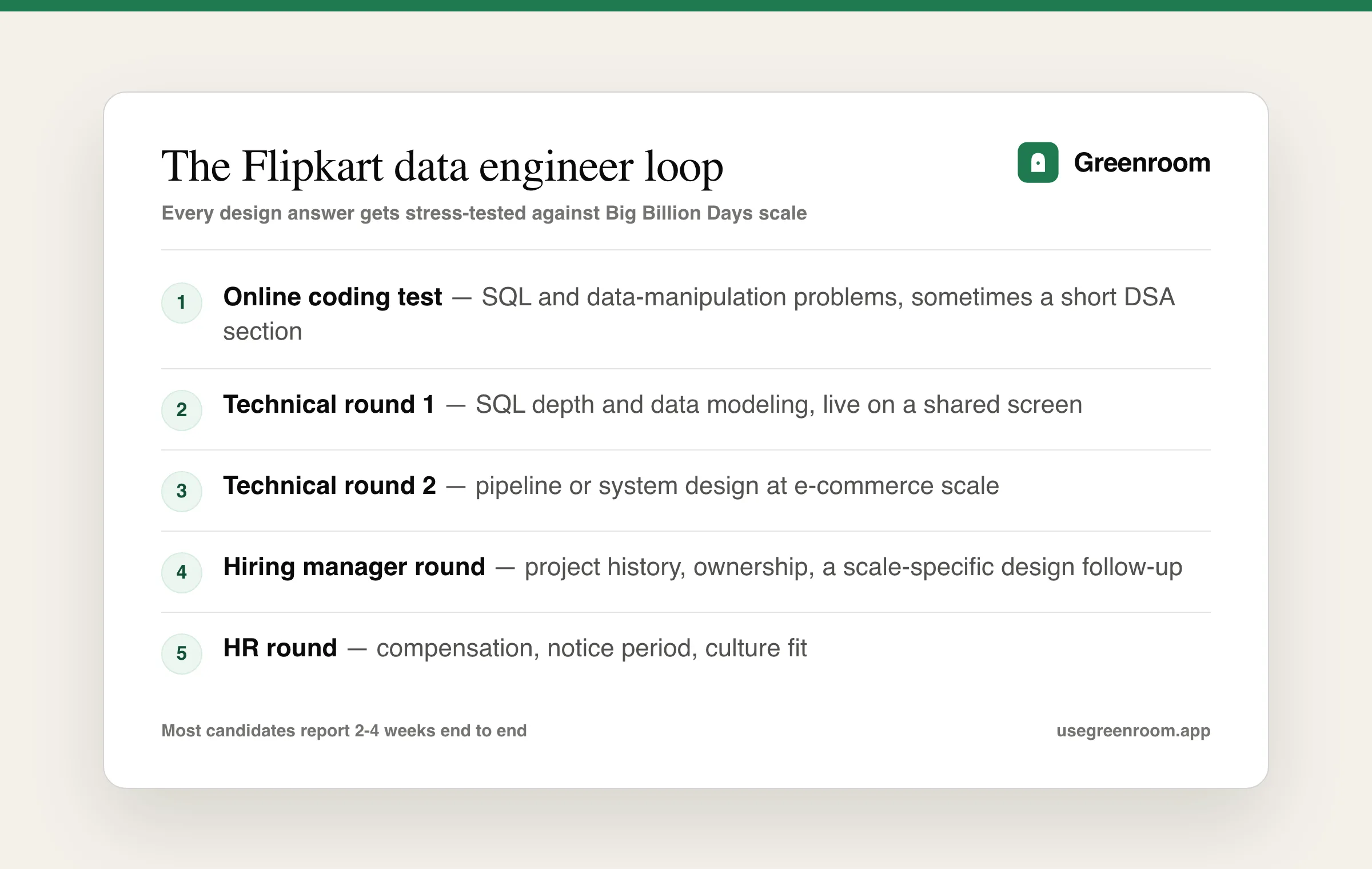
The Flipkart data engineer interview process runs a tight four rounds, consistent across most reports:
- Online coding test — SQL and data-manipulation problems, sometimes with a short DSA section.
- Technical round 1 — SQL depth and data modeling, usually live on a shared screen.
- Technical round 2 — pipeline or system design at e-commerce scale, sometimes folded into machine coding.
- Hiring manager round — your project history, ownership, and a scale-specific design follow-up.
- HR round — compensation, notice period, culture fit.
Most candidates report 2–4 weeks end to end, faster than FAANG loops but no less demanding per round. The condensed round-by-round breakdown lives on our Flipkart Data Engineer interview prep page — this post goes deep on the actual questions.
Flipkart data engineer SQL interview questions
SQL comes first and it comes live — expect to type and narrate simultaneously. Reported question shapes:
- Write a SQL query to find the 7-day rolling retention of users.
- Find sellers whose order volume dropped more than 30% week over week.
- Return the second-highest order value per city, handling ties.
- Compute a running total of daily GMV per category:
-- Running total of daily GMV per category
SELECT
  category,
  order_date,
  SUM(gmv) OVER (
    PARTITION BY category
    ORDER BY order_date
    ROWS BETWEEN UNBOUNDED PRECEDING AND CURRENT ROW
  ) AS running_gmv
FROM daily_category_gmv
ORDER BY category, order_date;
The follow-up is always the same shape: what happens to this query at 40x write volume during a flash sale? Where does it slow down first? Our SQL interview questions guide covers the window-function patterns this question family builds on.
Data modeling questions
The modeling round almost always anchors to a domain Flipkart actually runs — catalog, orders, or seller inventory:
- Design a data model for the seller-inventory system. Grain first: is one row a SKU, a SKU-warehouse pair, or a batch?
- When would you choose a star schema over a wide denormalized table for order analytics?
- Explain SCD Type 1 vs Type 2 — and where Flipkart would actually need Type 2 (price history, seller-rating history).
- How do you partition a fact table that's queried by date during the year and by seller during a sale?
Interviewers here reward candidates who ask "what's one row?" before drawing a single box. Jumping straight to table names reads as guessing.
Pipeline and system design questions
This round is a data-flavored system design interview, scaled to India's biggest shopping event:
- Design a pipeline that ingests order events at 40x normal volume for six days, with exactly-once semantics.
- Batch or streaming for a live "items sold" counter on the Big Billion Days homepage — defend the choice.
- A backfill needs to reprocess 3 days of order data without double-counting GMV downstream. Walk me through it.
- How do you handle late-arriving delivery-status events in a partitioned warehouse?
Structure wins over vocabulary: state the peak volume assumption out loud, propose ingestion → buffer → storage → transform → serve, then volunteer failure modes — idempotent writes, dead-letter queues, backpressure — before the interviewer asks. The general framework is in our data engineer interview questions guide.
Behavioral and hiring-manager questions
The hiring manager round is where "can I trust this person on-call during a sale" gets decided:
- Tell me about a data quality incident you owned end to end, and how you prevented a repeat.
- Describe a time a pipeline you built failed during a high-traffic event. What did you do?
- Walk me through a modeling decision you'd make differently with hindsight.
Answers need specifics and numbers — "improved reliability" loses to "cut failed backfills from 4/week to 0 over a quarter." Our data engineer interview questions guide has more STAR-shaped examples for technical behavioral rounds.
LeetCode, StrataScratch, a friend's notes — where each fits
An honest map of the usual prep stack for this specific loop:
- LeetCode — only partially calibrated; Flipkart DE coding leans SQL and data manipulation over graph algorithms. Its SQL 50 set is the useful slice.
- StrataScratch / DataLemur — close in question shape to Flipkart's SQL screens; good for reps, silent on live follow-ups.
- A senior's WhatsApp notes / GeeksforGeeks interview experiences — fine for calibrating what recent loops looked like; treat as anecdotes, not a syllabus, since scale questions shift every hiring season.
- ChatGPT — useful for generating extra practice prompts or reviewing a written answer; it will not interrupt your query mid-explanation with "does that survive 40x volume?" the way a real Flipkart interviewer does.
- Greenroom — the spoken layer. Ari, the AI interviewer, runs SQL-reasoning, modeling and pipeline-design rounds out loud with live scale-based follow-ups, and scores the structure a hiring manager actually listens for. Pair it with the fundamentals above — it won't teach warehousing from zero.
How to prepare for the Flipkart data engineer interview
- Week 1: SQL depth — window functions, rolling retention, running totals, dedup — spoken, not just passed against test cases.
- Week 2: data modeling — catalog, orders and seller-inventory domains, grain declared first, plus SCDs and partitioning trade-offs.
- Week 3: pipeline design — batch vs streaming, exactly-once, backfills, and a scale story you can defend under a "what if traffic is 40x" follow-up.
- Week 4: behavioral stories with real numbers, rehearsed out loud until they survive a "tell me more" follow-up.
If you're interviewing at other Indian scale-ups in parallel, the loops rhyme but the scale story differs — our Swiggy data engineer interview guide and Zomato data engineer interview guide cover where each diverges.
For the models these pipelines feed, see our Flipkart ML engineer interview questions guide.
Frequently asked questions
What questions are asked in a Flipkart data engineer interview?
Advanced SQL (window functions, rolling retention, running totals), data modeling (star schema, SCDs, grain and partitioning), pipeline/system design at Big Billion Days scale, and behavioral questions about data quality incidents and pipeline failures.
How many rounds are there in the Flipkart data engineer interview?
Typically four: an online coding test, two technical rounds (SQL/modeling, then pipeline/system design), a hiring manager round, and HR. Most candidates report 2–4 weeks end to end.
Is the Flipkart data engineer interview hard?
The SQL and modeling bar is high but predictable in shape. What surprises most candidates is that every design answer gets stress-tested against Big Billion Days-level traffic spikes, not average-day volume.
Does the Flipkart data engineer interview include DSA coding?
Mostly SQL and data-manipulation coding, with an occasional lighter DSA section in the online test. Window functions and complex joins matter far more here than graph or DP problems.
What is the hardest part of the Flipkart data engineer loop?
Sustaining clear, structured reasoning under live follow-ups across all four rounds — most candidates can answer the first question in each round, but lose points when the interviewer pushes "and what happens at scale?"
How do I prepare for the Flipkart data engineer interview in one month?
Week 1 SQL window functions and rolling-window queries, week 2 data modeling for catalog/orders/inventory, week 3 pipeline design with a defensible scale story, week 4 spoken behavioral stories with real numbers — with at least one full spoken mock per round type before the real loop.