There is a version of you that has spent four months preparing for interviews. You've read the books. You've done the LeetCode. You've watched the YouTube playlist on the STAR method — twice. You feel ready. You sit down for the real thing, and the interviewer says "so, tell me about a time you failed at something important," and what comes out of your mouth is technically words, but the structure collapsed somewhere around "so my team and I" and you never found your way back.
The problem is not that you didn't know. The problem is that you never practiced saying the thing under the pressure of being observed. That is what an AI interview coach is supposed to fix: the gap between knowing the answer and being able to deliver it in real time without your brain short-circuiting.
There are now several tools claiming to be the best AI interview coach. Some are genuinely useful. Some are useful for something other than what they say. And one of them will get you fired before you're hired. Here is the honest ranked comparison.
What makes an AI interview coach actually good?
Before ranking tools, let's be clear on the rubric. A good AI interview coach must:
- Simulate a real interview conversation — not just flash questions at you, but respond to your answer and push back the way a real interviewer would.
- Give actionable, specific feedback — not "good answer!" but "your STAR story was missing a quantified result, and you said 'um' fourteen times."
- Be available on demand — you're not going to schedule practice; you're going to practice at 11pm the night before. The tool needs to be there.
- Cover the rounds that actually decide offers — behavioral, phone-screen, technical communication, not just coding puzzles.
- Not actively risk your career — one tool on this list will be flagged or disqualify you if used incorrectly. That needs to be said plainly.
The 6 best AI interview coach tools, ranked
1. Greenroom — best overall for spoken practice with real feedback
What it is: Greenroom is a voice-based AI mock interview tool built around a single insight: the gap between knowing your answer and saying it is a physical skill, trained only by reps. Ari — Greenroom's AI interviewer — runs live voice sessions, asks follow-up questions based on what you actually said, and generates a post-session feedback report covering score, structure, pace, and filler words.
What it trains: Behavioral interviews, HR and phone-screen rounds, technical communication, and spoken delivery generally. If your problem is that you know the answer but fumble the delivery, or that you ramble, or that your STAR stories collapse under a follow-up, this is the tool built for exactly that problem. Read how AI interview feedback actually works to understand what the report measures.
What it misses: Greenroom is not a coding judge. It doesn't run your code against test cases. For the code-writing part of technical interviews, you still need LeetCode or HackerRank. Greenroom is for the communication around the code, not the code itself.
Honest tradeoff: An AI interviewer is not a senior human who's been in actual hiring loops. For the most nuanced, role-specific judgment, a real engineer via interviewing.io is still the gold standard. We lay out that comparison in AI mock vs a real engineer mock.
India relevance: Strong. On-demand at any hour, no timezone matching, no scheduling. Covers Indian MNC placement patterns and global tech rounds.
Cost: Free to start, paid for higher volumes.
2. ChatGPT — most flexible, lowest ceiling without good prompting
What it is: ChatGPT is a general-purpose LLM that you can prompt to act as an interview coach. With a well-crafted system prompt, it will ask questions, receive your text answer, and give specific feedback. With a bad one, it'll produce generic, enthusiastic, and essentially useless praise.
What it trains: Whatever you prompt it to train. A good session — "act as a tough behavioral interviewer for a senior product manager role at a Series B fintech, ask me questions about stakeholder management, and after each answer give specific feedback on my STAR structure" — is legitimately useful for text-based answer development. See using ChatGPT for interview practice for worked examples.
What it misses: Voice. ChatGPT does not interview you out loud. If your actual interview is verbal — and for most roles, it is — then typing answers into ChatGPT trains the wrong modality. You'll produce well-structured written answers and then freeze the moment you need to say them.
Cost: Free (GPT-4o with limits), paid for higher volumes.
3. Google Interview Warmup — best free starting point, stops too soon
What it is: Google Interview Warmup is a free browser-based tool from Google that presents interview questions, records your spoken answer via mic, transcribes it, and gives you light insight — which keywords you hit, how long you talked, which "talking points" appeared. We compare it in depth in Greenroom vs Google Interview Warmup.
What it trains: Basic spoken practice — the experience of saying an answer out loud and seeing a transcript. For someone who has never practiced speaking interview answers, Warmup is a low-pressure entry point.
What it misses: Follow-up questions. Scoring. Adaptive difficulty. Any judgment on structure, reasoning quality, or delivery beyond word-count and keyword presence. It is a transcript mirror, not a coach.
Cost: Free.
4. Pramp — best for human reps, worst for availability
What it is: Pramp pairs you with another job-seeker for reciprocal mock interviews. You interview them for the first half; they interview you for the second. We go deep on this in Greenroom vs Pramp.
What it trains: The human-social dimension of interview pressure — the awkward silence, the polite but real judgment, the experience of being in a live conversation. Interviewing your partner also teaches the evaluator's rubric from the inside.
What it misses: Availability and consistency. Pramp requires scheduling. Your "interviewer" varies from sharp and challenging to genuinely confused. And you spend half the session in the wrong seat.
Cost: Free core access.
5. interviewing.io — best human feedback, highest cost, not really AI
What it is: interviewing.io connects you with real senior engineers — many with FAANG backgrounds — for paid one-on-one mock interviews. The feedback is human, role-specific, and the most nuanced you can get outside of an actual interview. We detail the comparison in Greenroom vs interviewing.io.
What it trains: Everything a real interview tests, because the interviewer is a real interviewer. Senior-level judgment, role-specific technical depth, the experience of being in a room with someone who knows exactly what they're evaluating.
What it misses: Scale. Sessions typically run $100–$225 each. You can afford three or four in a prep cycle — not twenty. Volume at this price doesn't work.
Cost: Typically $100–$225 per session.
6. Final Round AI — do not use this in a real interview
What it is: Final Round AI is a real-time AI copilot that listens to your live interview through your mic and gives you suggested answers on a hidden overlay — effectively feeding you lines while the interviewer is asking the question.
What it trains: Nothing, in the skill-building sense. Using a real-time copilot doesn't build the skill — it bypasses the interview. When detected (which is increasingly common as screen-sharing policies, audio monitoring, and interviewer attentiveness have caught up), it disqualifies you immediately and often leads to blacklisting. We compare it directly in Greenroom vs Final Round AI.
Honest tradeoff: There is no honest tradeoff. Using AI assistance during a live interview is cheating by any reasonable definition, puts your career at real risk if caught, and does not build any skill you keep.
Cost: Paid.
The best AI interview coach stack, by prep stage
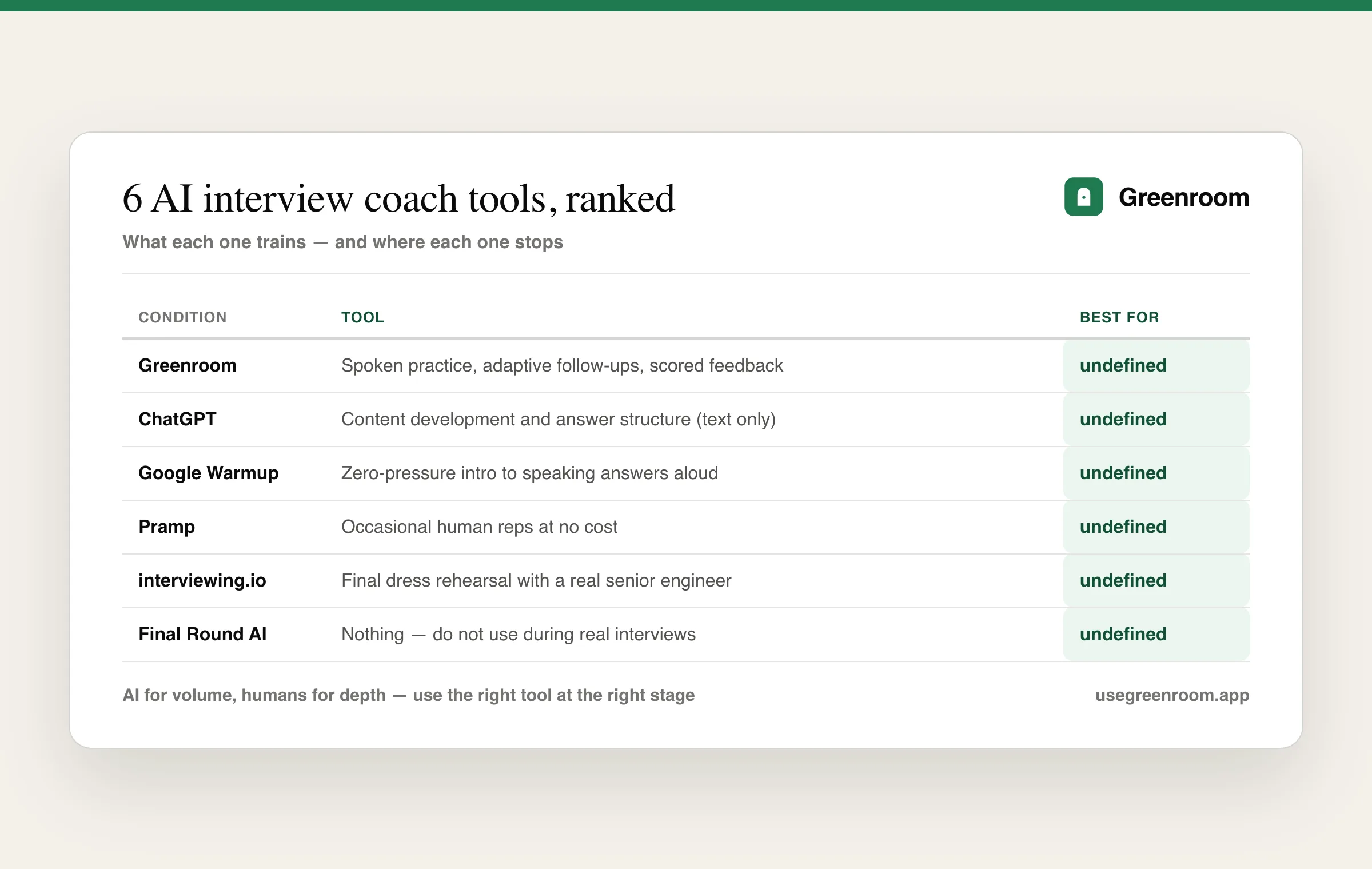
Rather than picking one tool, the strongest candidates use different tools for different stages:
Early prep (weeks 3–6 out): ChatGPT to map question categories and draft raw answers. HackerRank or LeetCode for the algorithmic foundation. LinkedIn Interview Prep to scan what good answers look like for your target role.
Active practice (weeks 1–3 out): Greenroom daily or every other day for spoken reps. Start with behavioral answers; add technical communication once behavioral is solid. Google Interview Warmup for a zero-pressure warm-up before a Greenroom session if nerves are high. Pramp once a week for human contact and the social dimension of live interviews.
Final week: Greenroom for a full mock of your three hardest question types. Interviewing.io for one or two sessions with a real engineer in your target company's domain.
This stack is not expensive if you're strategic: Greenroom's free tier covers early reps, Pramp is free, Warmup is free, and one interviewing.io session for the final dress rehearsal costs less than a month of unused gym membership.
What "AI interview coach" actually means in 2026
The category label is doing a lot of work. Products marketed as "AI interview coaches" include real-time cheating tools (skip these), passive transcript tools that just show you what you said, text-based LLMs doing mock interviews, voice-based AI interviewers with adaptive follow-ups and structured feedback, human-matching platforms with AI scheduling, and human-only platforms with real engineers. If you're not sure where the line sits between a real coach and a quiz with a voice, the full guide to how an AI mock interview works draws it clearly.
The definition that matters for improving your performance: a real AI interview coach is a tool that interviews you in the modality the real interview uses — spoken — adapts to what you say, tells you specifically what to fix, and lets you re-test. By that definition, the category is smaller than the marketing suggests.
Frequently asked questions
What is the best AI interview coach in 2026?
For spoken practice with structured feedback, Greenroom is the strongest option — it runs live voice sessions, asks adaptive follow-up questions, and gives you a per-session score and delivery notes. For text-based content development, ChatGPT with strong prompting is a solid supplement. Google Interview Warmup is the best free starting point for overcoming nerves about speaking aloud, though its feedback depth is limited. The right answer depends on what you're training: delivery and fluency (Greenroom), content structure (ChatGPT), or pure algorithmic coding (HackerRank or LeetCode).
Is there a free AI interview coach?
Yes. Google Interview Warmup is free and covers behavioral and technical questions with spoken delivery. Greenroom offers a free tier. ChatGPT has a free version with usage limits. Pramp's core peer matching is also free. The free stack of Warmup + Greenroom (free tier) + ChatGPT covers most of the prep for most candidates before any paid investment is needed.
Is it cheating to use AI for interview preparation?
Using AI to practice before your interview — running mock sessions, drilling your answers, getting feedback — is not cheating. It is preparation, the same as reading books, working with a coach, or drilling questions with a friend. Using AI assistance during the live interview itself (like Final Round AI's real-time overlay) is a different matter: it's against the explicit policies of most companies, is increasingly detectable, and represents a misrepresentation of your own abilities. The distinction is practice (fine) vs. in-interview assistance (not fine).
Can an AI coach replace a human mock interview?
No, and the best candidates don't try. AI mock interviewers are excellent for high-frequency spoken reps with instant feedback — the volume work that builds fluency. Human mock interviewers from interviewing.io or a trusted senior contact provide judgment, nuance, and role-specific depth that AI cannot fully replicate. The strongest prep combines both: AI for volume, humans for depth. One well-timed human mock after dozens of AI reps is typically more valuable than either alone.
Which AI interview tool is best for India?
For India-based candidates, Greenroom stands out for on-demand availability (no timezone dependency, no scheduling), coverage of both Indian MNC placement patterns and global tech company interviews, and pricing that includes Indian-market tiers. Google Interview Warmup is a free starting point available in India with no signup friction. HackerRank remains essential for the OA filtering rounds that dominate Indian campus placement pipelines.
How many sessions with an AI interview coach does it take to improve?
Candidates with a structural problem — STAR stories regularly lacking a result, or consistently over-explaining — typically see measurable score improvement in four to six focused sessions where they isolate and re-test the specific issue. Candidates with a delivery problem — filler words, pace, trailing sentences — often see faster gains because those are physical habits that change with repetition. The key variable is not volume but targeted repetition: identifying the specific gap from feedback and drilling that gap, not just doing more sessions in general.