I used to walk out of interviews knowing I'd underperformed: not because I didn't know my stuff, but because I froze the second someone asked me to explain it out loud. If that's you too: you know the material, you've built real things, then a question lands across the table and your mind goes blank, and you can't reach the answer you definitely have. Here's the part that changed everything for me, freezing in interviews is not a competence problem. It's a retrieval-under-pressure problem, and it's one of the most fixable things in interview prep. (It's the exact reason I built Ari, the AI interviewer behind Greenroom. But first, why it happens.)
What's actually happening when you freeze
Under acute stress, your body floods with adrenaline and your working memory —the mental scratchpad you use to hold a question and assemble an answer— narrows sharply. Knowledge you have isn't gone; the path to it is temporarily blocked. This is why you remember the perfect answer in the car ten minutes later. The information was always there. The pressure just closed the door.
Two things make it worse: novelty (the situation feels unfamiliar, so more of your attention goes to managing the unfamiliarity) and self-monitoring (you're watching yourself fail in real time, which eats the working memory you need for the answer).
Why “know the material better” doesn't fix it
The instinct is to study more. But you didn't freeze because you knew too little. You froze because retrieval failed under pressure. Adding more knowledge to a system that can't retrieve under stress doesn't help. What helps is training the retrieval itself, under conditions that resemble the real thing.
The fix: make the situation un-novel
The reason a senior engineer doesn't freeze isn't that they're calmer by nature. It's that they've been in the situation a hundred times. Novelty is gone, so working memory stays free for the actual answer. You can manufacture that same familiarity deliberately:
1. Rehearse out loud, under pressure, repeatedly
Silent practice doesn't train retrieval-under-stress because there's no stress and no retrieval, your brain just recognizes the answer. Speaking answers out loud, on a timer, without restarts, is the only thing that rehearses the actual failing system. Volume is the mechanism: the tenth mock feels routine in a way the first never could. It's the same reason AI mock interviews work on freezing. They manufacture those reps on demand.
2. Practice recovering, not just answering
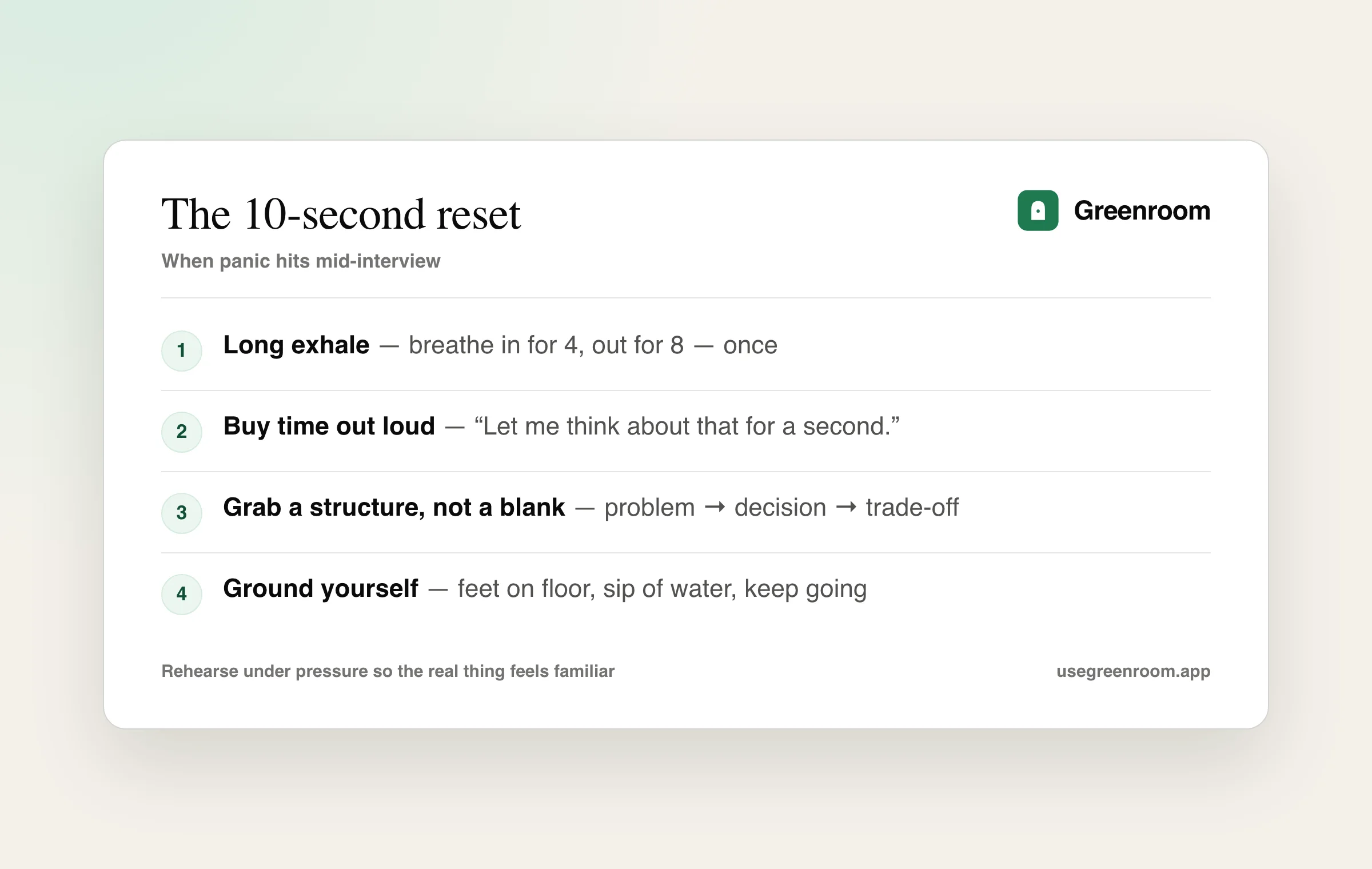
You will blank sometimes even when prepared. The skill that saves you is recovery, and it can be rehearsed. Practice saying out loud: “Let me take a second to think about that,” then narrating your way back in. We have a full guide on recovering from blanking. A candidate who recovers smoothly often scores higher than one who never wobbled. It signals composure.
3. Have structures, not scripts
Memorized scripts shatter the moment the question is phrased differently. And then you freeze harder. Structures survive. “Problem → decision → trade-off → reflection” for project questions, or STAR for behavioral, gives you a rail to grab when your mind goes blank. You're never staring at nothing; you're starting at “what was the problem?”
4. Slow the first ten seconds
Freezing accelerates when you rush. A deliberate pause (a breath, “good question, let me think”) buys your working memory time to reopen the door. Interviewers read a thoughtful pause as confidence, not weakness.
How to build the reps
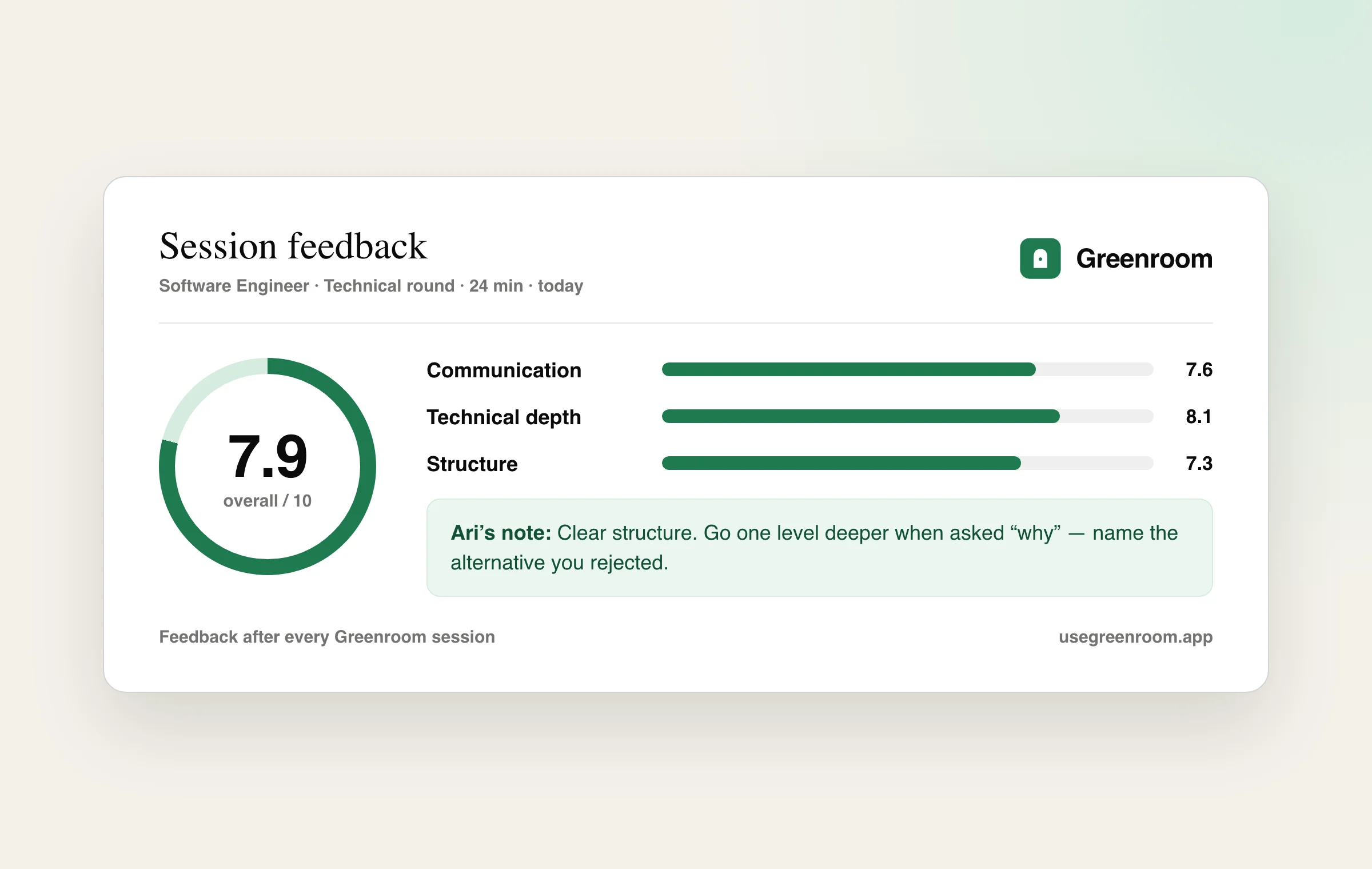
The hard part of this advice is doing it — most people can't easily run repeated, high-pressure spoken mocks. That's the gap Greenroom fills: a voice interviewer that asks about your real projects, applies genuine back-and-forth pressure, and is available as often as you need, so the situation stops being novel long before the real one. The free tier is enough to start tonight.
Frequently asked questions
Why do I freeze in interviews even when I know the material?
Because freezing is a retrieval-under-pressure problem, not a knowledge problem. Stress narrows your working memory and temporarily blocks the path to information you already have. Which is why the answer comes to you afterward. The fix is training retrieval under realistic pressure, not studying more.
How do I stop freezing in interviews?
Rehearse answers out loud, on a timer, without restarts, many times so the situation stops feeling novel. Practice recovering from a blank, not just answering. Use structures (like problem→decision→trade-off→reflection) instead of memorized scripts, and deliberately slow your first ten seconds with a thinking pause.
Does studying more fix interview freezing?
Usually not. You didn't freeze from knowing too little; you froze because retrieval failed under stress. Adding knowledge to a system that can't retrieve under pressure doesn't help, rehearsing out loud under pressure does.
Is freezing in interviews a sign I'm not good enough?
No. Strong, experienced engineers freeze too. It's a stress response tied to unfamiliarity and self-monitoring, and it fades with reps. The candidates who don't freeze have usually just been in the situation many more times.