Here's an uncomfortable truth recruiters will tell you privately: the better candidate doesn't always get the offer — the clearer communicator often does. Two engineers can have identical skills, and the one who explains their thinking crisply will out-interview the one who knows more but can't get it across. The encouraging part is that interview communication is a skill, not a personality trait, and it improves faster than almost anything else in your prep. Here's how.
What “good communication” means in an interview
It is not being charismatic or quick-witted. In an interview, good communication is four concrete things:
- Structure — your answer has a clear beginning, middle, and end, not a stream of consciousness.
- Concision — you make your point and stop, instead of trailing on until you've buried it.
- Clarity — the interviewer can follow your reasoning without having to reconstruct it.
- Relevance — you answer the question they actually asked.
Every technique below builds one of these four.
1. Lead with the answer (bottom line up front)
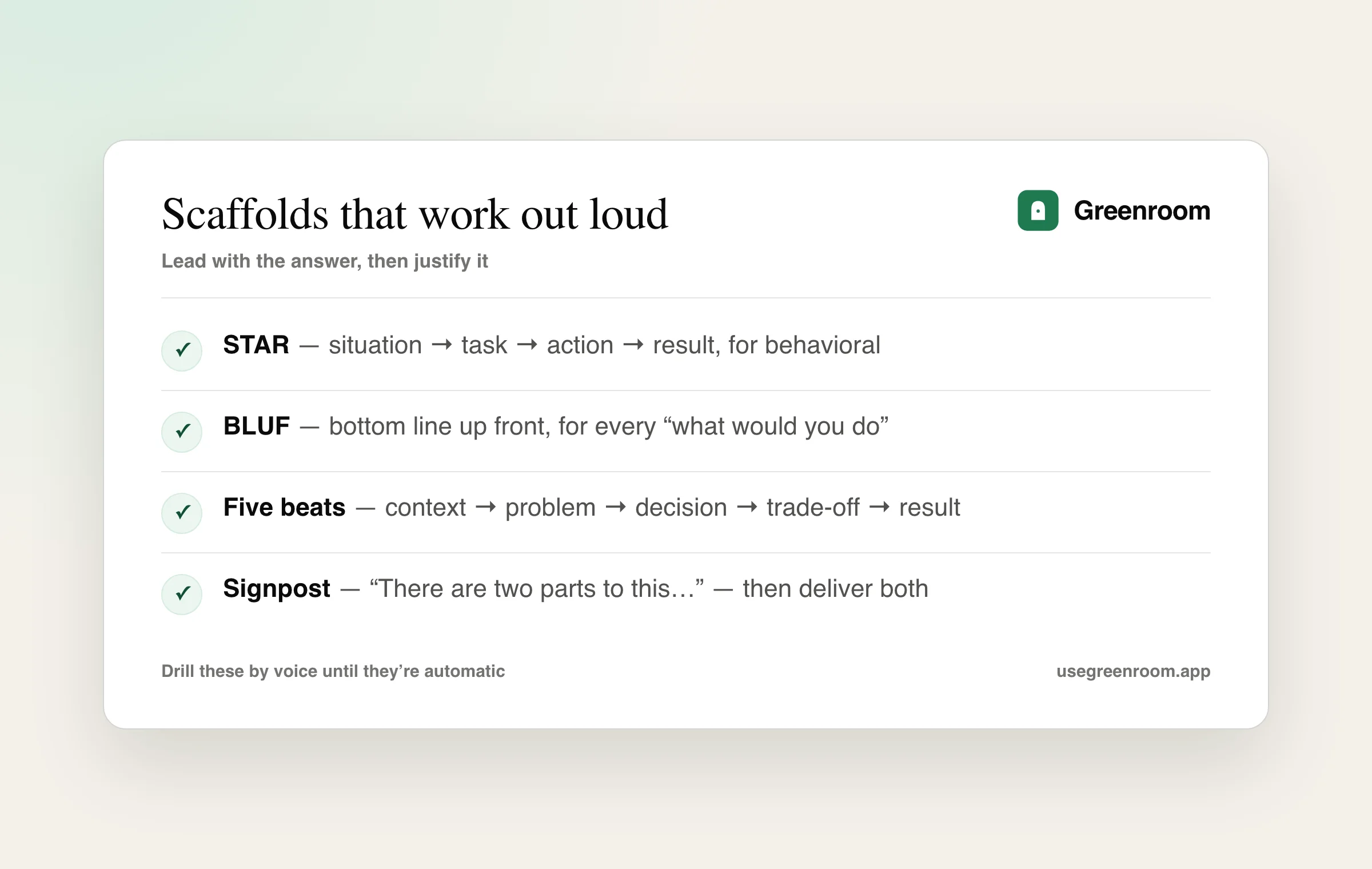
The most common communication mistake is burying your conclusion at the end of a long windup. Flip it: state your answer first, then explain. “I'd use a queue here — let me explain why” beats five sentences of context before the interviewer learns where you're going. Leading with the bottom line instantly makes you sound clearer and more senior.
2. Signpost your structure
Tell the interviewer the shape of your answer before you give it. “There are three trade-offs I'd weigh — let me take them one at a time.” Now they can follow you effortlessly, and you can't lose your own thread because you've laid down a map. Signposting is the single highest-leverage verbal habit you can build.
3. Use a structure for every answer type
- Behavioral questions → STAR: Situation, Task, Action, Result. It guarantees a beginning, middle and end. More on STAR for senior engineers.
- Project questions → problem → decision → trade-off → reflection. Full breakdown here.
- Technical/system design → think out loud: narrate your reasoning, state assumptions, name alternatives. Silence reads as being stuck; narration shows your process. More on communicating in coding interviews.
4. Answer the question they actually asked
Anxiety makes people answer the question they wish they'd been asked, or the one they rehearsed. Listen to the end, pause, and answer the real question. If you're unsure what they want, ask: “Do you mean at the database level or the API level?” Clarifying is a strength, not a weakness.
5. Kill the two clarity-killers: rambling and filler
- Rambling comes from not knowing where your answer ends. Fix it by deciding your last sentence before you start — land it and stop. A crisp two-minute answer beats a sprawling five-minute one every time.
- Filler (“um,” “like,” “basically,” “you know”) fills the silence you're afraid of. The fix isn't to eliminate silence — it's to get comfortable pausing. A confident pause is far better than a filler word.
6. The one practice method that actually works
You cannot improve communication silently. The only thing that moves the needle is speaking out loud and reviewing yourself. Record an answer on your phone and watch it back — you'll spot the rambling, the buried point, and the filler in thirty seconds, and you'll improve more from that than from any amount of reading. Then do it again. Communication is a motor skill; it improves with reps, not theory.
Practice with something that talks back
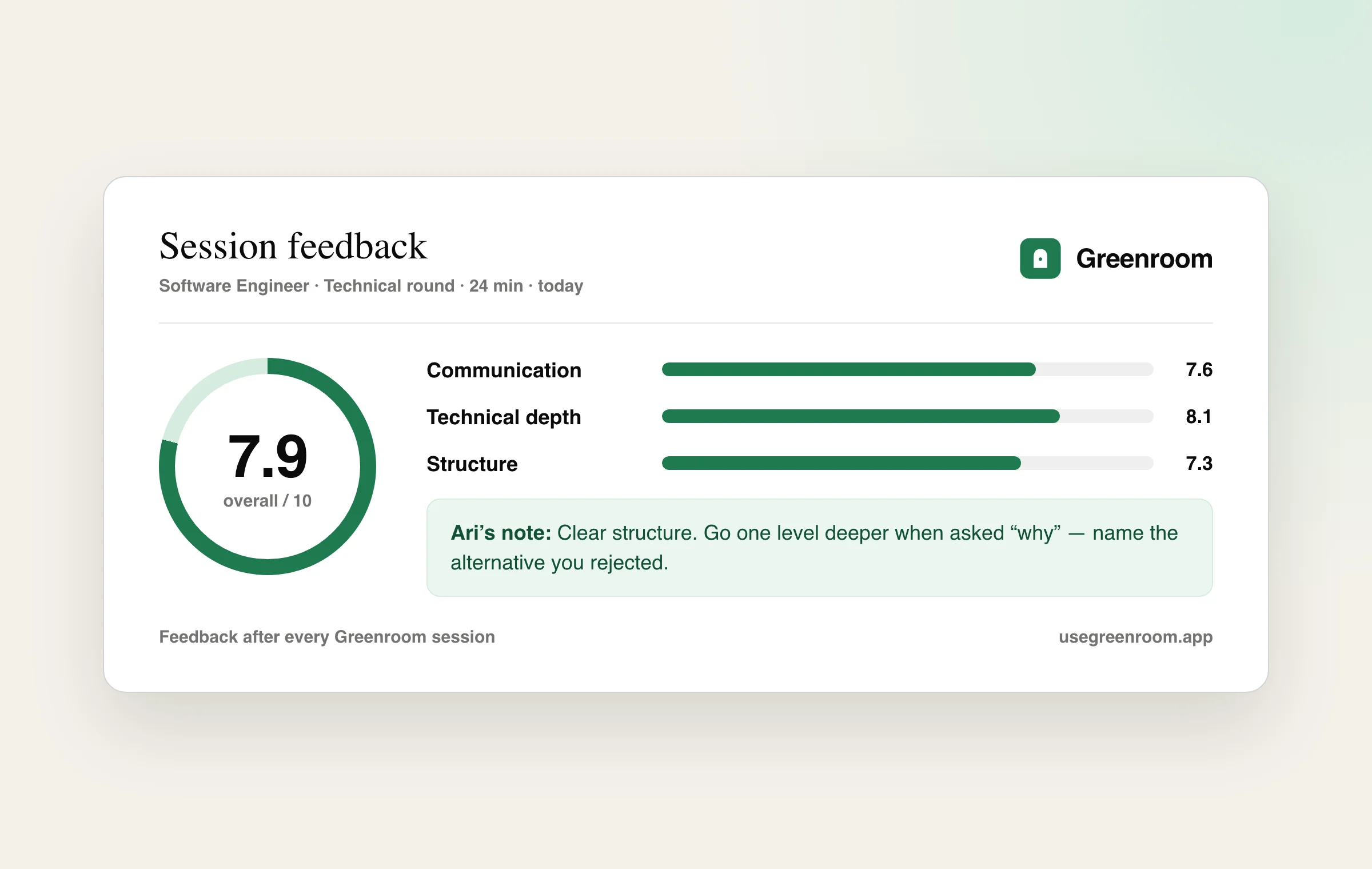
Recording yourself catches delivery problems; a real back-and-forth catches the harder ones — answering follow-ups, recovering, staying clear under pressure. Greenroom runs voice interviews on your own projects and gives feedback on how clearly you came across, so you can build these habits against real questions. Free tier to start. If your gap is delivery polish specifically (filler, pace), see our comparison with Yoodli.
Frequently asked questions
How can I improve my communication skills for interviews?
Lead with your answer instead of burying it, signpost the structure of your response (“there are three reasons…”), use a framework like STAR for behavioral and problem→decision→trade-off for projects, answer the question actually asked, and cut rambling and filler. Then practice out loud and review recordings of yourself — communication is a motor skill that improves with reps, not reading.
Why is communication so important in interviews?
Because interviewers can only evaluate what you successfully convey. Two candidates with identical skills get different outcomes when one explains their reasoning clearly and the other can't. Clear communication often beats deeper knowledge that's poorly expressed.
How do I stop rambling in interviews?
Decide your last sentence before you start answering, so you have a point to land on, then stop once you've made it. Rambling comes from not knowing where your answer ends. A crisp two-minute answer beats a sprawling five-minute one.
How do I reduce filler words like 'um' and 'like'?
Filler fills silence you're uncomfortable with, so the fix is getting comfortable pausing instead. Record yourself to become aware of your filler patterns, then practice replacing them with a brief, confident pause. Awareness from reviewing recordings is what drives the change.