He cleared the coding round comfortably. He designed a distributed system without breaking a sweat. Then an interviewer asked, "Tell me about a time you played as a team, no matter the position," and he answered with a story about how he personally rescued a project from his incompetent teammates. He thought it was a strength answer. Atlassian scores that round, and he did not get the offer.
That is the most-underestimated thing about Atlassian backend interview questions: the values interview is a real, scored, potentially disqualifying round, not a friendly chat at the end. Add a distinctly multi-tenant flavour to the system design round and you get a loop that catches strong engineers who prepared only algorithms. I built Greenroom after freezing in an interview I had prepared hard for, so this guide covers all five rounds and how to talk through them.
The Atlassian backend engineer interview process in 2026
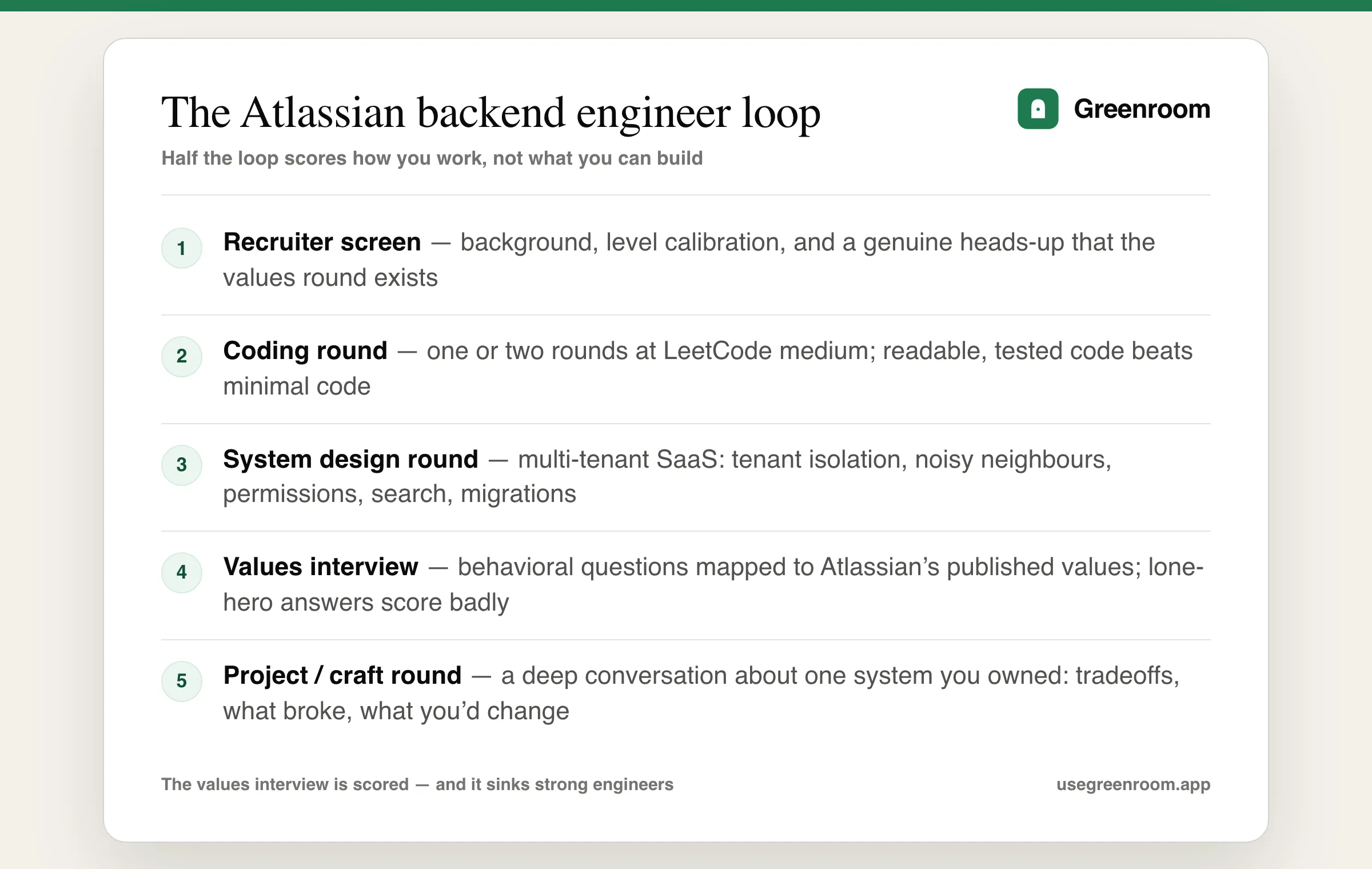
Atlassian's Bengaluru engineering org runs the global loop. What candidates report as the Atlassian backend interview process:
- Recruiter screen — background, level calibration, and a genuine heads-up that the values interview exists. Take that heads-up literally.
- Coding round — one or two rounds, LeetCode medium territory, on a shared editor. Readable, tested code is preferred over minimal code.
- System design round — a multi-tenant SaaS product: Jira, Confluence, notifications, permissions, search.
- Values interview — a dedicated behavioral round mapped to Atlassian's published company values. Scored, and capable of sinking an otherwise strong loop.
- Project / craft round — a deep conversation about something you actually built: why those decisions, what broke, what you would change.
The distinguishing feature: Atlassian weights how you work as heavily as what you can build. Our Atlassian interview questions guide covers the company-wide loop across roles; this one goes deep on the backend track.
The values interview: a scored round, not small talk
Atlassian publishes its company values openly — including the well-known "Open company, no bullshit," "Build with heart and balance," "Don't #@!% the customer," "Play, as a team," and "Be the change you seek." The Atlassian values interview asks behavioral questions mapped to them, and the interviewer is scoring against a rubric.
How to prepare without sounding like you memorised a careers page:
- Read the actual values, then map your own stories to them. Do not invent stories to fit; take real ones and notice which value each demonstrates. Five or six stories can cover all of them.
- "Play, as a team" is the one people fail. Answers where you are the lone hero who fixed everything score badly. Credit specific people, describe what you handed off, and name a time you followed someone else's call.
- "Open company, no bullshit" wants a story about saying an uncomfortable true thing — telling a stakeholder a date was not real, flagging your own bug to a customer, disagreeing with your manager in the room rather than afterwards.
- "Don't #@!% the customer" wants a decision where you chose the user over convenience — pulling a release, eating the cost of a migration, refusing a shortcut that would have degraded reliability.
- "Build with heart and balance" is about sustainable tradeoffs, not heroic all-nighters. A story about how you avoided a crunch is stronger than a story about how you survived one.
- Answer in first person with numbers, and expect follow-ups. "What did you do?" is the question underneath every question.
Our behavioral interview questions guide, tell me about a conflict with a coworker and tell me about a time you failed cover the story structures this round rewards.
System design: multi-tenant SaaS, not consumer scale
Atlassian's design prompts are shaped by what Atlassian is: a multi-tenant SaaS platform where one customer's twenty-thousand-user instance shares infrastructure with a five-person startup's. That produces a different question set from consumer-scale prompts.
- Tenant isolation. Shared database with a tenant column, schema per tenant, or database per tenant — know the tradeoffs cold. Shared is cheap and operationally simple but risks cross-tenant leakage through one missing
WHEREclause. Isolated is safe and expensive and makes migrations a fleet operation. Say which you would choose for which customer segment; "it depends on tenant size" is the correct instinct. - Noisy neighbours. One tenant running a runaway automation must not degrade everyone else. Per-tenant rate limiting, quotas, and work queues partitioned by tenant. This comes up in almost every reported design round.
- Permissions at scale. Jira and Confluence permissions are genuinely hard — projects, spaces, groups, roles, inherited and overridden. Designing a permission check that stays fast when a user belongs to two hundred groups is a real Atlassian problem, and a great answer names denormalised permission caches plus invalidation on group change.
- Search across tenants without leaking. An index per tenant, or a shared index with a mandatory tenant filter applied at the query layer where it cannot be forgotten. Say where the filter is enforced.
- Notifications and fan-out. A comment on a busy issue notifies hundreds of watchers across channels. Fan-out on write versus on read, deduplication, batching and digests, and user preferences.
- Migrations and zero downtime. Atlassian ships to live customers continuously. Expand-and-contract schema changes, backfills that do not lock, and feature flags are all fair game.
The Atlassian backend engineer prep page has a round-by-round checklist, and our microservices interview questions guide, system design interview guide for India and DBMS interview questions guide cover the supporting layers.
The coding round: readable, tested, medium
Atlassian's coding rounds sit at LeetCode medium rather than hard, and the emphasis is unusual: they care about code you would be comfortable merging. Recurring shapes are string and array processing, hash maps, trees, intervals, and small object-oriented problems where you design a couple of classes and implement them.
Habits that score here specifically:
- Clarify the requirements before typing. Atlassian problems are often deliberately slightly under-specified.
- Name things well. It sounds trivial and it is genuinely part of the evaluation at a company that sells developer tools.
- Handle edge cases explicitly rather than defensively. Say which inputs are invalid and what you do about them.
- Write or describe tests. Even naming three test cases aloud lands well.
- Talk while you work. Long silences read as stuck. Our how to think out loud in interviews guide covers the pattern.
The DSA coding interview preparation guide covers the topic list, and the Java interview questions guide is worth a pass since much of Atlassian's backend is JVM-based.
The project / craft round: bring one system you actually know
This round is a deep, unstructured conversation about something you built. It goes badly for people who describe a project and well for people who can defend it. Prepare one system in genuine depth — ideally something you owned for months, not a weekend project.
What to have ready: the constraint that shaped the design, the alternative you rejected and why, the thing that broke in production, what you measured, what you would do differently now, and what you handed to someone else. Interviewers will drill on any of those, and "I don't remember" is fine once but fatal three times. If your best work is under NDA, describe the shape and the tradeoffs without the specifics — that is normal and expected.
LeetCode, Grokking, ChatGPT — where each fits
An honest map of the prep stack for this loop:
- LeetCode — necessary but sufficient for only one round, at medium difficulty. Over-indexing on hard problems is a common misallocation for this specific company.
- Grokking the System Design Interview and Designing Data-Intensive Applications — good general depth, though neither covers multi-tenancy well. Read Atlassian's own public engineering writing on tenant isolation and their cloud platform to fill that gap.
- Atlassian's published company values — genuinely required reading, and unusually so. This is the rare company where reading the values page is direct interview preparation rather than corporate box-ticking.
- GeeksforGeeks and interview-experience threads — useful for round format, weak on the values round, which is where people actually fail.
- ChatGPT — decent for generating design prompts and reviewing written stories. It will not ask "what did you do?" for the third time while you are visibly reaching.
- Greenroom — the spoken layer. Ari, the AI interviewer, runs values-style behavioral rounds out loud, pushes the follow-up when a story credits nobody but you, and scores structure and clarity. Fair tradeoff: Ari will not review your code line by line, so pair it with LeetCode.
How to prepare for the Atlassian backend interview
- Week 1: DSA at medium difficulty, prioritising readable, tested solutions over speed. Practise naming test cases aloud.
- Week 2: the multi-tenancy concept set — tenant isolation models, noisy neighbours, permission checks at scale, per-tenant search, zero-downtime migrations. Explain each in ninety seconds without notes.
- Week 3: read Atlassian's values, then map six real stories to them. Rehearse each in first person, out loud, to three follow-ups deep. Separately, prepare one system for the craft round in full depth.
- Final week: two full spoken mocks — one technical, one values-and-craft — and the role-specific prep page the night before, not new material.
Interviewing across comparable loops? The Uber backend engineer guide covers a bar-raiser round with similar follow-up depth, the Flipkart backend engineer guide and Swiggy backend engineer guide cover machine-coding-heavy Indian product loops, and the Zomato backend engineer guide covers a higher DSA bar.
Interviewing for a frontend role instead? Our Atlassian frontend engineer interview questions guide covers the values interview, accessibility and design systems at enterprise scale.
For the data platform side of the same company, see our Atlassian data engineer interview questions guide.
Frequently asked questions
What is the Atlassian backend engineer interview process?
Candidates report a recruiter screen, one or two coding rounds at roughly LeetCode medium, a system design round on multi-tenant SaaS problems, a dedicated values interview mapped to Atlassian's published company values, and a project or craft round that goes deep on something you actually built. All five are scored, and the values round can sink an otherwise strong loop.
What is the Atlassian values interview?
It is a dedicated, scored behavioral round with questions mapped to Atlassian's published values, including Open company no bullshit, Build with heart and balance, Don't #@!% the customer, Play as a team, and Be the change you seek. Prepare five or six real stories in first person and map them to the values rather than inventing stories to fit. Lone-hero answers where you rescued a project from your teammates score badly.
What system design questions does Atlassian ask?
Prompts are multi-tenant SaaS shaped: design Jira or Confluence, design the notification system, design permissions, design search across tenants. Interviewers push on tenant isolation models and their tradeoffs, preventing noisy neighbours through per-tenant quotas and partitioned queues, keeping permission checks fast for users in many groups, enforcing the tenant filter where it cannot be forgotten, and shipping schema migrations with zero downtime.
How hard is the Atlassian coding round?
It sits at LeetCode medium rather than hard, and the emphasis is on code you would be comfortable merging: clear naming, explicit edge-case handling, and stated or written tests. Clarifying deliberately under-specified requirements before typing is part of the evaluation. Over-preparing on hard algorithm problems is a common misallocation for this company.
What is the Atlassian project or craft round?
It is an unstructured deep conversation about a system you actually built. Bring one project you owned for months and be ready to explain the constraint that shaped the design, the alternative you rejected, what broke in production, what you measured, and what you would change now. If the work is under NDA, describing the shape and tradeoffs without specifics is normal and expected.
How many rounds is the Atlassian backend interview and how long does it take?
Most reported loops run four to six rounds — recruiter screen, one or two coding rounds, system design, the values interview and a project or craft round — over roughly three to five weeks. Use the gaps to rehearse behavioral stories out loud, since half the loop is scored on spoken reasoning rather than code.