"Design restaurant search," said the interviewer. The candidate reached for the answer everyone reaches for: a LIKE '%biryani%' query with an index on the name column. The interviewer nodded politely and asked what happens when the user types "biriyani." Then "biryani near me open now." Then "biryani under 300 rupees delivering in 30 minutes." By the fourth follow-up the index was rubble.
That escalation is characteristic of Zomato backend interview questions. The rounds are standard — DSA, low-level design, system design, hiring manager — but the DSA bar is noticeably higher than at most Indian consumer-internet companies, and the design rounds keep pulling on a thread until something gives. I built Greenroom after freezing in an interview I had prepared hard for, so this guide covers what Zomato asks and how to hold the thread out loud.
The Zomato backend engineer interview process in 2026
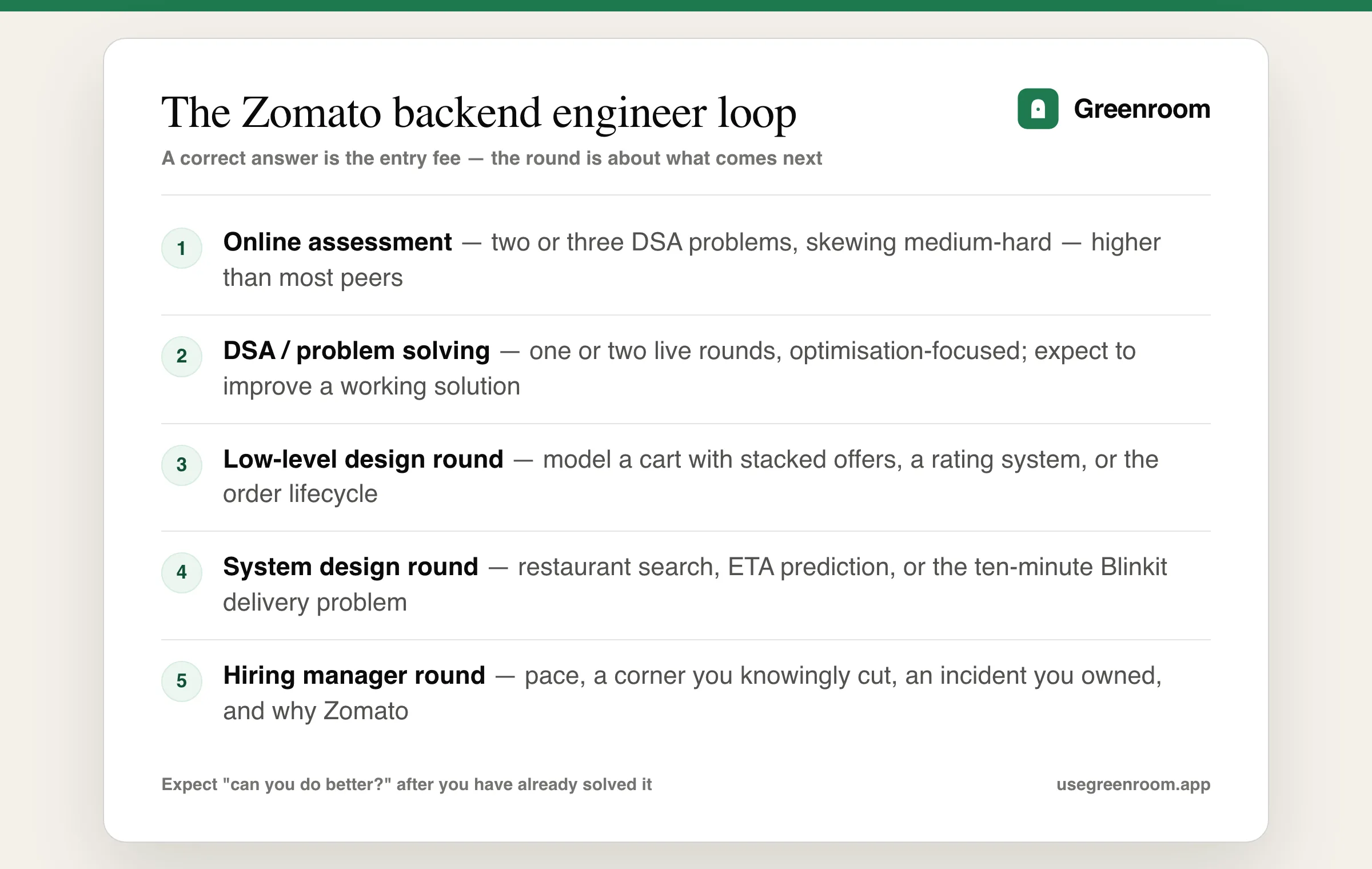
Zomato's loop is compact but sharp. What candidates report as the Zomato backend interview process:
- Online assessment — two or three DSA problems, and this is where Zomato's reputation comes from: the difficulty skews harder than peer companies, closer to LeetCode medium-hard.
- DSA / problem solving round — one or two live coding rounds with an interviewer, optimisation-focused. Expect to be asked to improve a working solution.
- Low-level design round — model a domain in classes: an order, a cart with offers, a rating system, a notification service.
- System design round — search, ETA, order lifecycle, or the ten-minute delivery problem from Blinkit.
- Hiring manager round — ownership, incidents, speed-versus-correctness tradeoffs, and why Zomato.
The differentiator: Zomato interviewers are unusually willing to keep asking "can you do better?" after you have produced a correct answer. Treat your first working solution as the opening of the conversation, not the end. Our Zomato interview questions guide covers the company-wide loop across roles.
The DSA round: correct is the entry fee, optimal is the answer
This is the round that surprises people. The Zomato DSA round expects a working solution reasonably quickly and then spends the remaining time on optimisation — space for time, a better data structure, an early exit, a preprocessing step.
Recurring topics in reported loops: arrays and two pointers, hashing, sliding window, heaps and top-k, binary search on the answer, trees, graphs and shortest paths, tries for prefix search, and dynamic programming at the classic level. Tries come up more often than at other companies for an obvious reason — search autocomplete is core product.
The behaviour that scores: clarify inputs before writing anything, state your complexity unprompted, then say what the bottleneck is and what you would trade to remove it. "This is O(n log n) because of the sort; if the values are bounded I can bucket them and get O(n) at the cost of memory" is exactly the sentence this round is listening for. Our DSA coding interview preparation guide and data structures interview questions guide cover the topic list.
Low-level design: model the domain, defend the boundaries
The Zomato low-level design round asks you to model something concrete in classes — a cart with stacked offers, a restaurant rating system, an order, a notification dispatcher. What is scored is whether your model prevents nonsense and whether you can justify each boundary.
- State machines over booleans.
PLACED → CONFIRMED → PREPARING → PICKED_UP → DELIVERED, withCANCELLEDreachable only from the early states. Enumerate transitions; do not scatterifchecks. - Offers are the trap. Stacked discounts, per-user caps, minimum order value, restaurant-funded versus platform-funded. Model a rule chain with an explicit application order and say that order out loud — a percentage discount applied before or after a flat discount gives different money.
- Money as integers. Paise as
long. Floats for currency stop the round. - Idempotency on the expensive operations. Placing an order, applying a coupon, issuing a refund. Client-supplied key, database uniqueness constraint. The Razorpay backend interview guide goes deep on this pattern and it transfers directly.
- Concurrency. Two devices placing the same cart, or a restaurant marking an item unavailable mid-checkout. Name your locking strategy and its cost.
The Zomato backend engineer prep page has a round-by-round checklist, and our OOPs interview questions guide and design patterns interview questions guide cover the vocabulary this round expects.
System design: search, ETA and the ten-minute promise
Zomato's design prompts cluster into three families, and each has a well-known depth ladder.
Restaurant search. Start by admitting a relational LIKE query is the wrong tool. Then: an inverted index, analyzers for typo tolerance and Indian-language transliteration ("biriyani", "biryani", "बिरयानी" are one query), geo-filtering by delivery radius, and ranking that blends text relevance with distance, rating, availability and commercial signals. Say that the index is a derived store kept in sync by a pipeline from the primary database, and that a lag of a few seconds is acceptable while a lag of an hour is not. Our Elasticsearch interview questions guide covers this layer in detail.
ETA prediction. Three components, and naming all three is the win: kitchen preparation time (varies by restaurant, dish and current load), partner assignment and pickup time, and travel time on a road network with traffic. Say that ETA is a prediction with a confidence interval, that showing a range is a product decision with engineering consequences, and that the feedback loop — actual delivery times flowing back into the model — is part of the system, not an afterthought.
The ten-minute problem. Blinkit's promise inverts the architecture: you cannot predict-and-dispatch in ten minutes, so the answer is dense dark stores, inventory that is accurate per store in real time, and pre-positioned supply. Interviewers like this prompt because the naive food-delivery design simply does not work, and the candidate has to notice why.
Across all three, structure the same way: constraints first, then the diagram, then failure and degradation. Our system design interview guide for India and Kafka interview questions guide cover the supporting pieces.
Databases, caching and the fundamentals follow-ups
Because Zomato is read-heavy at the top of the funnel and transactional at the bottom, fundamentals questions carry real weight. Be ready for: which queries you would index and why an index can make a write slower, isolation levels and the anomalies each still permits, cache invalidation on a menu that changes during service, and the difference between caching a rendered response and caching the underlying data.
A recurring one worth rehearsing: "a restaurant marks an item out of stock — how long until every user sees it, and what do you do about the ones mid-checkout?" The honest answer involves a short TTL, an invalidation event, and a validation step at order placement that can still fail the order gracefully. Our DBMS interview questions guide and Redis interview questions guide cover the ground.
Behavioral rounds: speed, ownership and why Zomato
Zomato's culture question is about pace. The hiring-manager round reliably probes a time you shipped fast and what you knowingly traded away, an incident you owned, and a disagreement you handled. They are not looking for someone who never cut a corner; they are looking for someone who knew it was a corner, said so, and came back for it.
First person, two minutes, numbers. "We fixed the bug" is invisible. "Search p95 hit 900 milliseconds after we added the offers filter, I moved the filter into the index instead of post-filtering in the service, and we landed at 180 milliseconds" is a hire signal. Our tell me about a time you failed and behavioral interview questions guide have the structure.
LeetCode, GeeksforGeeks, ChatGPT — where each fits
An honest map of the prep stack for this loop:
- LeetCode — more important here than at most Indian product companies because of the higher DSA bar. Medium is the floor, not the target; work some medium-hard.
- GeeksforGeeks and interview-experience threads — useful for calibrating format and difficulty. Anecdotes, not a syllabus.
- Designing Data-Intensive Applications — the right depth for the search-index-as-derived-store and consistency questions this loop produces.
- Elasticsearch or Solr documentation — read the analyzer and relevance-scoring pages as a candidate. The search prompt becomes much easier when you can name real components.
- ChatGPT — good for generating LLD prompts and reviewing a written design. It will not say "can you do better?" three times in a row while you sit with it.
- Greenroom — the spoken layer. Ari, the AI interviewer, runs the round out loud, pushes the optimisation follow-up when you stop at your first correct answer, and scores structure and clarity. Fair tradeoff: Ari will not review your code line by line, so pair it with LeetCode.
How to prepare for the Zomato backend interview
- Week 1: DSA daily, medium climbing to medium-hard. After every solved problem, spend five extra minutes out loud on how you would improve it.
- Week 2: low-level design — a cart with stacked offers, a rating system, an order lifecycle. Draw the state machine first, then the classes, then explain both aloud.
- Week 3: design out loud — restaurant search, ETA, and the ten-minute delivery problem. Constraints first, then diagram, then failure modes.
- Final week: five behavioral stories in first person with numbers, two full spoken mocks with optimisation pushback, and the role-specific prep page the night before — not new material.
Interviewing across comparable companies? The Swiggy backend engineer guide covers the nearest equivalent bar with a heavier machine coding round, the Flipkart backend engineer guide covers the 90-minute build format, the Uber backend engineer guide covers dispatch and geospatial depth, and the Zomato data engineer guide covers the analytics track.
Interviewing for a frontend role instead? Our Zomato frontend engineer interview questions guide covers search and autocomplete UI, infinite feeds and virtualization.
Frequently asked questions
What is the Zomato backend engineer interview process?
Candidates report an online assessment with two or three DSA problems, one or two live problem-solving rounds, a low-level design round modelling a domain in classes, a system design round on search, ETA or order lifecycle, and a hiring-manager round on ownership and pace. The loop is compact but the DSA difficulty skews higher than at most Indian consumer-internet companies.
Is the Zomato DSA round hard?
Harder than most Indian product companies, yes. The assessment sits closer to LeetCode medium-hard than medium, and the live rounds are optimisation-focused: producing a correct solution is the entry fee, and the remaining time is spent on whether you can improve it. Being able to name your bottleneck and what you would trade to remove it matters as much as the initial answer.
What system design questions does Zomato ask?
The prompts cluster into three families: restaurant search with typo tolerance, geo-filtering and blended ranking; ETA prediction combining kitchen preparation time, partner assignment and road-network travel time; and the ten-minute delivery problem from Blinkit, which requires dark stores and real-time per-store inventory rather than a standard food-delivery design.
How do you answer the restaurant search design question at Zomato?
Start by saying a relational LIKE query is the wrong tool, then describe an inverted index with analyzers for typo tolerance and Indian-language transliteration, geo-filtering by delivery radius, and ranking that blends text relevance with distance, rating, availability and commercial signals. Add that the index is a derived store kept in sync by a pipeline, where a few seconds of lag is acceptable and an hour is not.
What low-level design questions does Zomato ask?
Common prompts are a cart with stacked offers, a restaurant rating system, an order lifecycle and a notification dispatcher. Interviewers look for an explicit state machine rather than booleans, an offers rule chain with a stated application order, money stored as integer paise, idempotency on order placement and refunds, and a named concurrency strategy for simultaneous updates.
How many rounds is the Zomato backend interview and how long does it take?
Most reported loops run four to six rounds — online assessment, one or two DSA rounds, low-level design, system design and a hiring-manager round — over roughly two to four weeks. Gaps between rounds are usually scheduling rather than deliberation, so use them to practise optimising and designing under spoken pushback.