A candidate I'll call Ananya solved a Zomato DSA question cleanly in fifteen minutes —a sliding-window problem she'd seen a variant of before— and relaxed. Then the same interviewer, in the same sixty-minute slot, asked her to turn it into a low-level design: "now design the classes for a rate limiter that would sit in front of this API, and tell me what happens to a TCP connection when the OS runs out of file descriptors." She'd prepped DSA and system design as two separate buckets. Zomato had just merged them into one round, and her OS knowledge from three semesters ago was suddenly load-bearing.
That's the real shape of Zomato interview questions: DSA doesn't stand alone, and CS fundamentals (OS, networking, DBMS) aren't a separate checkbox, they surface as follow-ups inside almost every round. I built Greenroom after freezing in exactly this kind of interview, where a clean first answer isn't the end of the question, it's the opening move. This guide covers the real Zomato interview process, the questions that come up, and where role-specific prep (backend, data, ML, frontend, fullstack, EM) branches off.
The Zomato interview process
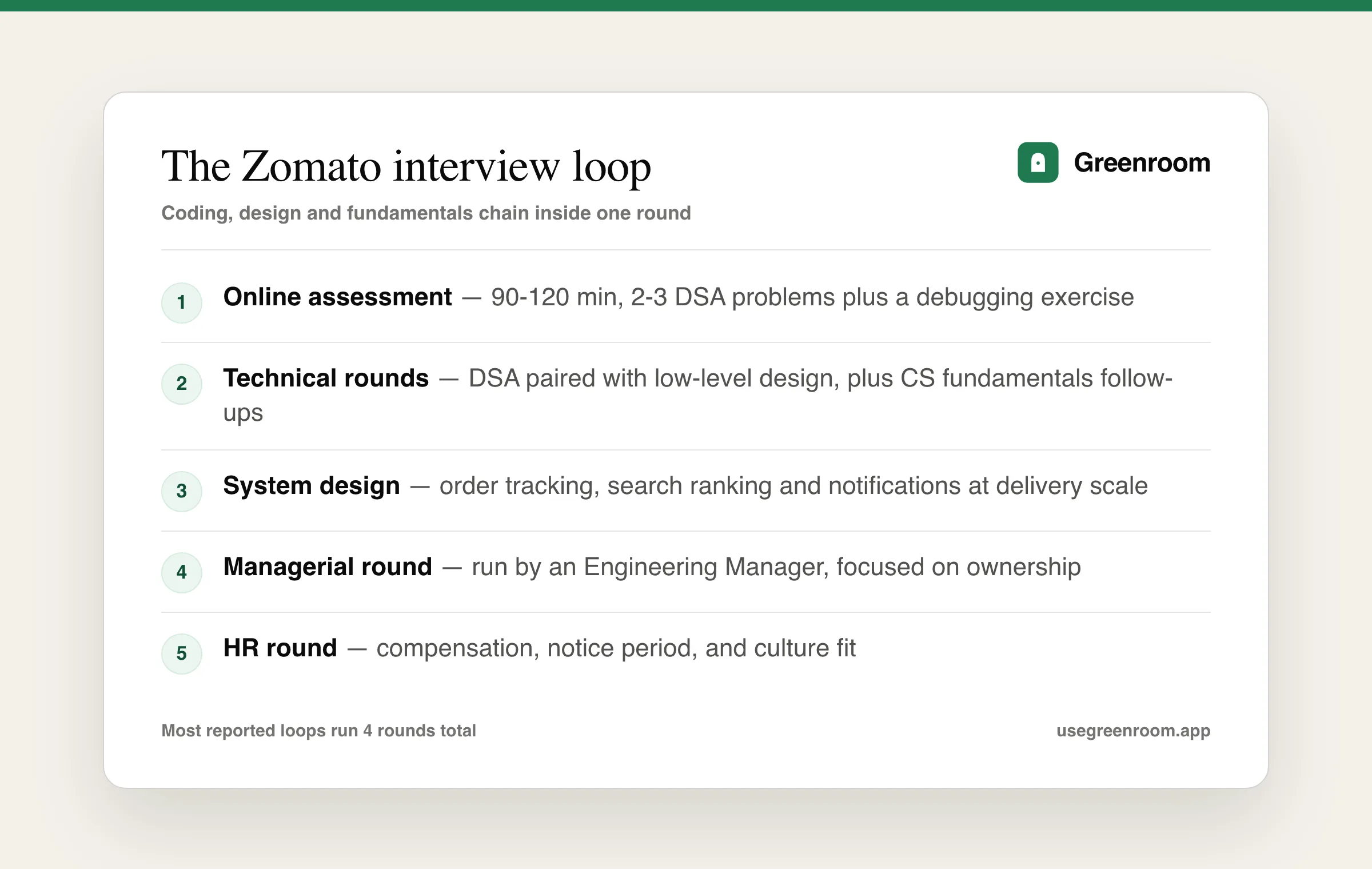
Candidates consistently report the same shape for the Zomato interview process:
- Online coding assessment — 90–120 minutes, 2–3 DSA problems plus a debugging exercise.
- 2–3 technical rounds — DSA combined with low-level design in the same session, plus a dedicated system design round for senior roles.
- Managerial round — run by an Engineering Manager, focused on project depth and ownership.
- HR round: compensation, notice period, and culture fit.
Most loops run 4 rounds total end to end. The detail that catches people off guard: Zomato doesn't cleanly separate "the DSA round" from "the design round" — expect an interviewer to take your working solution and immediately ask you to design the classes around it, then pivot into an OS or networking question about what happens underneath.
DSA questions paired with low-level design
Zomato's signature move is pairing a coding problem with a design follow-up in the same round, so prepare each question as a two-part answer, not a solve-and-stop:
- Design a rate limiter that works across a distributed fleet of API servers.
- Walk me through how you'd shard a write-heavy Postgres table.
- Given a stream of events, return the top-K most frequent items in a sliding window.
- Design the classes for a parking-lot or elevator system, then extend it live for a new constraint.
CS fundamentals —tested almost everywhere
Ananya's mistake wasn't the DSA problem or even the design— it was assuming operating systems knowledge wouldn't come up outside a dedicated "CS fundamentals" round. At Zomato it does, folded into coding and design rounds as follow-ups:
- What happens to a TCP connection when the OS runs out of file descriptors?
- Explain the difference between a process and a thread, and when you'd choose one over the other for a backend service.
- How does an index actually speed up a database query, and when does it stop helping?
- Walk through what happens between a client typing a URL and a response rendering, where can latency creep in?
Our operating system interview questions guide and DBMS interview questions guide cover these in depth — treat them as live ammunition for your coding round, not a separate study track.
System design questions
For senior and full-stack-leaning roles, expect system design pulled from food-delivery-scale problems — real constraints an interviewer can push on for twenty minutes:
- Design a real-time order-tracking system for a delivery partner's location.
- Design a restaurant search and ranking system that handles a lunch-hour traffic spike.
- How would you design a system to detect and prevent duplicate order submissions?
- Design a notification system that reaches a delivery partner within seconds of an order being placed.
Work these through the standard skeleton: clarify scale and latency constraints, propose a data model, pick a caching or queueing strategy, and close with failure modes. Our system design interview guide covers the general framework this borrows from.
Behavioral and hiring-manager questions
The managerial round is run by an Engineering Manager and leans into ownership and project depth over a scripted values checklist:
- Tell me about a time you debugged a production incident under pressure.
- Walk me through a technical decision you made that you'd reverse if you could.
- Describe a project where you had to push back on a requirement, what happened?
Our behavioral interview questions and answers guide covers structuring these with STAR without sounding rehearsed.
Role-specific prep: it's not one interview
The DSA-plus-LLD-plus-fundamentals shape above is the default for backend, frontend and fullstack roles at Zomato, but two roles diverge enough to need separate prep:
- Data Engineer — leads with advanced SQL and data modeling over classic algorithms, then pipeline design for reliability at scale. See the full Zomato Data Engineer interview prep or our Zomato data engineer interview questions guide.
- ML Engineer — blends coding with ML-system design: model serving, feature pipelines, evaluation metrics and production reliability, not just training a model. See the Zomato ML Engineer interview prep.
- Engineering Manager — weighs people leadership as much as technical depth: stories about growing engineers, resolving conflict, and driving delivery. See the Zomato Engineering Manager interview prep.
- Backend Engineer, the process described above almost verbatim. Full breakdown at the Zomato Backend Engineer interview prep.
- Frontend Engineer: same DSA-plus-design shape, with JavaScript fundamentals, framework internals, and browser performance layered on. See the Zomato Frontend Engineer interview prep.
- Fullstack Engineer: API design and databases on one side, React and frontend on the other, tied together in end-to-end system design. See the Zomato Fullstack Engineer interview prep.
LeetCode, GeeksforGeeks, ChatGPT: where each fits
An honest map of the usual prep stack, since each solves a different piece of this loop:
- LeetCode — right for the DSA half of the round; wrong as the main event, since the design-and-fundamentals follow-up is what actually separates candidates.
- GeeksforGeeks interview experiences — useful for calibrating what past candidates were asked at Zomato specifically; treat them as anecdotes, not a syllabus, since accuracy and recency vary post to post.
- A CS-fundamentals textbook — necessary but not sufficient; reading about file descriptors and reciting it out loud under a follow-up question are different skills.
- ChatGPT — solid for generating practice LLD prompts and sanity-checking a written design; it won't chain a coding question into an OS question into a design question the way a real Zomato interviewer will.
- Greenroom, the spoken layer. Ari, the AI interviewer, runs coding-into-design rounds out loud and pushes the same kind of chained follow-up Ananya hit, scoring clarity and structure, the same things the managerial round is quietly grading. It won't teach you operating systems from zero; pair it with the fundamentals above.
How to prepare for the Zomato interview
- Week 1: core DSA (arrays, trees, hash maps, graphs) practiced with the assumption that every solved problem gets a design follow-up.
- Week 2: low-level design: pick three prompts (rate limiter, parking lot, elevator system) and design the classes out loud, twice each, then extend one live for a new constraint.
- Week 3: CS fundamentals as spoken answers —OS (processes/threads, file descriptors), networking (TCP handshake, DNS resolution), DBMS (indexing, transactions)— each explained in under ninety seconds.
- Final week: one spoken mock chaining a coding problem into a design question into a fundamentals follow-up, plus the role-specific prep page above the night before.
If Zomato is one of several food-delivery or e-commerce companies you're targeting, the shape rhymes but the emphasis shifts: our Swiggy interview questions guide covers a similar loop with a heavier standalone machine-coding round, our Meesho interview questions guide covers a lighter DSA bar with system design built for Tier-2/3, low-bandwidth India, our Zerodha interview questions guide covers a fintech loop with a notably lighter DSA bar and heavier judgment-based screening, and the general operating system interview questions guide covers the fundamentals layer both loops assume.
Interviewing specifically for a backend role? Our Zomato backend engineer interview questions guide covers the higher DSA bar, the low-level design round, and the restaurant search and ETA design prompts in depth.
Interviewing for a frontend role instead? Our Zomato frontend engineer interview questions guide covers search and autocomplete UI, infinite feeds and virtualization.
Frequently asked questions
What questions does Zomato ask in a technical interview?
Expect DSA problems paired with a low-level design follow-up in the same round (a rate limiter, a sharding scheme), CS fundamentals as spoken follow-ups (OS processes and file descriptors, DBMS indexing, networking), system design at food-delivery scale (order tracking, search ranking, notifications), and behavioral questions run by an Engineering Manager.
How many rounds are in the Zomato interview process?
Typically an online coding assessment (90–120 minutes, 2–3 DSA problems plus debugging), 2–3 technical rounds combining DSA with low-level and system design, a managerial round with an Engineering Manager, and an HR round, 4 rounds total in most reported cases.
Does Zomato ask CS fundamentals questions?
Yes, and they come up almost everywhere rather than in one isolated round. Expect an OS, networking, or DBMS question as a follow-up inside a coding or design round: for example, being asked what happens to a TCP connection when file descriptors run out, right after solving a coding problem.
Is the Zomato interview process the same for every role?
The DSA-plus-low-level-design-plus-fundamentals shape is the default for backend, frontend and fullstack roles, but Data Engineer interviews lead with SQL and data modeling, ML Engineer interviews blend coding with ML-system design, and Engineering Manager interviews weigh people leadership as heavily as technical depth.
How hard is the Zomato interview?
It's a consistently high bar rather than a trick-question gauntlet. The hardest part for most candidates isn't any single round. It's sustaining structured reasoning as a coding question chains into a design question and then a fundamentals question, all in one sitting.
How is Zomato's interview different from Swiggy's?
Both run DSA plus design plus behavioral rounds at similar company scale, but Zomato leans harder on CS fundamentals (OS, networking, DBMS) surfacing as follow-ups inside coding and design rounds, while Swiggy has a more standalone, dedicated machine-coding round focused on extensible object-oriented design.