A candidate I'll call Priya designed a clean, textbook inventory-management system in her Zepto system design round — normalized tables, a sensible caching layer, the kind of answer that would sail through most e-commerce interviews. The interviewer's only question back was: "your customer was promised delivery in 10 minutes. Where in this design does that number actually get enforced?" She didn't have an answer, because nothing in her design treated the 10-minute SLA as a hard constraint — it was scale she'd designed for, not latency she'd designed against.
That's the real shape of Zepto interview questions: the DSA and machine-coding rounds look familiar if you've prepped for any fast-growing Indian product company, but the system design round is unusually unforgiving about one specific number — the 10-minute delivery promise that's Zepto's entire product. I built Greenroom after freezing in exactly this kind of interview, where a "correct" design isn't the same as a design that respects the actual constraint in front of you. This guide covers the real Zepto interview process, the questions that come up, and where the SLA-obsessed system design round trips people up.
The Zepto interview process
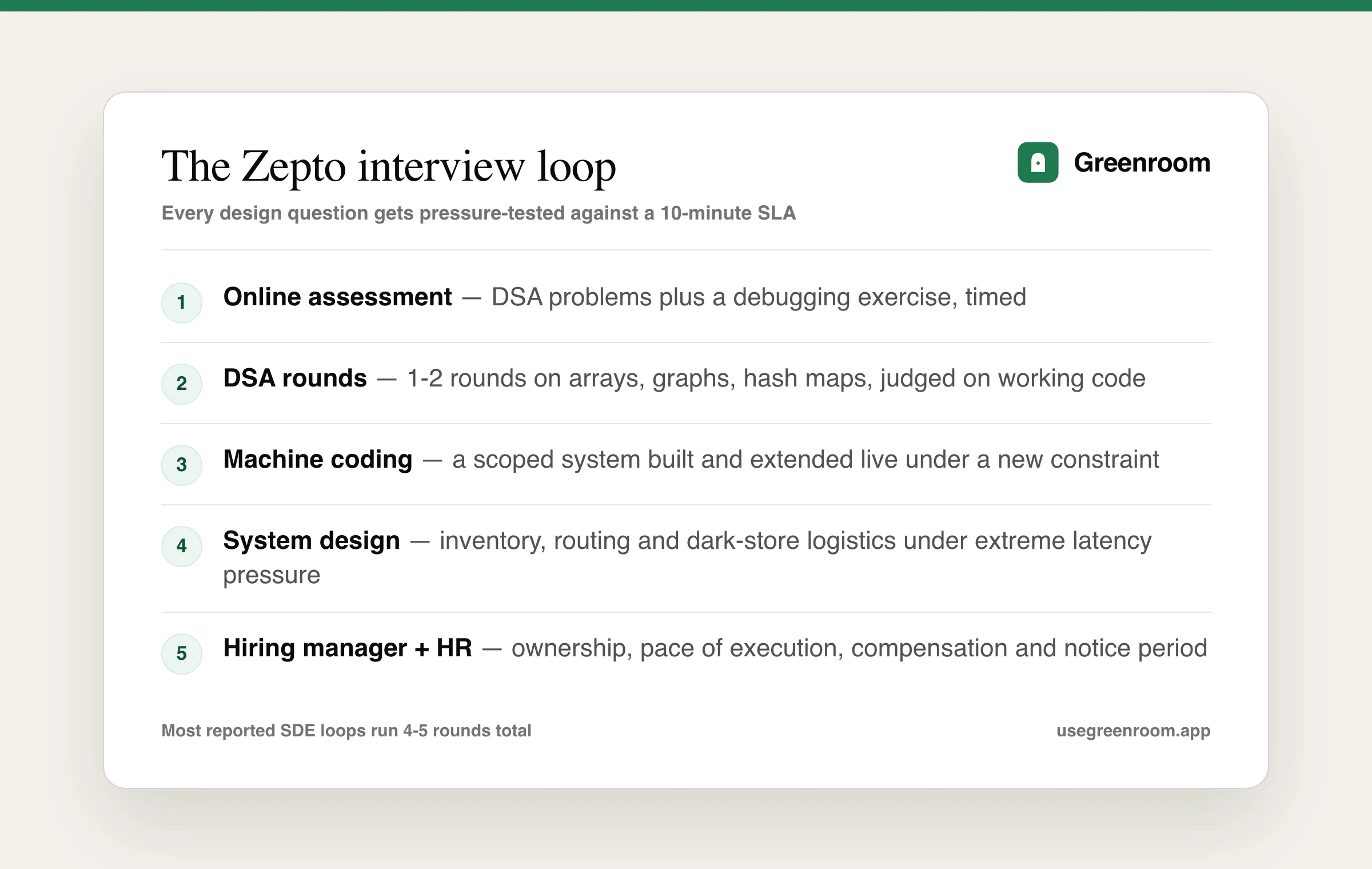
Candidates report a fast-paced loop, consistent with a company still scaling quickly:
- Online assessment — DSA problems plus a debugging exercise, timed.
- 1–2 DSA rounds — arrays, graphs, hash maps, judged on working code delivered under time pressure.
- Machine coding round — a scoped system built and then extended live under a new constraint mid-round.
- System design round — inventory, routing and dark-store logistics, explicitly graded against Zepto's delivery-time SLA.
- Hiring manager + HR — ownership, pace of execution, compensation and notice period.
Most reported loops run 4–5 rounds total, often compressed into a shorter overall timeline than a large, established company — a young, fast-scaling team moves quickly on both sides.
DSA and coding questions
Expect core data structures and algorithms with a practical, backend-flavored lean:
- Given a stream of events, return the top-K most frequent items in a sliding window.
- Design a data structure for a real-time leaderboard that supports fast insert and rank lookup.
- Find the shortest path in a weighted graph — and explain when Dijkstra breaks down.
- Reverse a linked list in groups of K.
The machine-coding round
A 45–60 minute round where you design and build a scoped system, then extend it live when the interviewer adds a new requirement:
- Build an in-memory inventory-tracking system that supports fast stock checks and reservations.
- Design a rate limiter that protects a checkout API during a flash-sale spike.
- Build a simple order-to-rider assignment system between two lists of entities.
Interviewers grade extensibility and correctness under a live-changing spec more than algorithmic cleverness — the same shape as machine-coding rounds at Swiggy or Flipkart, but graded with an eye toward whether your class design could plausibly survive a real dark-store operations team using it under pressure.
System design questions — the 10-minute constraint
This is Zepto's signature round. Every design prompt eventually gets pushed until you're forced to reckon with the delivery-time SLA as a hard constraint, not a soft goal:
- Design an inventory system across multiple dark stores that guarantees a product shown as "available" is actually available in 10 minutes.
- How would you design order-to-rider assignment to minimize delivery time under peak dinner-hour load?
- Design a system that decides which dark store fulfills an order, factoring in real-time stock and rider availability.
- What happens to your design when a dark store goes offline mid-shift — how does the system degrade instead of failing?
Priya's mistake wasn't her data model — it was treating 10 minutes as background context instead of a number that should shape every architectural choice: which cache invalidates first, which failure mode is unacceptable, which trade-off you're not allowed to make. Our system design interview guide covers the general framework this borrows from; Zepto's version demands you keep coming back to one specific latency budget.
Behavioral and hiring-manager questions
The hiring manager round leans into pace and ownership, fitting a company that ships fast:
- Tell me about a time you had to make a decision quickly with incomplete information.
- Walk me through a project where you owned something end-to-end under a tight deadline.
- Describe a time a fast decision turned out to be wrong — what did you do next?
Our behavioral interview questions and answers guide covers structuring these with STAR without sounding rehearsed.
LeetCode, GeeksforGeeks, ChatGPT — where each fits
- LeetCode — right for the DSA gate rounds; wrong as the main event, since the SLA-driven system design round decides more of the outcome.
- GeeksforGeeks interview experiences — useful for pattern-matching what past candidates were asked, though Zepto's interview reports are thinner and newer than for older companies — treat them as early signal, not a syllabus.
- A general system design course — necessary groundwork, but most courses design for scale, not for a hard latency SLA — you'll need to adapt the framework yourself.
- ChatGPT — solid for generating practice dark-store/inventory design prompts; it won't push you on the "where does the 10 minutes get enforced" follow-up the way a real Zepto interviewer will.
- Greenroom — the spoken layer. Ari, the AI interviewer, runs a live system-design round out loud and pushes constraint-specific follow-ups the way Priya's interviewer did, scoring how well your design actually respects the stated constraint, not just whether it's internally consistent.
How to prepare for the Zepto interview
- Week 1: core DSA — arrays, graphs, hash maps — practiced under a visible timer, since Zepto's rounds run fast.
- Week 2: machine coding — pick three prompts (inventory tracker, rate limiter, assignment system) and build each with clean, extensible classes in a 45-minute window.
- Week 3: system design specifically for quick-commerce — dark-store inventory, order-to-rider assignment, degraded-mode behavior — always circling back to "how does this respect the delivery-time SLA."
- Final week: one spoken mock where the interviewer pushes a latency-budget follow-up on every design choice, plus a pace-and-ownership behavioral pass.
If Zepto is one of several quick-commerce or logistics-heavy companies you're targeting, the shape rhymes but the constraint shifts — our Swiggy interview questions guide covers a similar machine-coding-plus-design loop at food-delivery scale, our Flipkart interview questions guide covers the e-commerce parent-scale version, our Ola interview questions guide covers a related real-time constraint problem — surge-time driver matching instead of a fixed delivery SLA, our Licious interview questions guide covers a related quick-commerce loop where the constraint is product decay instead of delivery speed, and the general backend developer interview questions guide covers the fundamentals every one of these loops assumes.
For the server-side loop in detail, see our Zepto backend interview questions guide, covering inventory reservation and the ETA promise.
Frequently asked questions
What questions does Zepto ask in a technical interview?
Expect DSA and coding (arrays, graphs, hash maps), a machine-coding round building a scoped system like an inventory tracker or rate limiter with clean, extensible code, system design questions explicitly graded against Zepto's 10-minute delivery SLA (inventory, order-to-rider assignment, dark-store degradation), and behavioral questions about pace and ownership.
How many rounds are in the Zepto interview process?
Typically an online assessment (DSA plus debugging), 1–2 DSA rounds, a machine-coding round, a system design round, and a hiring manager/HR round — 4–5 rounds total in most reported cases, often on a compressed overall timeline.
What makes Zepto's system design round different from other e-commerce interviews?
Every design prompt gets pushed until you have to explain exactly how your architecture enforces the 10-minute delivery promise, not just how it scales. Interviewers specifically probe where in your design that latency budget is actually protected — a generic scalable design without an SLA-enforcement mechanism reads as incomplete.
Is the Zepto interview process the same for every role?
The DSA-plus-machine-coding-plus-SLA-driven-design shape is the default for backend and fullstack roles; frontend roles keep the same DSA and machine-coding structure with JavaScript and performance depth layered on for the design round instead of logistics constraints.
How hard is the Zepto interview?
It's a high bar delivered at a fast pace, matching the company's own operating speed. The part most candidates underprepare for isn't the DSA round — it's realizing that a textbook-correct system design answer isn't enough if it doesn't explicitly account for the delivery-time constraint.
How is Zepto's interview different from Swiggy's or Zomato's?
All three run DSA-plus-machine-coding-plus-design loops, but Zepto's system design round is unusually singular in its focus — nearly every prompt gets pressure-tested against the same 10-minute SLA, whereas Swiggy and Zomato's design rounds cover a broader range of delivery-logistics constraints without one dominant number.
Interviewing for a data role? Our Zepto data engineer interview questions guide covers the SQL round, dark-store inventory modeling and the streaming pipeline questions.