A candidate I'll call Rahul designed a clean inventory-tracking system in his Licious interview — SKUs, warehouse locations, a straightforward stock-count decrement on each sale. The kind of design that works fine for almost any e-commerce company. The interviewer's follow-up: "this batch of chicken arrived at the processing center six hours ago. It's still sellable, but only for the next four hours, and only if it's stayed below 4°C the whole time. Your inventory count says '40 units in stock.' Should the app actually show it as available right now? What does your system know about those six hours that a normal 'in stock' count doesn't capture?" Rahul's design tracked quantity. It didn't track time or temperature — and for a company selling fresh meat and seafood with a shelf life measured in hours, that's not a missing feature, it's the entire product.
That's the real shape of Licious interview questions: the DSA and machine-coding rounds are familiar if you've prepped for any e-commerce-scale Indian product company, but the system design round is specifically about cold-chain inventory — stock that doesn't just run out, it expires, on a countdown measured in hours and gated by an unbroken temperature record, not a simple quantity check. I built Greenroom after freezing in exactly this kind of interview, where a design that's perfectly correct for durable goods is quietly wrong for perishables. This guide covers the real Licious interview process, the questions that come up, and where cold-chain design catches people off guard.
The Licious interview process
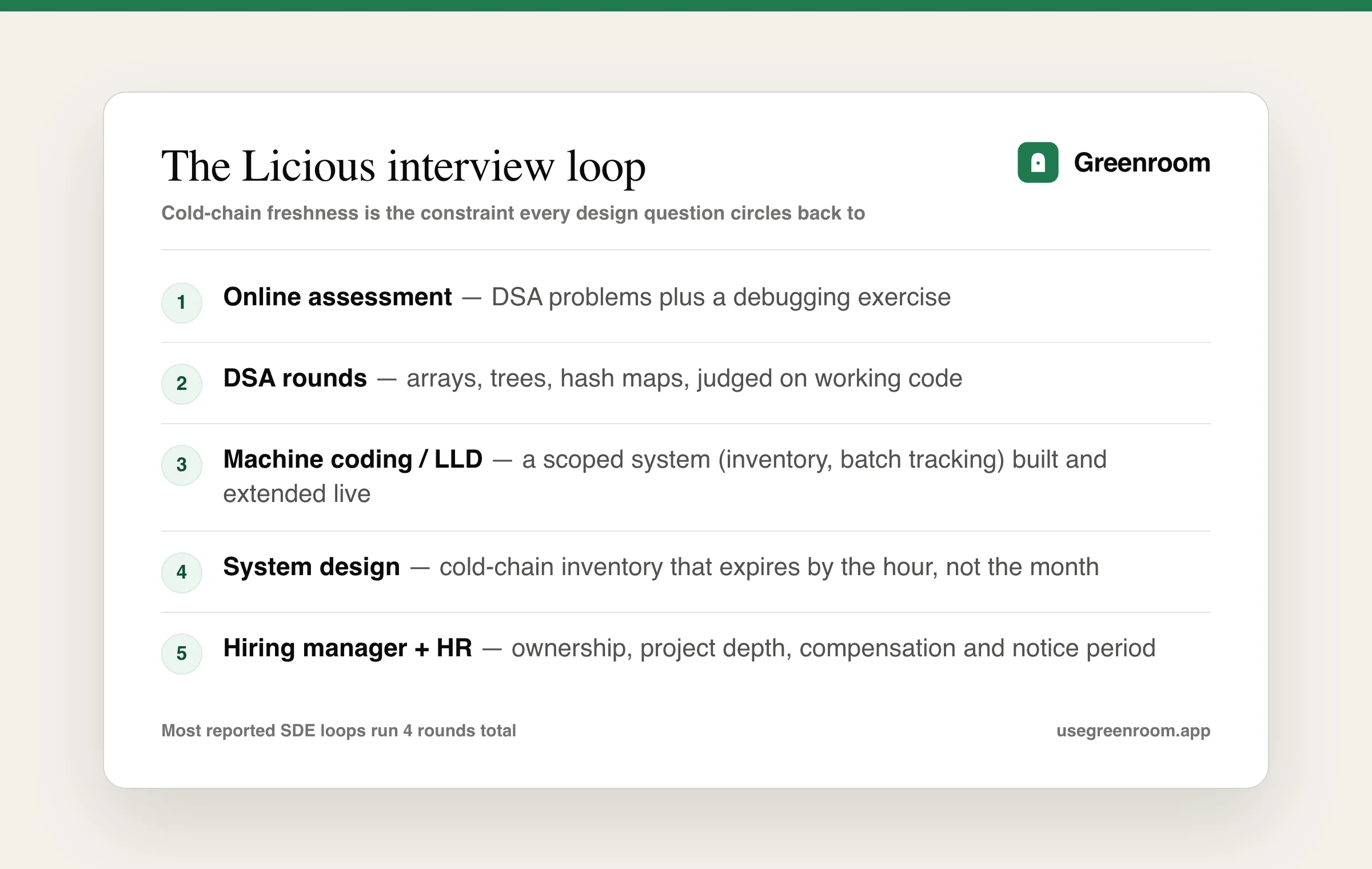
Candidates report a loop shaped like this:
- Online assessment — DSA problems plus a debugging exercise.
- DSA rounds — arrays, trees, hash maps, judged on working code.
- Machine coding / low-level design round — a scoped system (inventory, batch tracking) built and extended live under a new constraint.
- System design round — cold-chain inventory that expires by the hour, not the month.
- Hiring manager + HR — ownership, project depth, compensation and notice period.
Most reported loops run 4 rounds total. The detail that catches candidates off guard: an inventory design that's correct for a normal e-commerce SKU (decrement on sale, restock when supply arrives) is actively wrong for Licious's product — stock has to be modeled with a decaying freshness window and a temperature-integrity requirement, not just a quantity.
DSA and coding questions
Core data structures and algorithms, with a practical, time-and-quality-flavored lean:
- Given a batch of perishable stock with a freshness expiry timestamp, design an efficient way to always sell the soonest-expiring batch first (FEFO — first-expired, first-out).
- Design a data structure that supports fast lookup and removal of expired stock across many warehouse locations simultaneously.
- Given a stream of temperature-sensor readings from cold-storage units, detect a batch that breached its safe temperature range.
- Implement an efficient scheduling algorithm for delivery routes that prioritizes orders closest to their freshness cutoff.
The machine-coding round
A scoped system, built and then extended live when the interviewer adds a new requirement mid-round:
- Design a batch-tracking system that records a product's origin, processing time, and cold-storage duration.
- Build an inventory system that automatically marks a batch as unsellable once it crosses its freshness expiry, even if units remain.
- Design a system that flags a batch for disposal if a temperature-sensor reading shows a cold-chain breach.
Interviewers grade extensibility and correctness under a live-changing spec more than algorithmic cleverness — can your class hierarchy absorb "now also track humidity, not just temperature" without a rewrite.
System design questions — cold-chain integrity at scale
This is Licious's signature round. Expect design prompts pulled from the real messiness of selling stock that actively degrades in quality over hours, not months:
- Design an inventory system that shows a product as unavailable the moment its freshness window closes, across thousands of SKUs and multiple warehouses, in real time.
- How would you design a system that tracks unbroken cold-chain custody from processing center to delivery, and can prove it if a customer complains?
- Design a delivery-routing system that prioritizes orders whose products are closest to expiring, without sacrificing overall delivery efficiency.
- What happens to your design when a refrigeration unit fails at a warehouse — how does the system detect the breach and safely pull affected stock before it's sold?
Rahul's mistake wasn't the schema — it was applying an e-commerce mental model (stock either exists or it doesn't) to a product where stock exists in a decaying, time-and-temperature-bound state that has to be tracked continuously, not checked once at sale time. Our system design interview guide covers the general framework; Licious's version demands freshness and cold-chain integrity as first-class, continuously-tracked design elements.
Behavioral and hiring-manager questions
The hiring manager round leans into ownership and reasoning under quality-and-safety pressure:
- Tell me about a time you had to design something where "close enough" wasn't acceptable — quality or safety was non-negotiable.
- Walk me through a project where you had to reason about time as a first-class constraint, not just a timestamp field.
- Describe a time you debugged a production incident where the root cause was a real-world physical process (like temperature or timing), not application logic.
Our behavioral interview questions and answers guide covers structuring these with STAR without sounding rehearsed.
LeetCode, GeeksforGeeks, ChatGPT — where each fits
- LeetCode — right for the DSA gate rounds; wrong as the main event, since cold-chain inventory design is what actually separates candidates.
- GeeksforGeeks interview experiences — thin for Licious specifically, since perishables logistics is a more specialized category than mainstream e-commerce — treat any single report as one data point.
- A supply-chain or IoT-sensor-systems resource — genuinely useful here; study FEFO inventory strategies, cold-chain monitoring, and time-series sensor data handling, since that's closer to the actual syllabus than a generic e-commerce course.
- ChatGPT — solid for generating practice cold-chain design prompts and sanity-checking a written design; it won't push back on your freshness-modeling gap the way a real Licious engineer who's shipped perishables logistics will.
- Greenroom — the spoken layer. Ari, the AI interviewer, runs a mock system-design round out loud and pushes the "is it still sellable right now" follow-up Rahul got caught on, scoring how rigorously you model time and quality decay, not just quantity.
How to prepare for the Licious interview
- Week 1: core DSA — arrays, trees, hash maps — enough to clear the gate round comfortably.
- Week 2: machine coding — pick three prompts (batch tracker, expiry-aware inventory, temperature-breach detector) and build each with clean, extensible classes in a timed window.
- Week 3: cold-chain system design — freshness-aware inventory, temperature-integrity tracking, expiry-prioritized routing — worked through out loud, always asking "is this still sellable right now, and how do we know."
- Final week: one spoken mock where the interviewer pushes a freshness-and-temperature follow-up on every design choice, plus a quality-and-safety-focused behavioral pass.
If Licious is one of several e-commerce or quick-commerce companies you're targeting, the shape rhymes but the constraint shifts — our Zepto interview questions guide covers a related quick-commerce loop where the pressure is delivery speed rather than product decay, and the general system design interview guide covers the framework every one of these loops assumes.
Frequently asked questions
What questions does Licious ask in a technical interview?
Expect DSA and coding fundamentals, a machine-coding round building a scoped system like a batch tracker or expiry-aware inventory system with clean, extensible code, system design questions about cold-chain inventory that expires by the hour and requires continuous temperature tracking, and behavioral questions about reasoning through quality-and-safety-critical systems.
How many rounds are in the Licious interview process?
Typically an online assessment (DSA plus debugging), DSA rounds, a machine-coding/low-level design round, a system design round, and a hiring manager/HR round — 4 rounds total in most reported cases.
What makes Licious's system design round different?
It's specifically about modeling inventory that decays in quality over hours and requires an unbroken cold-chain temperature record, rather than a standard quantity-based stock count. Interviewers want you to design freshness expiry and temperature-integrity tracking as continuous, first-class parts of the system, not a single check at sale time.
Is the Licious interview process the same for every role?
The DSA-plus-machine-coding-plus-cold-chain-design shape is the default for backend and fullstack roles; frontend roles keep the same DSA and machine-coding structure with JavaScript, framework and performance depth layered on for the design round instead of inventory logic.
How hard is the Licious interview?
It's a consistently high bar rather than a trick-question gauntlet. The part most candidates underprepare for isn't the DSA round — it's realizing that a standard e-commerce inventory model (stock exists or it doesn't) is actively wrong for a product that decays continuously and has to be tracked by time and temperature, not just quantity.
How is Licious's interview different from Zepto's or other quick-commerce companies?
Zepto's core design constraint is delivery speed — getting an available product to a customer within a fixed time window. Licious's core constraint is product decay — determining whether a product is even still sellable at all, based on elapsed time and an unbroken cold-chain record, which its system design round specifically probes.