The recruiter calls at 4 PM sharp. You've rehearsed. You know the role, you know your projects, you even know which mug makes you look employed. You pick up, open your mouth, and "Hello, this is—" comes out with more vibrato than a wedding singer. Your voice is shaking, you can hear it shaking, and now you're thinking about the shaking instead of the question, which makes it shake more. I built Ari, Greenroom's AI interviewer, because that spiral used to be my entire interview experience. A voice shaking during an interview is one of the most common, and most misunderstood, nerve symptoms there is. It's mechanical, it's fixable in the moment, and it's trainable for good. Here's how.
Why does my voice shake during an interview?
Your voice isn't malfunctioning; your breathing is. A shaky voice when nervous is the tail end of a very physical chain. The interview triggers a fight-or-flight response —the same adrenaline cascade Harvard Health describes for any acute stress— which does three things to your speech hardware at once:
- Your breathing goes shallow and high. Adrenaline moves you from slow belly breathing to fast chest breathing. Your voice is literally powered by exhaled air, and choppy airflow produces a choppy sound — the tremble you hear is unstable air pressure, not weak nerves.
- Your throat and jaw tense up. Stress tightens the muscles around the larynx, which raises your pitch and makes the tremor more audible.
- Your heart rate spikes. At high heart rates the tremor can sync with your pulse. That fluttery quality that shows up mid-sentence.
Notice what's not on that list: anything about your competence, preparation, or personality. The tremble is plumbing. Which is excellent news, because plumbing can be fixed with mechanics, not therapy.
How to stop your voice from shaking: the 90-second reset
Because the shake is powered by breath, the fastest fix is to restore steady airflow. Run this in the two minutes before the call — or discreetly, mid-interview, while the interviewer is talking:
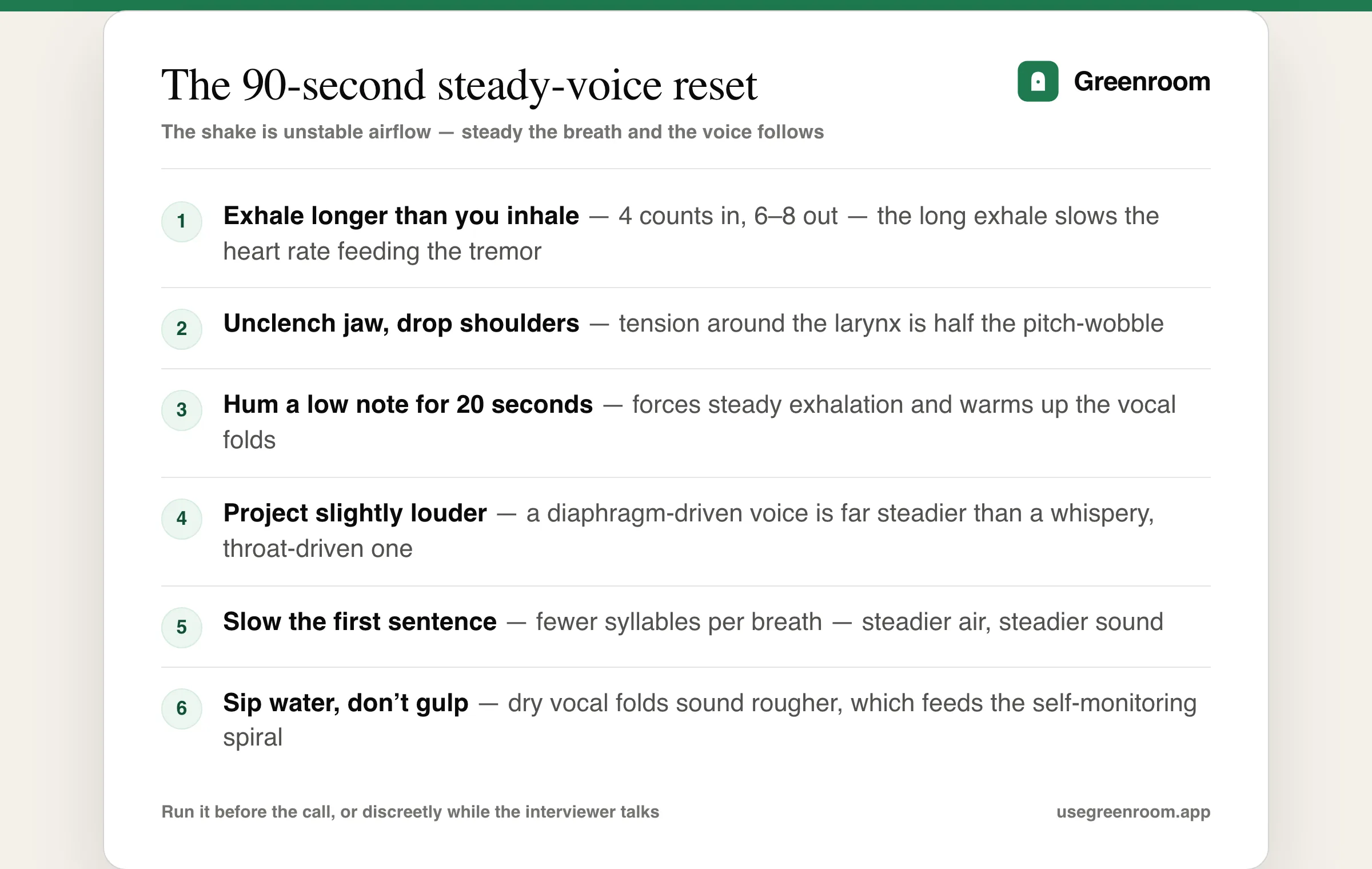
- Exhale longer than you inhale. Four counts in through the nose, six to eight counts out. The long exhale activates the vagus nerve, the body's brake pedal, and directly slows the heart rate feeding the tremor. (The full toolkit is in our guide to interview anxiety breathing techniques that actually work.)
- Unclench the jaw, drop the shoulders. Open your mouth wide once, like a yawn. Tension around the larynx is half the pitch-wobble.
- Hum for twenty seconds. Before the call, hum a low note. Humming forces steady exhalation and "warms up" vocal-fold vibration, singers do this for exactly this reason.
- Speak slightly louder than feels safe. Counterintuitive but reliable: projecting engages your diaphragm, and a diaphragm-driven voice is far more stable than a whispery, throat-driven one. Quiet nervous voices shake more.
- Slow your first sentence. A fast start burns through your breath mid-clause and the shake returns. Slow speech means fewer syllables per breath — steadier air, steadier sound. (Rushing is also what triggers stumbles, see how to stop stuttering in an interview.)
- Sip water, don't gulp it. Dry vocal folds sound rougher, which makes you perceive more shake and tense up further. Keep water within reach for every call.
And one mental move: stop trying to hide it. The moment you start monitoring your own tremble, you've split your attention in half, and answer quality drops fast. Interviewers notice a shaky first minute far less than you think. And they notice a distracted, self-monitoring candidate a lot more.
Shaky voice on phone screens and video calls
Remote formats make the tremble worse for a sneaky reason: your voice is the whole show. No hand gestures, no eye contact, no whiteboard — just audio, sometimes compressed to sound worse than it is. Three format-specific fixes:
- Stand up for phone screens. Standing opens the diaphragm and deepens breathing automatically. Pacing slowly is even better. Half of our telephonic interview tips come down to this one posture change.
- On video, look at the camera, not your own face. Watching yourself talk is self-monitoring with a live feed, the exact spiral that feeds the shake. Hide self-view if the platform allows it. (More in our video interview tips.)
- Front-load your energy. The shake is worst in the first 60 seconds and almost always fades once you're mid-answer. Script your greeting and opening line so the shakiest moment carries the least improvisation.
Train a steady voice before interview day
Everything above is symptom management. The cure is exposure: your body stops flooding you with adrenaline when interviews stop being novel threats, and the only way to teach it that is repetition under realistic pressure. Compare your options honestly. Recording yourself on a phone builds awareness but zero pressure, your voice doesn't shake alone in your room. Toastmasters provides real audience pressure weekly, but for speeches, not the Q&A rhythm of interviews. Yoodli analyzes pitch and pacing from your uploads, useful for tracking, silent on your actual answers. A friend's mock interview works well exactly once, before both of you start giggling. ChatGPT never hears your voice at all.
Greenroom was built for precisely this gap: Ari runs spoken mock interviews with real follow-up questions, so your voice gets its reps under genuine on-the-spot pressure. But with zero social cost when rep #1 comes out wobbly. Most candidates find the tremble noticeably fades somewhere around the fifth or sixth session, for a simple reason: the phone call at 4 PM is no longer the first time. Pair the reps with the calm-building habits in how to stay calm in interviews, and if your fillers spike along with the shake, the pause protocol for "um" stacks neatly on top.
Frequently asked questions
Why does my voice shake during an interview?
Adrenaline shifts you into shallow, rapid chest breathing, and your voice is powered by exhaled air, unstable airflow produces the audible tremble. Stress also tenses the muscles around your larynx, raising pitch and making the wobble more noticeable. It's a mechanical breathing problem, not a confidence defect.
How do I stop my voice from shaking when nervous?
Restore steady airflow: exhale for longer than you inhale (4 counts in, 6–8 out), unclench your jaw, hum a low note before the call, and speak slightly louder than feels safe so your diaphragm drives the sound. Slowing your first sentence keeps the steadiness through the answer.
Does a shaky voice ruin an interview?
No. Interviewers hear nervous first minutes constantly and score your answers, not your vibrato. What actually costs points is the spiral: monitoring your own voice instead of the question, rushing to finish, or going quiet. A shaky voice saying a structured answer beats a steady voice saying a rambling one.
Why does my voice tremble on video calls?
Two reasons: your voice carries the entire impression (no body language to share the load), and self-view turns you into your own audience, watching yourself talk feeds the self-monitoring loop that worsens the tremble. Hide self-view, look at the camera, and front-load a scripted opening line.
What breathing exercise steadies a shaking voice?
Extended-exhale breathing: inhale through the nose for four counts, exhale slowly for six to eight. The long exhale activates the vagus nerve, which lowers heart rate, the engine behind the tremor. Two minutes before the call is enough, and a single long exhale mid-interview (while the interviewer talks) works as a top-up.
Can practicing out loud really stop my voice from shaking?
Yes, it's the only thing that stops it at the source. The shake comes from your body treating interviews as novel threats, and repeated realistic spoken practice (mock interviews with unpredictable follow-ups) is how the nervous system downgrades the threat. Most people hear a clear difference within five or six sessions.