"Tell me about yourself." Four words you've answered in the shower a hundred times. But now there's a hiring manager on the Zoom call, your own face is staring back at you from the corner of the screen, and somewhere between "I'm a" and "final-year student," your mouth files for divorce from your brain. The word comes out in three broken pieces. You apologize. That makes it worse. I know this feeling personally — freezing and tripping over my own introduction is the exact reason I built Ari, Greenroom's AI interviewer. So here is the honest guide to how to stop stuttering in an interview: why it happens, what helps in the moment, and the only kind of practice that actually rewires it.
Why do I stutter in interviews when I don't normally?
If you speak fluently with friends but stutter in interviews, the cause is almost never your speech. It's your processing load. Under interview pressure, adrenaline speeds up your thoughts while your mouth stays at its normal speed, so your speech system is trying to output sentences that aren't fully built yet. At the same time you're running a second job in the background: monitoring how you sound, reading the interviewer's face, and worrying about the next question. Speech researchers call the result nervous disfluency: repeated syllables, restarted sentences, long "uh" bridges.
Two things follow from that diagnosis. First, it's not a character flaw, and interviewers see it constantly. Second, the fix isn't "speak better". It's reducing the load: slower starts, shorter sentences, and enough rehearsal that your common answers don't need building from scratch on the spot.
Nervous stumbling vs. a real stutter
There are two different things people mean by stuttering during an interview, and they need different advice. Nervous disfluency shows up only under pressure and disappears with practice and calm. A developmental stutter (called stammering in India and the UK) is a neurological condition that affects about 1% of adults (roughly 70 million people worldwide, per the Stuttering Foundation) and it doesn't vanish because you did breathing exercises.
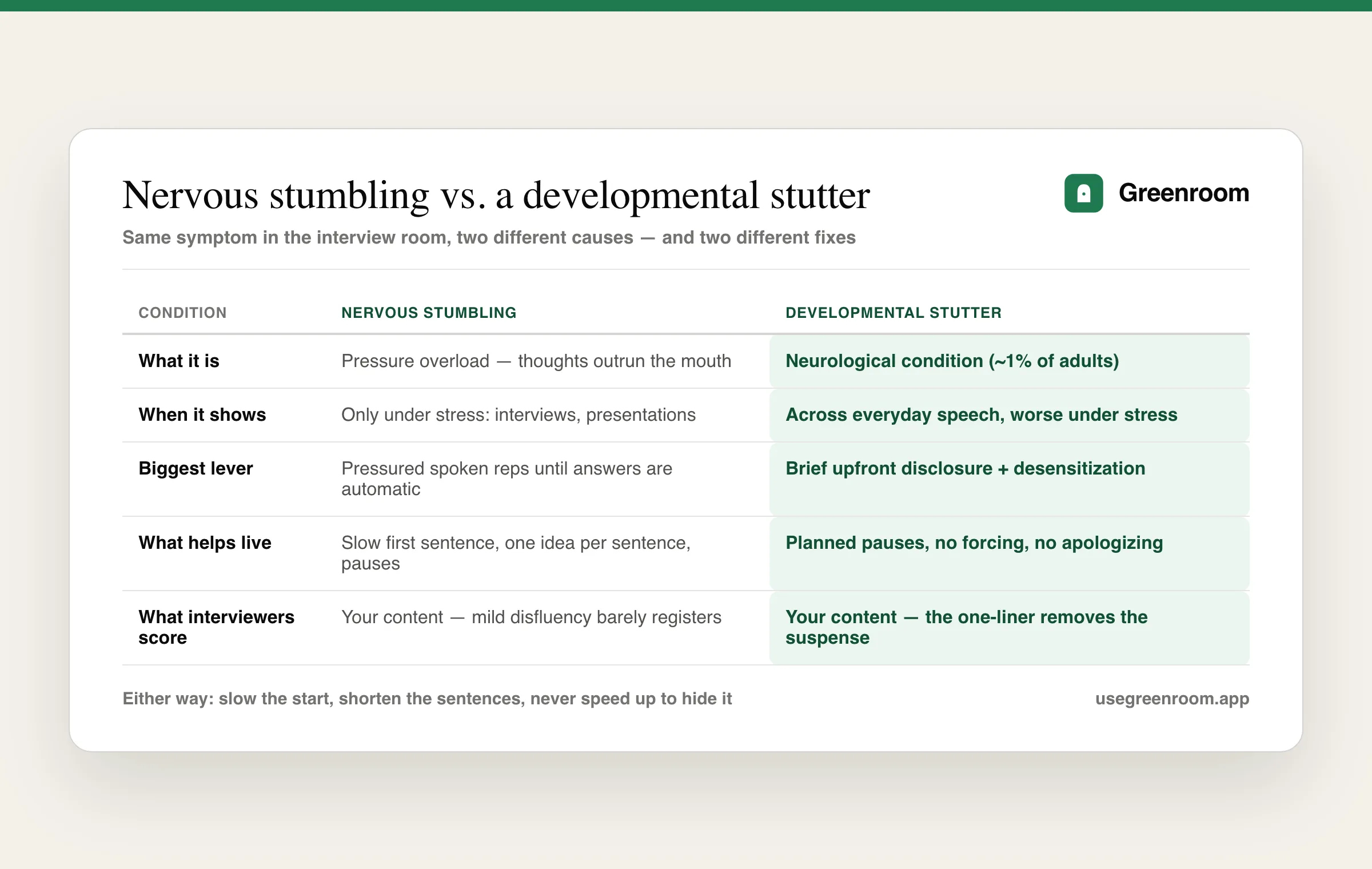
If you're in the first group, everything in this post applies directly. If you're in the second, the in-the-room techniques still help (slower openings, planned pauses), but the bigger levers are disclosure and desensitization, more on both below. Either way, the worst move is the same: trying to hide it by speaking faster.
How to stop stammering when nervous: what works mid-answer
Here's the in-the-room protocol, in the order you should reach for it:
- Start slow on purpose. Your first sentence sets your pace for the whole answer. Deliver it 20% slower than feels natural, nobody has ever failed an interview for starting calmly.
- Shrink your sentences. Stumbles happen mid-clause, when your mouth outruns your plan. One idea per sentence. Full stop. Breathe. Next idea.
- Pause instead of pushing. When you feel a block coming, stop talking entirely for one second. A silent pause reads as thoughtful; a forced word reads as panic. (This is the same move that kills filler words, see how to stop saying "um" in interviews.)
- Never apologize mid-answer. "Sorry, I'm nervous" interrupts your own momentum and draws a spotlight to something the interviewer had already moved past.
- Script your first 40 words. Most interview stuttering happens in the first minute, before you settle. Memorize your opening (name, current role or degree, one line about what you do) so the scariest moment runs on autopilot.
If the stumble spirals into a full blank, that's a different problem with its own fix, the recovery playbook for blanking mid-interview covers it.
Does stuttering affect job interviews?
Honestly: less than you fear, more than zero. Interviewers overwhelmingly score what you said (structure, evidence, relevance) and most barely register disfluency unless it's severe. What genuinely hurts candidates isn't the stutter; it's the behaviors that ride along with it: rushing, apologizing, giving shorter answers to escape faster, or avoiding speaking up confidently at all.
If you have a diagnosed stutter, consider naming it upfront in one calm sentence: "I have a stutter, so I may take a moment on some words. It doesn't affect my thinking." This does two useful things: it deletes the suspense (the thing you're dreading is now just information), and it reframes every subsequent block as expected rather than alarming. The Stuttering Foundation recommends exactly this kind of brief, matter-of-fact disclosure. In India, where group discussions and JAM rounds put speech on display even before the interview, the same one-liner works with a placement panel.
Practice that rewires it (reading this post won't)
Here's the uncomfortable part: you cannot read your way out of interview stuttering. Fluency under pressure is a motor skill, and motor skills only improve with reps under the same pressure. Your options, honestly compared:
- Recording voice memos is free and reveals your baseline, but there's no pressure and no follow-up questions, the two things that trigger the stutter.
- Toastmasters builds genuine stage comfort, but it trains speeches, not interviews, and meetings are weekly at best.
- Yoodli and similar speech apps count your disfluencies and pacing, which is useful telemetry. But they analyze delivery, not whether your answer to "why should we hire you" was any good.
- ChatGPT mock interviews are text-first. Typing fluent answers does nothing for your mouth.
- A friend on a video call is the classic option, and it works — until the third session, when neither of you takes it seriously.
Greenroom sits in the gap: Ari, the AI interviewer, runs real spoken interviews with follow-up questions that don't wait for you to feel ready, which is precisely the condition you need to rehearse. Because Ari is software, the fear of judgment that fuels the stutter is gone, so you can take twenty imperfect reps in the time one human mock takes to schedule. Candidates who freeze usually find the tenth rep sounds nothing like the first. Pair the reps with the breathing techniques that actually lower interview anxiety, and if your voice trembles as well as trips, read the companion guide on fixing a shaking voice during interviews.
Frequently asked questions
Why do I stutter in interviews when I don't normally?
Because interviews overload your speech system: adrenaline speeds your thoughts past your mouth while you simultaneously compose answers, monitor how you sound, and read the interviewer. That produces nervous disfluency, repeated syllables and restarted sentences, which is a pressure problem, not a speech disorder, and it fades with pressured practice.
How do I stop stammering when nervous?
Slow your first sentence by about 20%, keep sentences to one idea each, and pause silently for a second when you feel a block coming instead of forcing the word. Script and memorize your first 40 words, since most nervous stammering happens in the opening minute before you settle.
Does stuttering affect job interviews?
Far less than most candidates fear. Interviewers score the content and structure of your answers, and mild disfluency barely registers. What actually costs points are the escape behaviors: rushing, apologizing repeatedly, or cutting answers short to stop talking sooner.
Should I tell the interviewer I have a stutter?
If you have a diagnosed stutter, a one-line disclosure usually helps: "I have a stutter, so I may take a moment on some words. It doesn't affect my thinking." It removes the suspense for you and reframes any block as expected information rather than a surprise, which is the approach the Stuttering Foundation recommends.
Is stammering the same as stuttering?
Yes — stammering (the usual term in India and the UK) and stuttering (the American term) describe the same condition. Both are distinct from nervous disfluency, the pressure-triggered stumbling that fluent speakers experience in interviews.
Can practice really reduce stuttering in interviews?
Yes, if the practice is spoken and pressured. Reading answers or typing them into ChatGPT doesn't train your mouth. Repeated out-loud mock interviews with unpredictable follow-up questions (with a friend, a coach, or an AI interviewer like Ari) desensitize the trigger, and most people hear a clear difference within ten sessions.