You record a practice answer on your phone, play it back, and start counting. "Um, so, basically, my project was, like, um, a food delivery app?" Eleven filler words. Forty seconds. Your answer had the structural integrity of wet biscuit, and the worst part is you had no idea you were doing it, nobody ever does. The first time I heard my own interview recording, I sounded like a man being interrogated about a crime he didn't commit. If you want to know how to stop saying "um" in interviews, the good news is this is the most fixable speaking problem there is. It responds to a specific drill within days, not months. Here's the whole method.
Why you say "um" so much when nervous
"Um" isn't a bad habit you picked up. It's a system message. Linguists who study disfluency (Michael Erard wrote an entire book on this, literally titled Um…) have shown fillers appear when your brain needs a moment to plan the next phrase but doesn't want to surrender the floor. In conversation, that's useful: silence invites interruption, so "um" holds your turn.
Interviews break the equation twice. First, nerves shrink your planning capacity, so you need more bridges per sentence. Second, and this is the part nobody tells you, the interviewer isn't trying to interrupt you. The floor is yours for the length of your answer. Every "um" is you defending against a theft nobody is attempting. Which means the fix isn't suppressing the sound; it's replacing it with what it was always covering for: a pause.
Do filler words matter in an interview?
Honest answer: a few don't, a flood does. Normal fluent speech runs about two to three fillers per hundred words: interviewers are human, they say "um" too, and nobody's docking points for it. Toastmasters clubs literally assign an "Ah-Counter" role in every meeting because even practiced speakers produce them.
What costs you is density. When every clause leans on "um," "like," "you know," "basically," three bad things happen: your answer takes 30% longer to say the same thing, the interviewer's attention drifts to the tic instead of the content, and, the real damage, you sound uncertain about things you actually know cold. In a phone screen with no video, your voice is the entire signal; a filler-heavy answer and a wrong answer can sound surprisingly similar down a phone line.
The pause protocol: what to say instead of "um"
The replacement for "um" is nothing. Literally nothing. A one-second silent pause does everything "um" was doing (buying planning time, holding your turn) while reading as composure instead of doubt. Newsreaders and senior executives aren't fluent because they think faster than you; they've just made peace with silence.
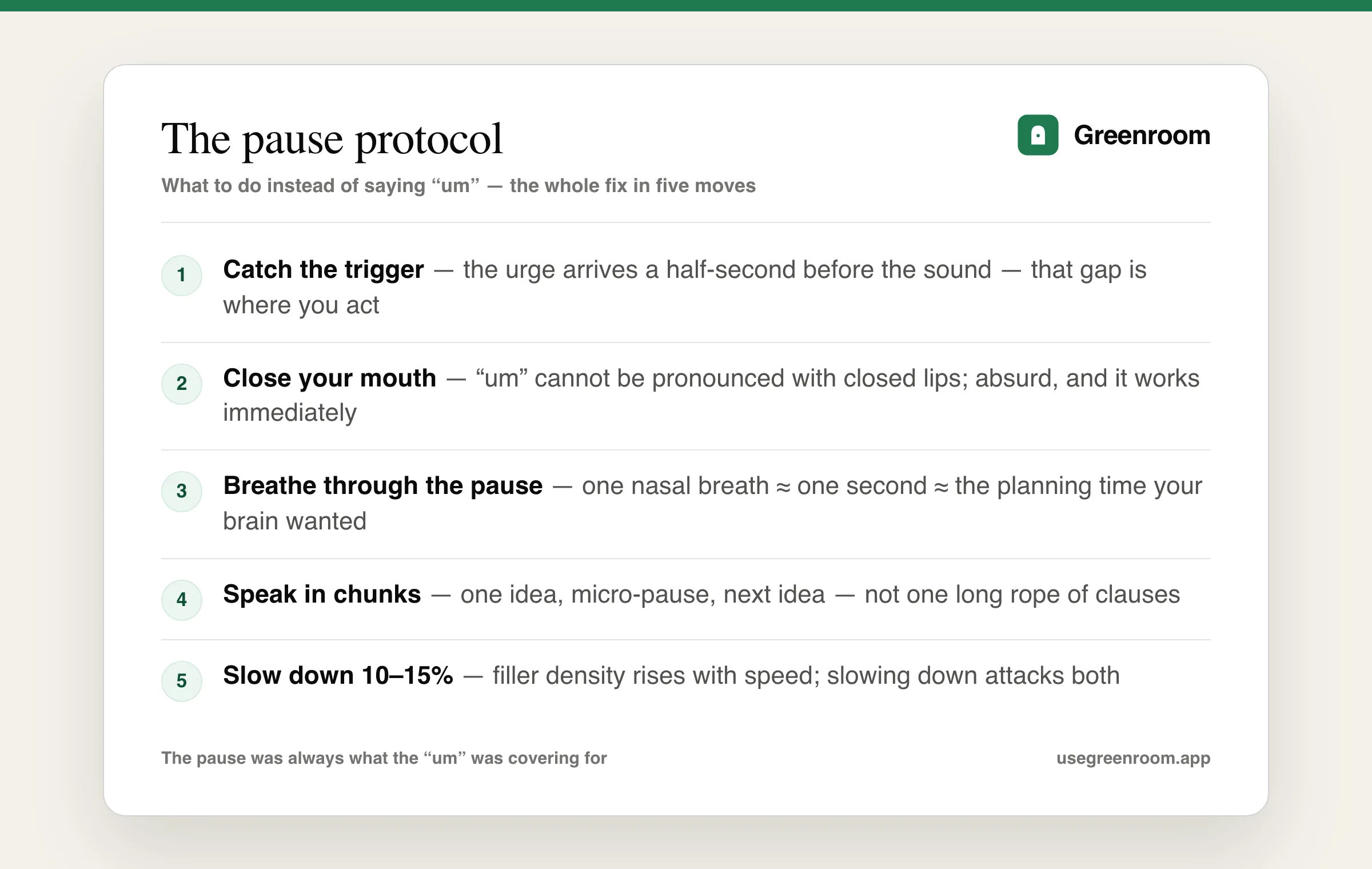
The protocol, step by step:
- Catch the trigger. The urge to say "um" arrives a half-second before the sound. That gap is where you act, the whole skill is noticing it.
- Close your mouth. Physically. "Um" cannot be pronounced with closed lips. This sounds absurd and works immediately.
- Breathe through the pause. One nasal breath ≈ one second ≈ exactly the planning time your brain wanted.
- Land the next phrase, then stop again. Speak in chunks of one idea, with micro-pauses between them, instead of one long rope of clauses tied together with fillers.
- Slow down 10–15% overall. Filler density rises with speed. The same nervous energy that makes your voice shake in interviews also makes you sprint, slowing down attacks both.
One warning from honesty: don't aim for zero. Speakers who over-police fillers start sounding robotic and lose the thread of their own answer. Target is fewer and quieter, not extinct.
Drills that cut filler words in a week
Awareness is 80% of this fix, and awareness only comes from hearing yourself. Four drills, in order:
- Day 1, get a baseline. Record a two-minute answer to "tell me about yourself." Count the fillers. Write the number down; this is the score you're beating.
- Days 2–3, the transcript highlight. Transcribe a recorded answer (any notes app dictation works) and highlight every filler. Seeing "um, like, basically" in print builds the disgust that fuels the habit change.
- Days 3–5, chunk reading. Read any paragraph aloud, inserting a deliberate full-second pause at every comma and full stop. This trains your mouth that silence is survivable. It will feel unbearably slow; on a recording it sounds authoritative.
- Days 5–7, pressured reps. Answer real interview questions out loud, with follow-ups you didn't script, while applying the closed-mouth pause. This is the transfer step — fillers cut in calm practice come sprinting back under pressure unless you rehearse under pressure.
That last step is where most tools fall short, so let's compare honestly. Voice memos are free and fine for the baseline, but nothing pushes back. Yoodli and similar speech-coaching apps count your filler words automatically and chart pacing, genuinely useful telemetry, but they grade delivery, not whether your answer was actually good. Toastmasters' Ah-Counter gives you accountability once a week, for speeches rather than interviews. ChatGPT asks fine questions but in text, and typing has never produced an "um" in recorded history. Greenroom closes the loop: Ari, the AI interviewer, runs the interview by voice, asks the unscripted follow-ups that spike your filler count, and the feedback covers both the delivery and the substance, because a beautifully paused answer that says nothing still loses. It's the same principle as thinking out loud in interviews: the skill only exists when spoken.
Frequently asked questions
How do I stop saying um in an interview?
Replace it with a silent pause: when you feel the "um" coming, close your lips, take one nasal breath, then continue. Drill it by recording answers, counting your fillers, and re-recording until the count drops — then pressure-test with live mock interviews, because fillers return under stress unless you practice under stress.
Do filler words matter in an interview?
A handful don't — normal speech contains two to three per hundred words and interviewers produce them too. High density matters: answers stuffed with "um, like, basically" run longer, pull attention away from your content, and make you sound unsure of things you actually know.
Why do I say um so much when nervous?
Fillers are turn-holding signals: your brain uses them to buy planning time without surrendering the floor. Nerves shrink your planning capacity, so you need more of them. But in an interview nobody is trying to take the floor from you, which is why a silent pause works just as well.
What should I say instead of um?
Nothing. A one-second silent pause buys the same thinking time and reads as composure rather than doubt. If you need a longer beat on a hard question, name it once, "let me think about that for a second", and then actually pause.
How many filler words per minute is normal?
Conversational speech averages roughly two to three fillers per hundred words, around four to six per minute of speaking. Below that, nobody notices. If a two-minute answer contains fifteen or more, the fillers have become the message, and it's worth a week of drills.
Does pausing in an interview look bad?
No — it reads as thinking, which is exactly what interviewers want to see. Candidates consistently overestimate how long their pauses feel: a gap that feels like an eternity to you registers as about one composed second to the listener.