Meta's interview is famous for its pace. In the coding rounds you often get two problems in 45 minutes — which means you cannot afford to flail. Meta isn't trying to trick you; it's measuring specific signals on a rubric, and once you know what those signals are, the whole loop becomes far more predictable. Here's the breakdown.
The Meta interview process
- Recruiter screen — motivation, logistics, timeline.
- Technical screen — one 45-minute round, usually two coding problems.
- The on-site ("full loop") — typically: two coding rounds, one system design round (called "Ninja" / product architecture for experienced engineers), and one or two behavioral rounds ("Jedi" / behavioral).
Meta coding questions
Meta leans on medium-difficulty problems you must solve quickly and cleanly:
- Arrays, strings, hash maps — two-sum variants, subarray problems, interval merging.
- Trees & graphs — BFS/DFS, binary tree paths, clone a graph.
- Recursion & backtracking — subsets, permutations.
- Heaps — top-K elements, merge K sorted lists.
Because you're solving two in 45 minutes, the winning move is to clarify fast, state your approach, code without long silences, and test quickly. Meta explicitly scores communication and problem-solving as separate signals.
Meta system design
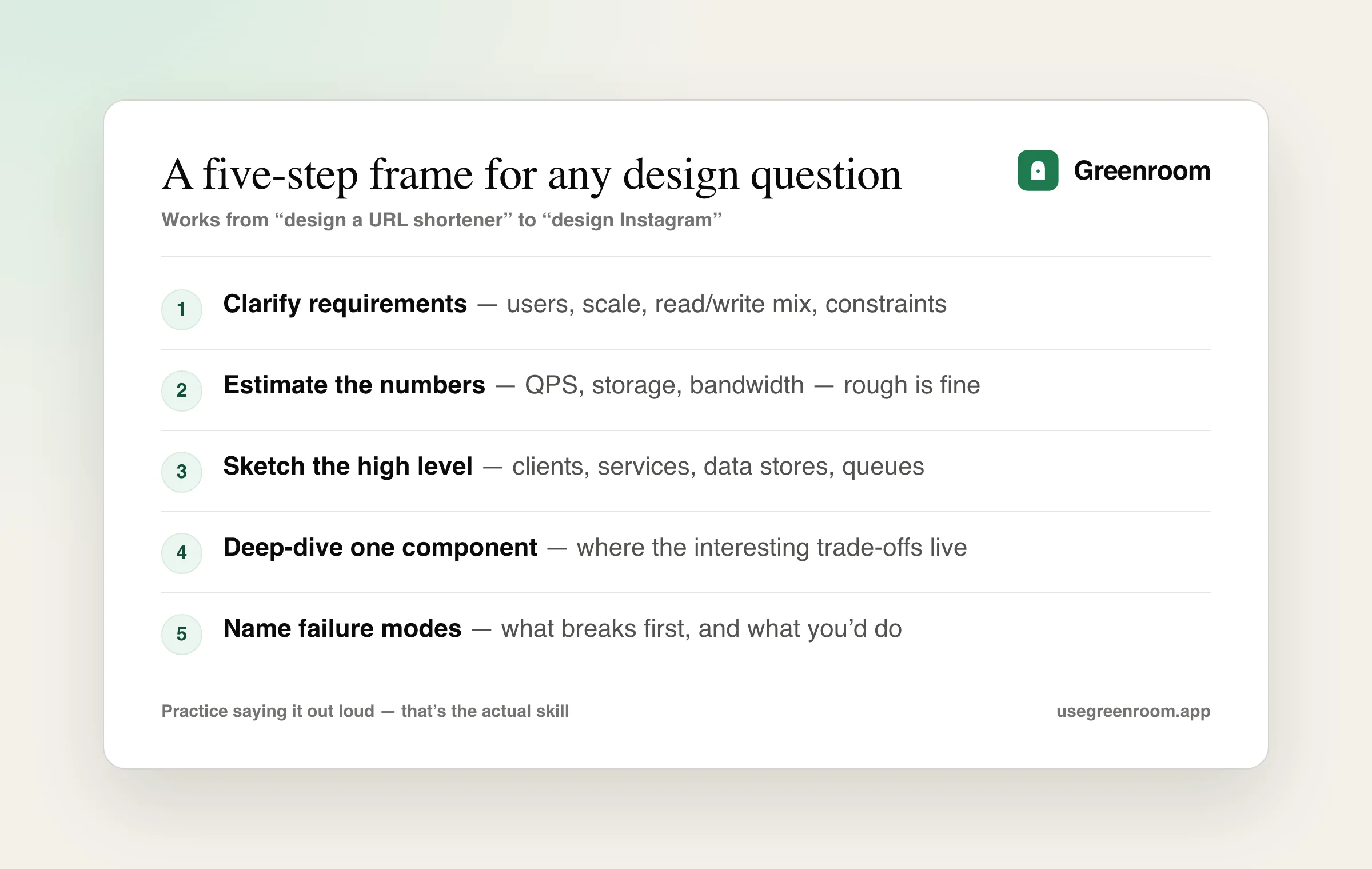
For E4 and above, the design round asks you to design a real Meta-scale product: a news feed, Instagram, a messaging system, a notification service, or a nearby-friends feature. They want functional and non-functional requirements, API design, data modeling, scaling and a clear discussion of trade-offs. See our system design guide.
Meta behavioral ("Jedi") round
Meta's behavioral round maps to values like "Move Fast", "Be Bold", and "Focus on Impact". Expect:
- Tell me about a project you're most proud of and your impact.
- Describe a conflict with a coworker and how you handled it.
- Tell me about a time you had to move fast with ambiguity.
- A time you received tough feedback.
Use STAR and quantify impact — Meta is obsessed with measurable impact.
How to prepare
You can't fake Meta's pace. The only way to get comfortable solving and talking at the same time, fast, is to rehearse it out loud under time pressure. Greenroom runs a real spoken interview that pushes you to narrate your approach and answer behavioral questions with follow-ups, then flags where you went silent or rambled. Pair it with our FAANG prep guide and coding communication tips — and if you're interviewing for the data org, our Meta data engineer interview questions guide covers the rapid SQL screen, data modeling and product-sense rounds specifically.
Interviewing for a specific Meta role? We have deeper round-by-round guides for Meta frontend interview questions and Meta backend interview questions, both covering the two-problem coding format and the people round.
Frequently asked questions
How many coding problems does Meta ask in one round?
Meta's coding rounds are famously fast — you typically get two problems to solve in a single 45-minute round. That pace means you should clarify the problem quickly, state your approach, code without long silences and test fast, rather than spending all your time perfecting one solution.
What rounds are in the Meta interview loop?
A full Meta loop usually includes a recruiter screen, a 45-minute technical screen with coding, and an on-site of about four to five rounds: two coding rounds, one system design (product architecture) round for experienced engineers, and one or two behavioral ('Jedi') rounds mapped to Meta's values.
What does Meta look for in the behavioral round?
Meta's behavioral round maps to values like Move Fast, Be Bold and Focus on Impact. Interviewers want STAR-format stories that show measurable impact, handling ambiguity, resolving conflict and acting on feedback. Quantifying your impact matters a lot, because impact is central to how Meta evaluates engineers.
How do I prepare for the Meta interview?
Practise medium-difficulty data-structure and algorithm problems until you can solve them fast and clean while narrating out loud, since Meta scores communication and problem-solving as separate signals. Rehearsing with a voice-based mock interview under time pressure, plus impact-driven behavioral stories, is the closest match to Meta's fast loop.