Most failed coding interviews aren't lost because the candidate couldn't solve the problem. They're lost because of a handful of avoidable coding interview mistakes — process errors, communication gaps, and panic responses that make a capable engineer look unprepared. Here are the 12 most common ones, and exactly how to fix each.
Process mistakes
1. Jumping straight to code
The biggest red flag. Interviewers want to see you clarify the problem, work an example, and state an approach before writing a line. Spend the first 3–5 minutes here every time.
2. Not asking clarifying questions
Assuming input constraints, edge cases, or the expected output silently signals weak engineering judgment. Ask about input size, duplicates, empty inputs, and the data range — it's scored positively.
3. Ignoring time and space complexity
Always state the Big-O of your approach before coding, and again after. Failing to analyze complexity — or not realizing your solution is O(n²) when O(n) exists — is a common rejection reason.
4. Optimizing too early
Reaching for the clever solution immediately and getting stuck looks worse than stating a brute-force baseline first, then improving it. State the simple solution, then optimize.
Communication mistakes
5. Coding in silence
The most damaging habit. If you go quiet, the interviewer can't follow your reasoning or give hints — and they're scoring your communication as much as your code. Narrate as you go.
6. Going silent when stuck
Freezing and saying nothing is worse than saying "I'm considering two approaches here — let me think aloud." Interviewers help candidates who externalize their thinking.
7. Ignoring hints
A hint is a lifeline, not a trap. Dismissing or not noticing one signals you're not listening. Acknowledge it: "Good point — that suggests a hash map would cut this to O(n)."
8. Arguing or getting defensive
If the interviewer points out a bug, don't defend it — investigate it. Defensiveness reads as someone who'll be hard to work with.
Execution mistakes
9. Not testing your code
Finishing and saying "done" without tracing through an example or checking edge cases is a missed opportunity. Walk through your code with a sample input out loud.
10. Skipping edge cases
Empty arrays, single elements, duplicates, negatives, overflow. Naming and handling these shows production-minded thinking.
11. Sloppy variable names and structure
`x`, `temp`, `data2` everywhere makes your code hard to follow and hurts the readability signal. Use clear names even under time pressure.
12. Letting panic take over
One stumble spirals into a freeze. Build a recovery routine: a long exhale, restate the problem, and grab the brute-force baseline to get moving again.
Fix them with realistic practice
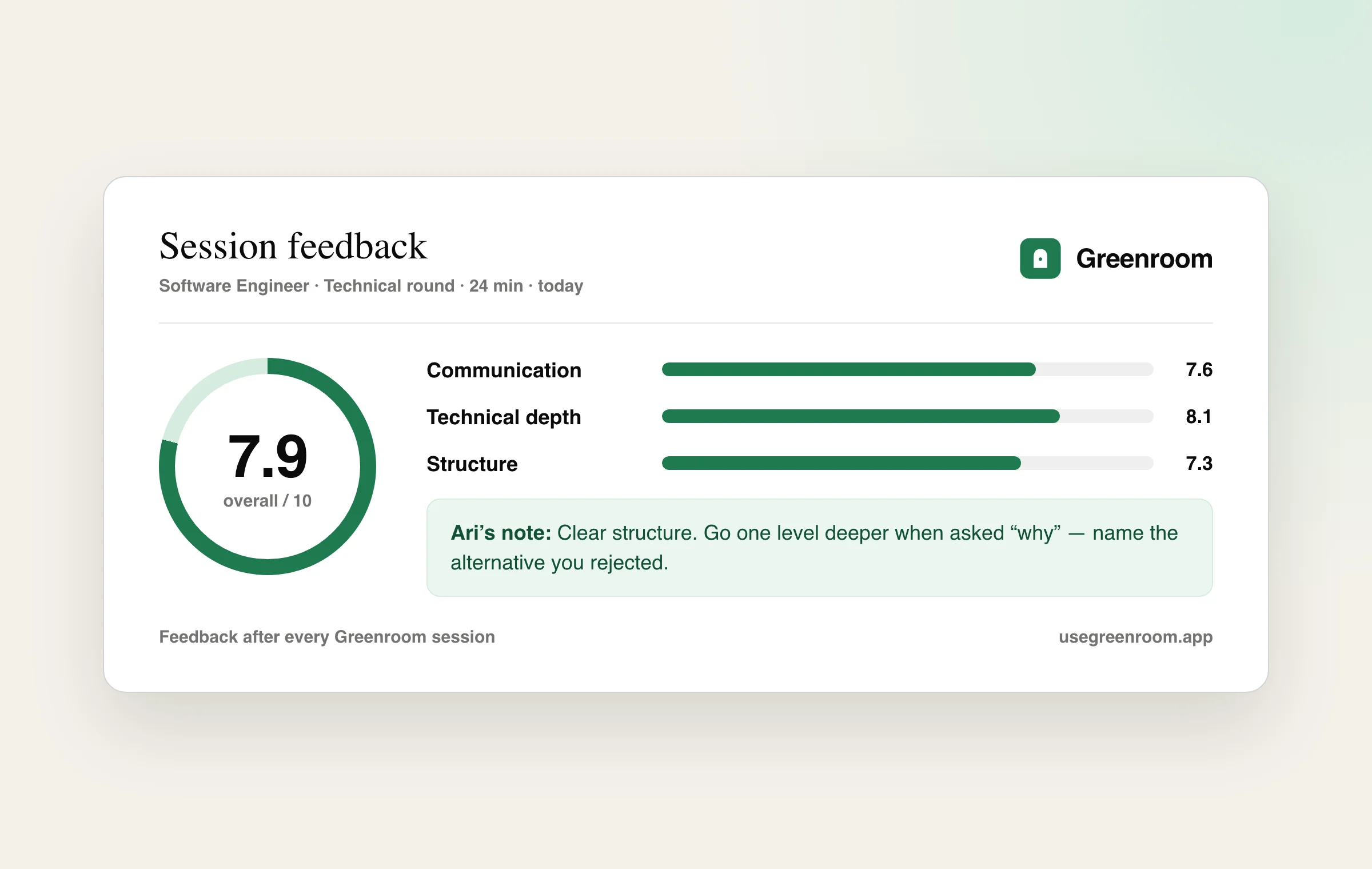
You can't fix coding-in-silence by solving more problems alone — that reinforces it. You fix it by practising out loud, with something that expects you to talk. Greenroom runs spoken mock interviews that ask you to clarify, narrate, and analyze complexity, then gives feedback on exactly these habits. See also our guides on practising mock interviews alone and stopping panic mid-interview.
A newer one worth adding to the list: our can you use AI in a coding interview guide covers accepting a generated answer without reading it.
Frequently asked questions
What is the most common coding interview mistake?
Jumping straight to writing code without clarifying the problem, working through an example, or stating an approach first. Interviewers want to see your problem-solving process, so spending the first few minutes clarifying constraints and outlining your plan is essential and is scored positively.
Why do candidates fail coding interviews even when they solve the problem?
Usually because of communication and process, not correctness. Coding in silence, not analyzing time and space complexity, ignoring hints, and skipping edge-case testing all hurt your score even with a working solution. Interviewers grade how you think and communicate, not just the final answer.
Should I talk while coding in an interview?
Yes — narrating your reasoning as you write is one of the most important things you can do. It lets the interviewer follow your logic, give you helpful hints, and score your communication. Going silent, especially when stuck, is one of the most damaging habits in a coding interview.
How do I stop making these mistakes?
Practise out loud, not silently. Solving problems alone reinforces bad habits like coding in silence. Use realistic spoken mock interviews that require you to clarify the problem, talk through your approach, analyze complexity, and test edge cases, so the right process becomes automatic before the real interview.