Two hundred HackerRank problems. All accepted. Green across the board. Hard difficulty, consistent submission rate, leaderboard ranking that would make your college professor weep with pride. You walk into the technical interview knowing the algorithm cold. The hiring engineer types the problem into the shared doc, leans back, and says: "Great. Can you walk me through your approach before you start coding?"
And your brain — which has been submitting code in silence for three months — freezes. You know the answer. You've solved this exact variant before. But you have never, not once, said the words "time complexity" or "why a hash map here" in a sentence. Out loud. To a human waiting for you to sound smart.
That freeze is not a knowledge problem. It is a practice-format problem. And it's the entire reason comparing HackerRank vs Greenroom for interview prep matters.
What HackerRank actually is — and who it's for
HackerRank is one of the most widely used technical practice platforms in the world, and genuinely dominant in India — where it's the default benchmark for engineering campus placements, MNC filters, and mass-hiring coding tests. It is a coding-first platform: thousands of algorithm problems across data structures, dynamic programming, graphs, strings, SQL, regex, and more. You submit code, it runs against test cases, it accepts or rejects. That's the loop.
HackerRank also offers certifications (the "HackerRank Skills Certification" in Python, JavaScript, SQL, etc.) that some recruiters accept as a shortcut filter. Companies use HackerRank for Work on the B2B side to screen candidates at scale. And HackerRank's Interview Preparation Kit is a curated problem set that many engineers use as a structured study guide — 69 challenges across core topics, designed to mirror what FAANG and MNC hiring rounds actually use.
For what it does, HackerRank is excellent. If you're going to be handed a coding problem in a timed environment and expected to produce passing code, nothing trains that loop better than actually doing it, repeatedly, under a timer. The submission-and-feedback cycle is fast, the problem bank is deep, and the difficulty calibration is reliable. It is the right tool for training the code-writing part of the coding interview. The catch is buried in that last sentence.
The part of the interview HackerRank doesn't train
A real technical interview is not a silent code submission. It is a conversation with a human who is watching you think, judging how you communicate, testing whether you consider edge cases aloud, and deciding whether you'd be pleasant to work with for eight hours a day.
Walking through your approach before you code. In almost every real interview — FAANG, top product companies, startups — you are expected to explain your plan before you type anything. "I'm thinking a BFS here because…" or "My first instinct is a greedy approach, but let me check if DP is cleaner…" — this is the senior-engineer signal, and it is entirely verbal. HackerRank trains you to code. It does not train you to narrate the thinking behind the code.
Handling the follow-up question. After your first answer, any real interviewer will probe: "Can you do it in O(n) space?" or "What if the input is 10 billion entries?" or "How would you test this?" These are adversarial follow-ups designed to test whether you really understand the solution or just pattern-matched it. HackerRank's judge checks correctness, not reasoning depth. No one challenges your complexity analysis in a text box.
The behavioral round you haven't practiced. Technical candidates routinely go into behavioral interviews having prepared nothing but code. Then they get "Tell me about a time you disagreed with a technical decision" and produce a word salad. Most engineering job offers include both rounds; most HackerRank-only prep completely ignores one of them.
Sounding like a senior engineer. The words you use, the way you frame tradeoffs, the confidence in your voice when you're uncertain — these are communication skills, and communication skills are only built by communicating out loud to someone who can tell when you're faking it.
What Greenroom does differently
Greenroom is an on-demand voice-based AI mock interview tool. Ari — Greenroom's AI interviewer — asks you questions out loud, listens to your spoken answer, and asks adaptive follow-ups based on what you actually said. It covers technical communication ("explain your approach to this system design"), behavioral rounds ("tell me about a time you shipped something you weren't proud of"), and HR or phone-screen rounds — the spoken side of the interview process that HackerRank doesn't touch.
After every session, Greenroom generates a structured feedback report: a 1–10 score, notes on answer structure, filler word count, pace, and whether your reasoning was coherent. You can run the same question again immediately and track whether the score moves. We cover what's in the report in how AI interview feedback actually works.
The contrast is sharp. HackerRank measures whether your code produces the right output. Greenroom measures whether your communication produces the right impression. Both matter for getting hired; they train completely different muscles.
Greenroom vs HackerRank, head to head
What each tool trains
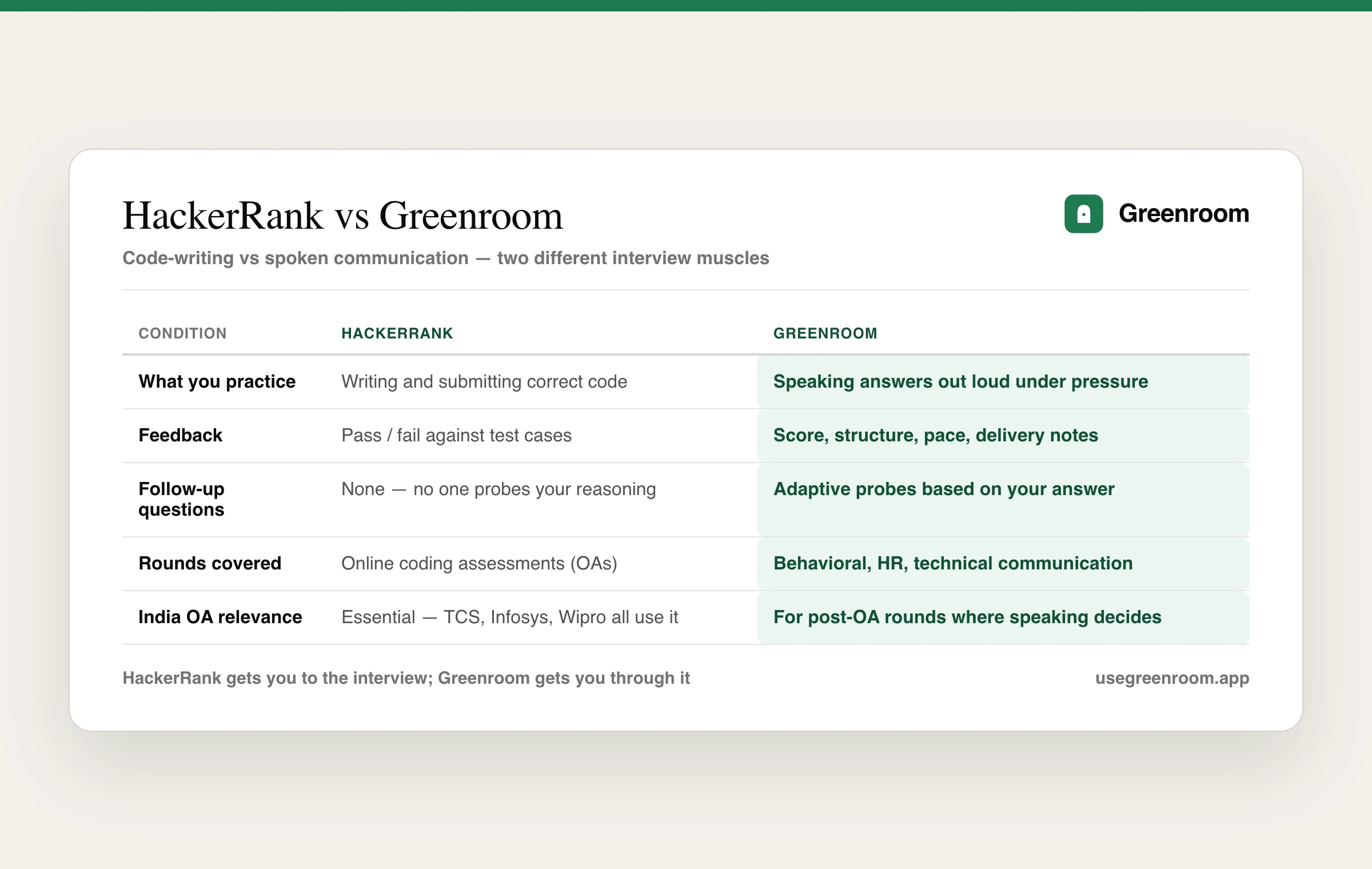
HackerRank: the ability to write correct, efficient code under a timer. The submission loop builds speed, pattern recognition, and test-case intuition — real skills, but specifically writing skills, not communication skills. Greenroom: the ability to speak clearly under interview pressure, structure answers to open-ended questions, handle follow-up probes, and sound like someone worth hiring. Real skills too — specifically speaking skills that HackerRank doesn't touch.
Which interview rounds each covers
HackerRank covers online coding assessments (OAs), timed coding rounds, and technical screening filters. These are real gatekeeping rounds that matter. But most job offers require clearing the human-facing rounds too — technical communication, system design discussion, behavioral, HR. Greenroom covers those. Specifically, behavioral interview questions for software engineers are exactly the kind of thing Greenroom is built to drill.
Feedback quality and form
HackerRank feedback is binary: accepted or not, with optional test case visibility. It tells you whether your solution worked. It gives you no information about how you presented it, whether your complexity analysis was right when you said it out loud, or how you sounded when the interviewer asked why you picked that data structure. Greenroom feedback is multi-dimensional: score, structure, pace, fillers, content. It gives you something to fix on the next rep, not just a pass/fail.
India-specific relevance
In India's tech hiring landscape, HackerRank is inescapable. Infosys, TCS, Wipro, Capgemini, and essentially every MNC and product company use it for filtering. You must be able to pass these OAs. But even companies that filter heavily on HackerRank have in-person or video rounds afterward that are entirely different in character. Many HackerRank-ready candidates stumble in those rounds because they've practiced the wrong thing.
How to use both tools together
The right move is not to choose. It is to understand what each tool does and use both at the right stage of prep.
Phase 1 — Build your coding foundation on HackerRank. Work through the Interview Preparation Kit systematically. Hit Medium difficulty consistently before touching Hard. Time your submissions. Get comfortable with the test-case submission loop.
Phase 2 — Practice narrating your solutions on Greenroom. Take problems you've already solved on HackerRank and explain your approach out loud to Ari. "I chose a sliding window here because the brute force is O(n²) and the input is unbounded…" This is the specific skill that separates a candidate who passes the OA from one who does well in the technical round. We cover this in detail in how to think out loud in interviews.
Phase 3 — Drill behavioral rounds heavily on Greenroom. Most technical candidates skip this. Most technical candidates regret it when the offer goes to the person who told better stories about their own work.
Phase 4 — A real human mock. Before your target interviews, do one or two sessions with a real senior engineer — through interviewing.io or a trusted contact in your target role — to get the kind of judgment only a human in that seat can give. We compare AI and human mocks in detail in AI mock vs real engineer mock.
Where HackerRank genuinely wins
- Online assessments are the gatekeeping reality. If companies use HackerRank to filter 1,000 applicants to 50, you need to pass the OA. There is no substitute for actually doing the problems.
- Algorithmic intuition compounds. Solving enough problems makes certain patterns automatic — sliding window, two pointers, BFS — and that fluency is real and comes from repetition on exactly this kind of platform.
- The certification has some value. For junior roles and campus placements especially, a HackerRank certification in your target language is a non-trivial signal where a resume might not stand out otherwise.
- It is free. HackerRank's core problem set requires no payment. The volume of available practice is genuinely enormous.
Where only Greenroom gets you
- Saying "I'm thinking a trie here because…" without sounding like you're reading from a script. That is a spoken fluency skill built by repetition out loud.
- Handling a follow-up that wasn't in the problem. "What if the input contains duplicates?" or "Can you do this without extra space?" — reasoning in real time, verbally, under the pressure of being evaluated. HackerRank's test cases don't do that.
- Behavioral rounds that don't make the interviewer wince. You know the ones. Practicing out loud, getting feedback, and re-trying until the story is compelling — that's Greenroom.
- Sounding calm when you don't know the answer. "That's an interesting constraint. Let me think through a few approaches…" is a learnable response. Greenroom can drill it. A text submission box cannot.
The real reason HackerRank-only prep fails
The underlying issue is a common category error: preparing for the wrong test. HackerRank is what companies use to filter. Interviews are what companies use to hire. They look similar — both involve technical problems — but they reward completely different things. Filtering tests reward speed and correctness under a timer. Interviews reward communication, reasoning transparency, collaboration signals, and behavioral judgment.
If your entire prep is optimized for filtering, you'll pass the filter and then fail the interview. The fix is not to stop preparing on HackerRank — it's to also prepare for what comes after.
Frequently asked questions
Is HackerRank enough to prepare for a technical interview?
HackerRank is excellent preparation for online coding assessments — the automated first-round filter that most companies use. It is not enough for the full interview because real interviews include verbal rounds: walking through your approach out loud, answering follow-up questions, discussing system design, and behavioral questions. Passing the OA gets you in the door; the remaining rounds require spoken communication practice.
Does HackerRank offer mock interviews?
HackerRank has a Mock Test feature that simulates the timed OA environment — useful for pacing practice. It does not offer live interactive mock interviews with a human or AI interviewer that asks follow-up questions and evaluates your spoken answers. For interactive voice-based mock interview practice, Greenroom is built specifically for that use case.
What does Greenroom practice that HackerRank doesn't cover?
Greenroom covers the spoken side of interviews: verbal technical communication, behavioral STAR stories with follow-up probes, HR and phone-screen rounds, and system design discussion. It gives per-session structured feedback on delivery — score, structure, pace, filler words — which is the kind of feedback that improves spoken performance, not code correctness.
Is HackerRank relevant for Indian campus placements?
Yes, very. HackerRank is the most widely used OA platform for Indian campus placements — TCS, Infosys, Wipro, Capgemini, and essentially all mass-hiring MNCs use it for initial filtering. If you're a student targeting campus placement, solving HackerRank problems is not optional. But the subsequent rounds — technical interviews, HR interviews — require spoken practice that HackerRank cannot provide.
Can I use Greenroom if I am preparing for a non-coding interview?
Yes. Greenroom's voice-based mock interviews cover behavioral rounds, HR rounds, and communication-heavy technical rounds regardless of whether coding is involved. For roles like product management, data science, consulting, or business analyst, where interviews are primarily spoken and behavioral, Greenroom is particularly well suited.
How do I practice the "walk me through your approach" part of coding interviews?
Take problems you've already solved on HackerRank or LeetCode and explain your solution out loud to Greenroom — treating it as a verbal session where you narrate your reasoning. Greenroom's AI interviewer will probe your approach, ask about complexity, and challenge your choices, which is precisely the experience you get in a real technical interview. The verbal narration is a separate skill from the coding itself and requires separate practice.