You've watched eighteen Exponent system design videos. You know the framework cold: clarify requirements, estimate capacity, sketch the API, choose a database, draw the high-level architecture, deep-dive the bottleneck. You could narrate someone else doing it in your sleep. Then your Google loop starts. The interviewer says "design a URL shortener" — genuinely easier than half the videos you watched — and your mouth opens, and nothing comes out for four seconds that feel like forty minutes.
Not because you don't know the concepts. Because you've only ever watched someone else perform under pressure. You've never actually done it yourself with a clock running, a camera on, and someone evaluating every word you say.
That gap — between knowing the answer and being able to say the answer under live conditions — is exactly what separates Greenroom vs Exponent. Both are legitimate, well-built tools. They solve adjacent problems. But if you're deciding where to put your prep time and money, it helps to understand what each one actually does and, more importantly, what each one cannot.
What Exponent actually is
Exponent is a content-first interview prep platform. It's best known for its system design course — a genuinely excellent structured curriculum taught by former engineers from Google, Meta, and Amazon. The videos walk you through distributed systems concepts from the ground up: load balancers, consistent hashing, database sharding, message queues, CDN architecture, and the trade-offs that connect them. The production quality is clean; the explanations are clear; the framework they teach (requirements → capacity → API → database → high-level design → deep dive) is a solid structure for real interviews.
Exponent also covers PM (product management) interview prep — product sense, estimation, metrics, execution — and has behavioral question guides and company-specific interview breakdowns. For PMs specifically, Exponent is one of the better resources available.
The peer mock marketplace is a real feature: book a slot with an Exponent community member for free, or pay for a session with a vetted expert (starting around $60 per session). Expert mocks can be excellent — these are people who have been interviewers at top companies, and they know the rubric from the other side of the table. The feedback you get from a genuinely experienced human interviewer is something an algorithm can't fully replicate.
What Exponent does brilliantly is teach you what a great answer looks like. If you're new to distributed systems and you want a structured way to build mental models before you ever attempt a practice problem, Exponent is hard to beat as a best system design interview prep curriculum.
What it is not — and this is the critical distinction — is a practice tool. It is a learning tool. And there is a meaningful difference between the two.
The gap Exponent can't fill
Here's the uncomfortable truth about video-based interview prep: your brain watches an Exponent video and thinks "yes, I get that." And it does — in the passive, recognition sense. The problem is that technical interviews test active recall under social pressure, not passive recognition while sitting comfortably on a sofa. These are almost completely different cognitive processes, and training one does not reliably transfer to the other.
Watching someone else design a distributed rate limiter is like watching a professional chef debone a chicken. You follow every cut. You nod along. You could describe every step back in detail. Then someone hands you a knife and a chicken, and you discover your hands have no idea what your eyes thought they learned.
Reading does not equal saying. An interviewer doesn't ask you to recognise the right answer from four options. They ask you to narrate a coherent thought process out loud, in real time, while they probe it. That verbal articulation — "I'm thinking about the trade-off between a normalised SQL schema and a wide-column store here, and I'll go with wide-column because our read pattern is..." — has to be practiced, not merely comprehended.
The expert mocks on Exponent can bridge this gap, but at $60 or more per session, you're limited to a handful of reps before the cost becomes prohibitive. The peer mocks are free but depend on who you're matched with and when they're available — quality ranges from sharp to accidentally counterproductive. And neither format gives you instant, structured feedback on verbal delivery — your pace, your filler words, your structural discipline — rather than just content.
The result is a preparation pattern that looks thorough but has a significant hole: candidates who have absorbed an enormous amount of content but have never been forced to produce it out loud under evaluation conditions. The Exponent alternative they need isn't a different curriculum. It's a fundamentally different kind of tool.
What Greenroom does differently
Greenroom is an AI mock interview platform built around voice. Ari, Greenroom's AI interviewer, runs live sessions where you speak your answers out loud — not type them, not pick from a rubric, not watch a sample answer. You say it, Ari listens, and then Ari follows up based on what you actually said — not a script.
That adaptive follow-up matters more than it sounds. A static mock interview tool asks "design a URL shortener" and waits for you to finish. Ari asks "design a URL shortener," listens to your specific answer, and then might ask "you mentioned a hash collision approach — at ten billion links, what does your collision resolution look like and what's the latency cost?" It's probing the specific reasoning you offered, not running through a predetermined checklist.
Before the session starts, Ari reads your GitHub repositories. If you've built a Redis-backed caching layer in a side project, Ari knows that and may ask you to connect your URL shortener's caching strategy to choices you made in real code. This personalisation means the session is calibrated to your actual experience level, not a generic "intermediate SWE candidate" template.
The feedback report scores each answer 1–10 and gives structured notes: answer structure, pace, filler word count, conceptual depth. Not "room for improvement on system design" — rather, "you jumped to the database schema before establishing your read-to-write ratio, which made the rest of the answer feel ungrounded." Specific enough to act on tonight.
Greenroom covers technical communication, system design interview practice, behavioral rounds, and HR/culture interviews. The free tier lets you run enough sessions to evaluate whether it's useful before spending anything. Paid plans start at $10/month (Pro) and $20/month (Premium). In India there's a ₹149 seven-day pass with three sessions — a low-friction way to get real reps before committing to a subscription.
Head-to-head: Greenroom vs Exponent
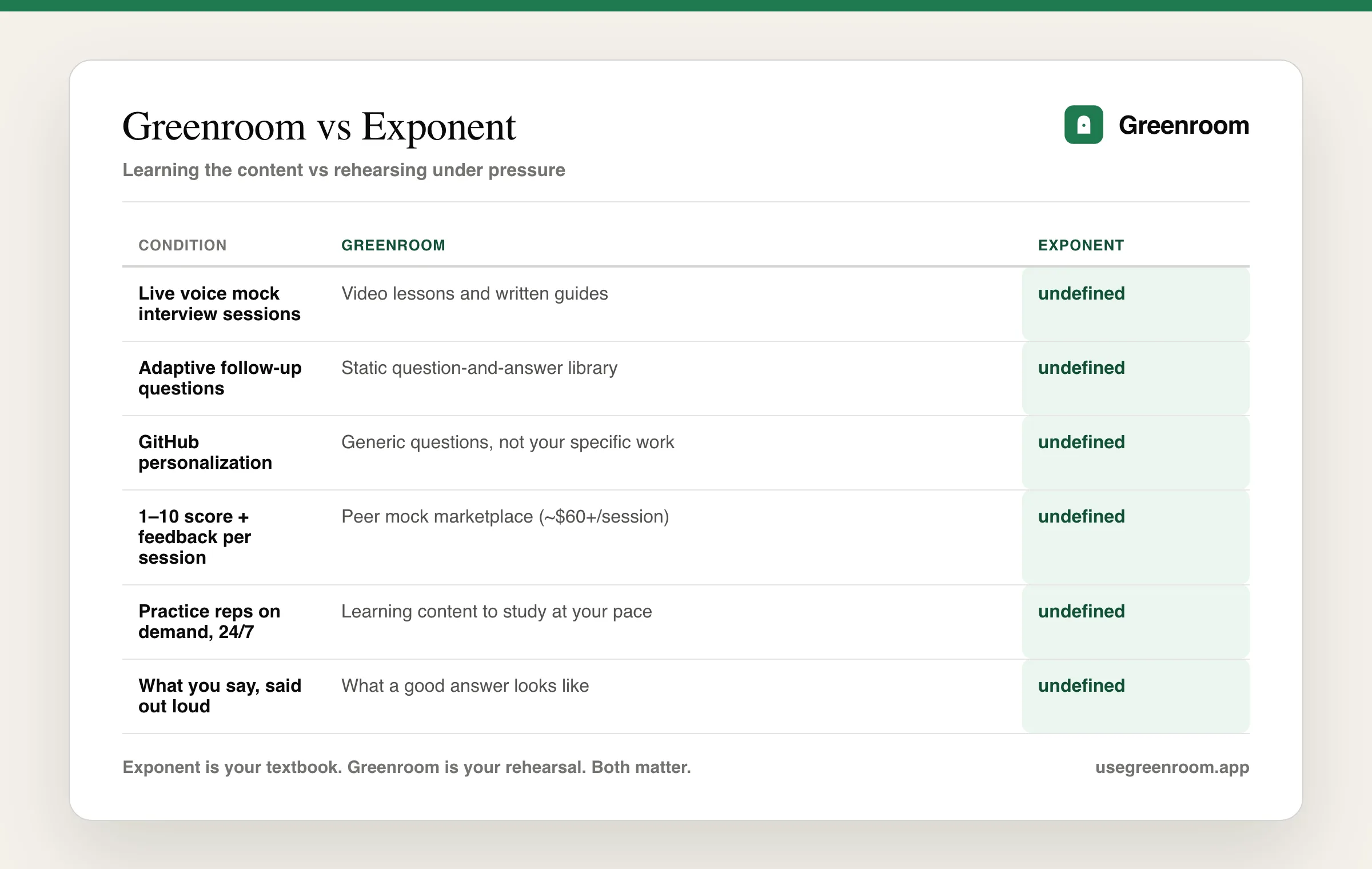
| Feature | Exponent | Greenroom |
|---|---|---|
| System design curriculum | Excellent — structured video course | None — practice-focused only |
| Live voice practice sessions | No | Yes — every session |
| Adaptive follow-up questions | No | Yes — based on your specific answer |
| GitHub-personalised sessions | No | Yes |
| Instant verbal delivery feedback | No | Yes — pace, filler words, structure |
| Answer scoring | No (qualitative from expert mocks) | Yes — 1–10 per session |
| Behavioral + HR rounds | Yes (written guides) | Yes — live voice practice |
| PM interview prep | Excellent | Basic |
| Expert human mocks | Yes ($60+/session) | No |
| Peer mocks | Yes (free) | No |
| On-demand availability | Yes (content) / Scheduled (mocks) | Yes — anytime, no scheduling |
| Pricing | ~$12–20/mo (content); $60+/session (expert) | Free tier; $10/mo Pro; $20/mo Premium; ₹149 India pass |
When Exponent wins
You're new to system design concepts. If you've never thought about CAP theorem, consistent hashing, or the difference between a message queue and a pub-sub system, you need to learn before you can practice. Exponent's curriculum gives you a structured map of the space. Don't skip this phase — practicing with concepts you don't yet understand just ingrains the wrong mental models faster.
You're preparing for PM interviews. Exponent's PM content — product sense, metrics, execution, root cause analysis — is genuinely strong and purpose-built for the PM interview format. Greenroom's voice practice is more engineering-interview-shaped.
You want video explanations, not just text. Some people learn distributed systems better by watching someone draw an architecture diagram and narrate trade-offs in real time. Exponent's video production is clean and well-paced; the visual medium matches the material particularly well for architecture topics.
You want occasional expert human feedback. A $60 Exponent expert session gives you something an AI genuinely cannot replicate: the intuition of someone who has run hundreds of interviews at a target company, a senior engineer's gut read on whether your answer felt confident rather than just correct, the experience of a genuine two-way technical conversation at senior level. If you can budget a few sessions, they're worth doing — particularly later in your prep cycle.
When Greenroom wins
You're one week out from your interview. With seven days left, you cannot finish a curriculum. What you need is reps — a high volume of spoken practice runs with immediate, specific feedback. Greenroom is purpose-built for exactly this. You can run three sessions in an evening and come out the other side knowing precisely which patterns you're stumbling on and why.
You need to fix verbal delivery, not just content. If you roughly know what to say but you say "um" thirty times per answer, or your structure falls apart under the first follow-up question, or you ramble for five minutes where ninety seconds was needed — those are delivery problems. Watching Exponent videos will not fix them. They are procedural, not declarative, and they only yield to practice. See how to think out loud in interviews for the technique; use Greenroom for the reps.
You want practice personalised to your background. A static curriculum treats every candidate as interchangeable. Ari knowing your GitHub means the session probes technical choices you've actually made, at a depth calibrated to your demonstrated experience. The follow-up questions feel like a real interview — which is exactly what they need to feel like before the real one.
You need volume that fits a budget. A monthly Greenroom subscription costs less than a single Exponent expert mock. If you need a dozen high-quality practice reps before your interview, the economics are not remotely comparable. Compare all the major AI interview coaching options to see how Greenroom sits in the wider landscape.
You want feedback on every single answer, not just the ones a human remembered to note. Greenroom's AI watches and scores your entire session — structure, pace, content, filler words — and surfaces the patterns across your answers. A human mock interviewer, however experienced, has finite attention and will not notice that you said "basically" twenty-two times in forty minutes. The AI catches everything.
The ideal prep stack
If you have three or more weeks before your interview, the optimal strategy is to use both tools — in sequence, not in parallel.
Weeks one and two: learn with Exponent. Work through the system design curriculum. Build mental models of the major patterns: caching layers, horizontal versus vertical scaling, eventual versus strong consistency, the role of a CDN, when to use a message queue. The goal at this stage is conceptual fluency, not performance fluency. Don't try to memorise solutions — try to understand why each design decision exists.
Weeks three and four: rehearse with Greenroom. Once you have the conceptual foundation, switch to daily voice sessions. Use the feedback report to identify your specific weaknesses — structural discipline, depth under follow-up, verbal clarity. Return to Exponent only to re-watch specific sections that match the gaps Greenroom flagged. The feedback loop between "session report" and "targeted re-learning" is tighter and more efficient than reviewing content at random.
Final week: full tilt on Greenroom. Daily sessions, increasing question difficulty, plus behavioral and HR rounds. Use the think-out-loud technique on every answer — narrate your reasoning process, not just your conclusions. The goal is to reach a state where your mouth can perform the answer your brain knows, automatically, even when you're nervous and the question is framed slightly differently than the version you practiced.
If you only have one week: skip the curriculum, go straight to Greenroom, run as many sessions as you can, and review the feedback between each one.
The underlying principle is borrowed from learning science: reading about a skill (declarative knowledge) and performing a skill under pressure (procedural knowledge) are different cognitive processes, and training one does not automatically transfer to the other. Exponent builds declarative knowledge. Greenroom builds procedural knowledge. You need both — sequenced correctly. For more on how AI practice compares to practicing with a real engineer, see AI mock vs real engineer mock and Greenroom vs interviewing.io.
Verdict
The mental model worth holding: watching an Exponent video of someone acing a system design interview is exactly as useful as watching a YouTube video of someone doing a pull-up. Necessary for understanding form. Completely insufficient for being able to do one under pressure, when it counts.
If you're learning system design from scratch, start with Exponent and finish the curriculum before you practice. If you are one to four weeks from your interview and you need spoken practice with structured, immediate feedback, start with Greenroom today — your first session is free.
Frequently asked questions
What is Exponent used for in interview prep?
Exponent is a content-focused platform used primarily to learn system design concepts, PM interview frameworks, and behavioral question structures. It offers structured video lessons, written guides, and a marketplace for peer and expert mock interviews. It is strongest in the learning phase of preparation — building conceptual foundations before you practice performance under pressure.
What is the difference between Exponent and Greenroom?
Exponent is a learning platform; Greenroom is a practice platform. Exponent teaches you what good answers look like through video lessons and structured guides. Greenroom makes you say those answers out loud in live voice sessions with an AI interviewer that asks adaptive follow-up questions and gives structured feedback on delivery, structure, and content. They solve adjacent problems and are most effective when used together.
Is Exponent worth it for software engineering interviews?
Yes, particularly for system design. Exponent's distributed systems curriculum is among the best available for building conceptual understanding — CAP theorem, consistent hashing, database trade-offs, message queue patterns. The caveat is that learning the concepts is not the same as being able to perform them under pressure. Exponent gets you to the knowing stage; Greenroom's voice practice gets you to the doing stage.
Does Greenroom cover system design interview practice?
Yes. Ari, Greenroom's AI interviewer, conducts live voice-based system design sessions, asks adaptive follow-up questions based on your specific answer, reads your GitHub to personalise the session, and gives a 1–10 score plus structured feedback on answer structure, depth, and verbal delivery. Greenroom does not teach system design concepts — that is a curriculum's job. Use a learning resource like Exponent first, then practice the performance with Greenroom.
Which is better for last-minute interview prep: Exponent or Greenroom?
Greenroom, unambiguously. If you have one week or less before your interview, the highest-leverage activity is volume of spoken practice reps with feedback — not more content consumption. Run Greenroom sessions daily, review each feedback report, and iterate on the specific weaknesses it surfaces. Watching more videos in the final week is largely wasted time if you cannot yet produce the answer out loud under pressure.
Can I use both Exponent and Greenroom together?
Yes, and this is the recommended approach if you have three or more weeks. Use Exponent to build conceptual foundations (weeks one and two), then switch to Greenroom for daily voice practice (weeks three onward). The feedback reports will surface specific knowledge gaps you can then revisit in Exponent's curriculum. The two tools are genuinely complementary — one is your textbook, the other is your rehearsal.