He had four years of React, a design system he had built himself, and a portfolio that made recruiters email him first. In round two, Google asked him to find the shortest transformation sequence between two words. He said, honestly, "Sorry — is this a frontend interview?" It was. It was also a Google interview, and at Google those two facts do not cancel each other out.
That is the single most useful thing to know about Google frontend interview questions: Google hires software engineers who happen to work on the web, so the coding rounds look like everyone else's coding rounds. The frontend specialisation shows up in one design round and in the follow-ups, not in a reduced algorithm bar. I built Greenroom after freezing in an interview I had prepared hard for, so this guide covers what Google actually asks a frontend candidate and how to reason through it aloud.
The Google frontend engineer interview process in 2026
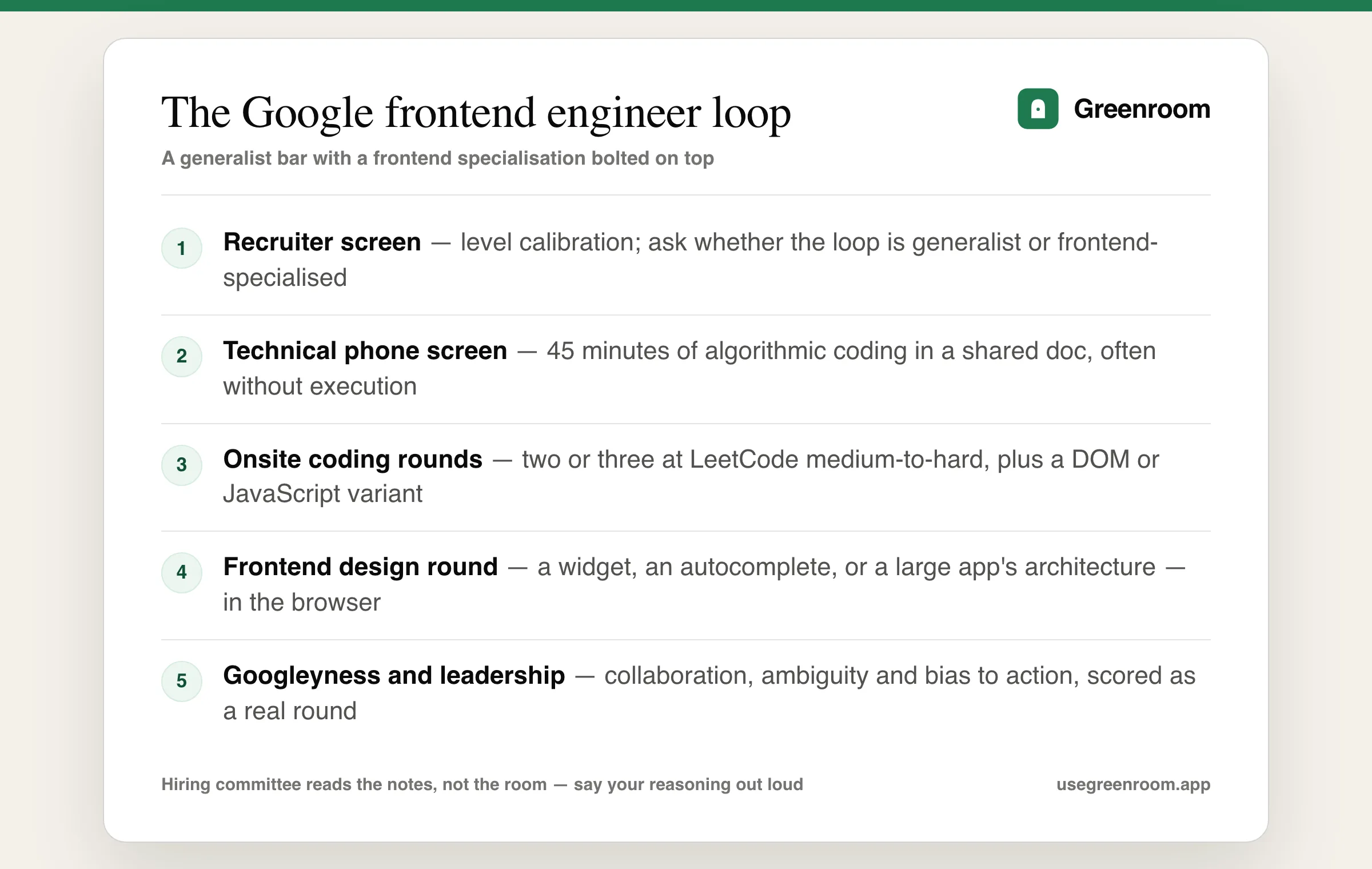
- Recruiter screen — level calibration and logistics. Ask directly whether your loop is generalist or frontend-specialised; it changes the ratio of algorithms to web questions.
- Technical phone screen — about 45 minutes of algorithmic coding, frequently in a shared document with no execution.
- Onsite (virtual) — usually four or five rounds: two or three coding, one frontend design, and one Googleyness and leadership round.
- Hiring committee — a packet of written feedback reviewed by people who never met you. This is why narrating your reasoning matters more here than almost anywhere else.
- Team matching and offer review — separate stages after the committee, and often the slowest part of the timeline.
Our Google interview preparation guide covers the company-wide loop and the Google backend engineer guide covers the server-side variant of the same rounds.
The coding rounds are algorithm rounds
Do not let anyone tell you otherwise. Google's frontend loop uses the same problem pool as the generalist loop, with occasional DOM-flavoured variants. The list worth owning: graphs and BFS/DFS, dynamic programming at a basic-to-medium level, binary search including binary search on the answer, heaps, intervals, tries, and string manipulation.
Two Google-specific habits. First, you are often typing in a document with no autocomplete and no compiler — so write slowly, correctly, and trace an example by hand at the end. Second, Google interviewers care unusually much about the analysis: state the time and space complexity unprompted, and say why the first idea was not good enough before you improve it.
The DOM-flavoured variants that show up in frontend loops are worth practising specifically — a virtual DOM diff, an LRU cache backing an image loader, a scheduler that batches work across frames:
// batching work across frames without blocking paint — a common Google follow-up
function runInChunks(items, work) {
  let i = 0;
  function frame(deadline) {
    // keep going only while the browser says there is idle time left
    while (i < items.length && deadline.timeRemaining() > 1) work(items[i++]);
    if (i < items.length) requestIdleCallback(frame);
  }
  requestIdleCallback(frame);
}
Then say the sentence that earns the point: "this trades total throughput for a responsive main thread — I would only do it for work the user is not waiting on." Our DSA coding interview preparation guide covers the problem list and big O notation questions covers the analysis vocabulary.
Web fundamentals Google actually probes
The frontend-specific depth surfaces as follow-ups, and it is browser fundamentals rather than framework trivia:
- The rendering pipeline — style, layout, paint, composite, and which CSS properties skip layout entirely. Knowing that
transformandopacitycan be composited is the baseline; explaining why is the answer. - The critical rendering path — what blocks first paint, what
deferandasyncchange, and why a font can hold your text hostage. - The event loop — tasks, microtasks, rendering opportunities, and why a 200ms synchronous loop drops every frame in that window.
- Caching and networking — HTTP caching headers, what a service worker changes, and the honest cost of a stale-while-revalidate strategy.
- Core Web Vitals — LCP, CLS and INP, what causes each, and how you would actually fix a regression rather than describe one. MDN and web.dev are the reference sources here, and Google's interviewers know them.
- CSS at scale — specificity, stacking contexts, containment, and why a layout thrashes when you read a layout property in a loop.
- Accessibility — semantics before ARIA, focus management, and keyboard traversal. See our HTML and CSS interview questions guide.
The frontend design round
The prompt is usually a widget or a surface rather than a distributed system: build an autocomplete, a photo gallery, an infinite feed, a collaborative editor's presence indicator, or "design the frontend architecture for a Google-sized app."
Structure that works: clarify the product and the constraints, sketch the component boundaries and where state lives, then talk data — fetching, caching, invalidation — and only then talk performance and accessibility. Finish with instrumentation.
The autocomplete prompt is worth rehearsing until it is boring: debounce input, cancel in-flight requests with AbortController, cache results per prefix, handle out-of-order responses by tagging requests, render a listbox with correct aria-activedescendant and full keyboard support, and degrade gracefully when the network is slow. That single answer touches five of the categories above. The Google frontend engineer prep page has a round-by-round checklist.
The Googleyness and leadership round
This is a scored round, not small talk. It covers collaboration, comfort with ambiguity, bias to action, and how you behave when you are wrong or when the requirements are not written down anywhere.
Bring four or five stories with real detail: a disagreement you resolved with data, a project where the requirements changed underneath you, a time you took action without a clear owner, a mistake you owned publicly, and a time you changed your mind. Rehearse each out loud to two follow-ups deep. Our behavioral interview questions guide and how do you handle criticism guide cover the shapes that recur.
LeetCode, GreatFrontEnd, ChatGPT — where each fits
- LeetCode — non-negotiable here, at medium climbing to hard, Google-tagged. This is the round that most often ends frontend candidates.
- GreatFrontEnd and JavaScript.info — the right depth for the DOM-flavoured variants and the fundamentals follow-ups.
- MDN and web.dev — the sources Google's own interviewers reference for rendering, caching and Core Web Vitals. Reading the Core Web Vitals docs before the design round is a high-yield hour.
- ChatGPT — good for generating problems and for critiquing a written design. It will not notice that you have been silent for four minutes, which is the actual failure mode in a Google coding round.
- Greenroom — the spoken layer. Ari, the AI interviewer runs the round out loud, asks the follow-up, and scores whether your reasoning was audible. Honest tradeoff: Ari will not grade your algorithm's correctness line by line, so pair it with LeetCode.
How to prepare for the Google frontend interview
- Week 1-2 — Google-tagged LeetCode mediums, written in a plain text editor with no autocomplete, complexity stated aloud every time.
- Week 3 — browser fundamentals: rendering pipeline, critical rendering path, event loop, HTTP caching, Core Web Vitals. Explain each in ninety seconds without notes.
- Week 4 — design an autocomplete, a gallery and an infinite feed out loud, constraints first, then build one of them and measure it.
- Final week — five Googleyness stories rehearsed to two follow-ups deep, two full spoken mocks, and the role-specific prep page the night before. Nothing new in the last 48 hours.
Interviewing across comparable loops? The Meta frontend engineer guide covers a feed-heavy design round, the Uber frontend engineer guide covers real-time UI, and the Microsoft interview preparation guide covers a gentler but broader bar.
Frequently asked questions
What is the Google frontend engineer interview process?
Candidates report a recruiter screen, a technical phone screen of about 45 minutes of algorithmic coding, and a virtual onsite of four to five rounds — two or three coding rounds, a frontend design round, and a Googleyness and leadership round. A hiring committee then reviews written feedback from people who never met you, followed by team matching and offer review, which is often the slowest stage.
Does Google ask frontend engineers algorithm questions?
Yes, and this is the most common surprise. Google hires software engineers who work on the web, so the coding rounds draw from the same pool as the generalist loop — graphs, dynamic programming, binary search, heaps, intervals and tries — with occasional DOM-flavoured variants such as a virtual DOM diff or an LRU cache. The frontend specialisation shows up mainly in one design round and in follow-up questions, not in a lower algorithm bar.
What web fundamentals does Google ask frontend candidates?
Browser mechanics rather than framework trivia: the rendering pipeline and which CSS properties skip layout, the critical rendering path and what defer and async change, the event loop and why a long synchronous task drops frames, HTTP caching and service workers, Core Web Vitals including what causes LCP, CLS and INP regressions and how you would fix one, CSS specificity and stacking contexts, and accessibility starting from semantics rather than ARIA.
What is the Google frontend design round?
It is a browser-scoped design round: build an autocomplete, a photo gallery, an infinite feed, or the frontend architecture for a very large app. Clarify constraints, then define component boundaries and where state lives, then data fetching, caching and invalidation, then performance and accessibility, and finish with instrumentation. The autocomplete answer alone should cover debouncing, request cancellation, per-prefix caching, out-of-order responses, and full keyboard and screen-reader support.
What is the Googleyness and leadership round?
It is a scored behavioral round covering collaboration, comfort with ambiguity, bias to action, and how you behave when you are wrong. Prepare four or five specific stories — a disagreement resolved with data, a project whose requirements shifted, action taken without a clear owner, a mistake you owned publicly, and a time you changed your mind — and rehearse each out loud to two follow-ups deep.
How hard is the Google frontend interview compared to other companies?
The algorithm bar is higher than at most frontend-specialised loops, which is where frontend candidates typically fall short, while the frontend design round is narrower in scope than a full distributed-systems round. Because a hiring committee reads only the written notes, candidates who solve problems silently often score worse than candidates who narrate a slightly weaker solution clearly.