He had read four Apple interview experiences the night before. Two said the loop was heavy on operating systems internals, one said it was mostly design, one said the whole thing was C. All four were accurate. They were also four different teams, and he was interviewing with a fifth.
That is the single most important thing about Apple backend interview questions: Apple does not run one hiring process, it runs many. Teams own their loops, so the same job title can mean a systems-heavy interview in one org and a services-and-design interview in another. The general shape is consistent — deep fundamentals, real questions about the thing the team actually builds, and a design conversation that starts from constraints rather than components — but the emphasis is not. I built Greenroom after freezing in an interview I had prepared hard for, so this guide covers what is consistent and how to find out the rest.
The Apple backend engineer interview process in 2026
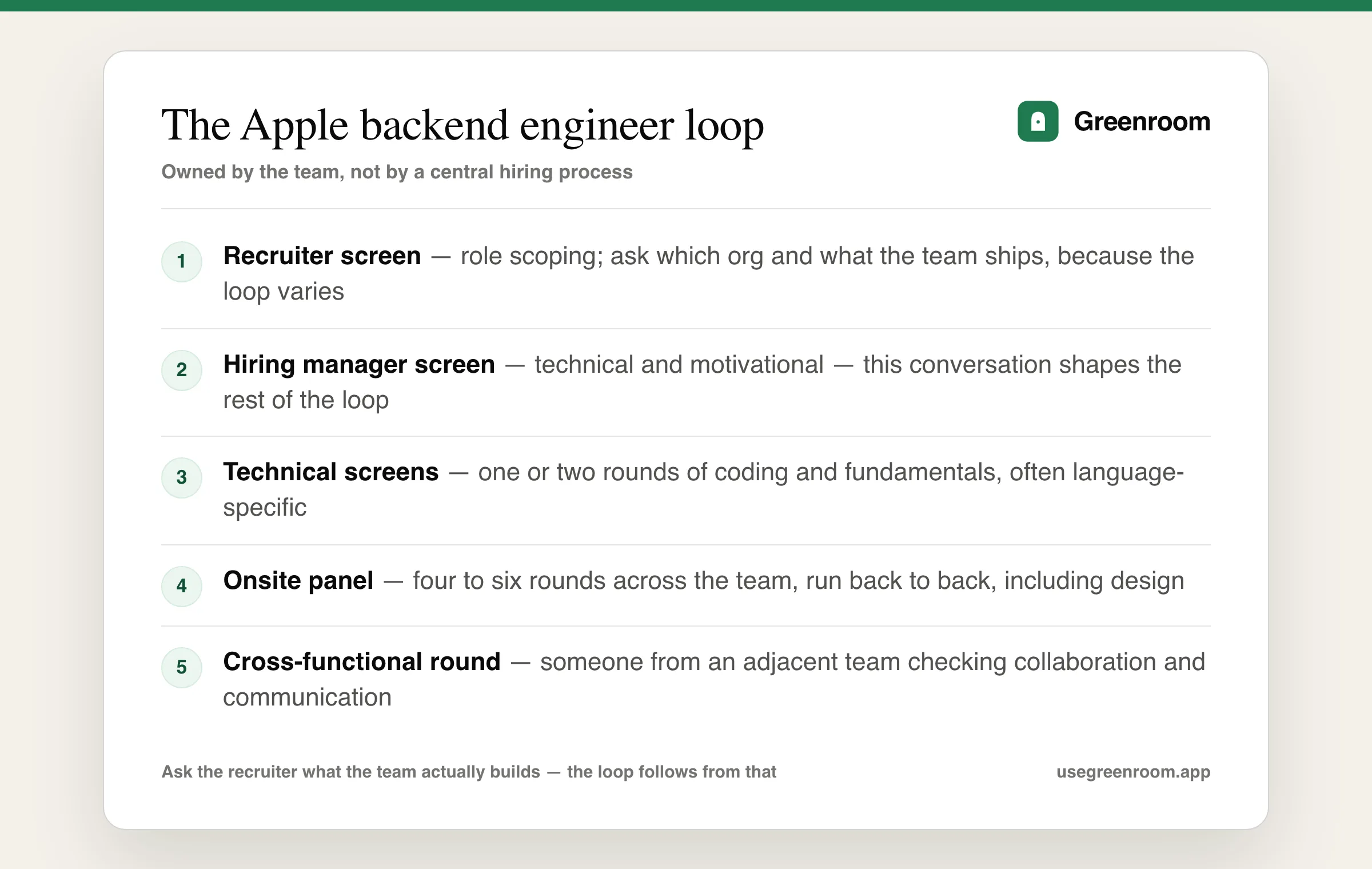
- Recruiter screen — the most useful conversation in the loop. Ask which org, what the team ships, and what the interviews will emphasise. Recruiters usually answer.
- Hiring manager screen — technical and motivational. At Apple this conversation genuinely shapes the rest of the process.
- Technical screens — one or two rounds of coding and fundamentals, often anchored to the team's language: Swift, Objective-C, Java, Go or C++ depending on the org.
- Onsite panel — typically four to six rounds run back to back with different members of the team, including at least one design round.
- Cross-functional round — someone from an adjacent team checking how you communicate outside your own group.
Our Apple interview preparation guide covers the company-wide patterns and the Apple data engineer guide covers the data-platform variant.
The coding rounds: fundamentals over puzzle volume
Apple's coding questions sit around LeetCode medium and lean towards data structures, strings, trees and graphs, but the follow-ups head towards mechanism rather than towards a harder problem.
Expect: what does this allocate, what is the memory profile, is this thread-safe, what happens under concurrency, how would you test it. Systems-adjacent teams will push into caching behaviour, memory layout and where the time actually goes.
# LRU cache: an Apple staple, because the follow-ups are all about mechanism
from collections import OrderedDict

class LRU:
    def __init__(self, cap):
        self.cap = cap
        self.d = OrderedDict()

    def get(self, k):
        if k not in self.d:
            return -1
        self.d.move_to_end(k)          # O(1) — recency is the ordering, not a scan
        return self.d[k]

    def put(self, k, v):
        if k in self.d:
            self.d.move_to_end(k)
        self.d[k] = v
        if len(self.d) > self.cap:
            self.d.popitem(last=False)  # evict the least recently used end
Then answer the follow-up before it arrives: "this is not thread-safe — concurrent get calls mutate the ordering, so I would either guard it with a lock or shard the cache by key hash to reduce contention." Our backend developer interview questions guide covers the wider fundamentals and our DSA coding interview preparation guide covers the problem list.
System design at Apple: constraints first, privacy included
Apple's design prompts are usually anchored to something the team owns — a sync service, a push notification path, a device-facing API, a media pipeline, a billing or entitlement system.
- Start from constraints, not components. Device diversity, offline behaviour, battery, network variability, and the fact that clients you cannot force-update stay in the wild for years.
- Privacy as a design input. This is genuinely distinctive at Apple. Expect to discuss what data you do not collect, on-device versus server-side processing, and how a feature works when the server is not allowed to see the content. Answering a design question with "we would log every event" reads badly here in a way it does not elsewhere.
- Backwards compatibility. Old OS versions, old app versions, and a protocol that must not break either. Say how a schema change rolls out safely.
- Sync and conflict resolution. Multi-device sync is the most Apple-shaped design problem there is: eventual consistency, conflict resolution strategy, and what the user sees when two devices disagree.
- Failure and degradation. What the feature does offline, and what it does when a dependency is slow rather than down.
- Scale with real numbers. Hundreds of millions of devices, and traffic spikes that follow an OS release rather than a shopping event.
- Operations. What you monitor, and how you diagnose a problem you cannot reproduce because it only happens on one device model in one region.
Our distributed systems interview questions guide covers the failure vocabulary and the Apple backend engineer prep page has a round-by-round checklist.
Fundamentals that recur across Apple teams
- Concurrency — threads, locks, deadlock, and lock-free approaches at a conceptual level. Asked more at Apple than at most product companies.
- Memory — allocation, reference counting versus tracing garbage collection, and where retain cycles come from if the team touches Apple platforms.
- Networking — connection lifecycle, TLS at a working level, timeouts, retries with backoff and jitter.
- Databases — indexes, transactions and isolation, plus the on-device storage story if the team ships client code. See our DBMS interview questions guide.
- Operating systems — processes and threads, scheduling, virtual memory. Systems teams go deep here; product teams less so. Our operating system interview questions guide covers it.
The behavioral thread and the cross-functional round
Apple's behavioral questions are less scripted than Amazon's and more conversational. Recurring shapes: a hard technical decision and its tradeoffs, a time you disagreed with a designer or a peer team, how you handled ambiguity, and what you have shipped that you are proud of and why.
The cross-functional round is specifically checking whether you can explain your work to someone who is not on your team. Practise explaining your most technical project in three minutes with no jargon. Our how to explain your project in an interview guide covers exactly this.
There is one more Apple-specific answer to prepare honestly: why Apple. Generic admiration for the products falls flat. A specific reason tied to the team's actual work does not.
LeetCode, DDIA, ChatGPT — where each fits
- LeetCode — medium range, but always continue past the solution into memory, concurrency and testing follow-ups.
- Designing Data-Intensive Applications — the best preparation for the sync, consistency and conflict-resolution conversations.
- Apple's own developer documentation and platform security guide — the security guide in particular tells you how Apple thinks about privacy in system design, which is the hardest part to guess.
- Talking to the recruiter — genuinely the highest-yield preparation step at Apple, because it tells you which of the above to weight.
- ChatGPT — useful for generating follow-ups on a solved problem. It cannot tell you what the specific team asks, and at Apple that is most of the variance.
- Greenroom — the spoken layer. Ari, the AI interviewer runs the design round out loud and scores structure and clarity, including the no-jargon explanation the cross-functional round wants. Honest tradeoff: Ari will not know your team's internals either, so use the recruiter for that.
How to prepare for the Apple backend interview
- Week 1 — LeetCode mediums, each finished with four follow-ups spoken aloud: allocation, thread safety, testing, failure in production.
- Week 2 — fundamentals depth in whichever direction the recruiter pointed you: concurrency and memory for systems teams, storage and APIs for services teams.
- Week 3 — design a multi-device sync feature, a push notification path and a device-facing API out loud, with privacy, offline behaviour and backwards compatibility in every one.
- Final week — a three-minute jargon-free explanation of your best project, a specific and honest answer to "why Apple", two full spoken mocks, and the role-specific prep page the night before.
Interviewing across comparable loops? The Microsoft backend engineer guide covers a similarly broad bar, the Meta backend engineer guide covers scale-first design, and the Google backend engineer guide covers a harder algorithm bar.
For the client side of the same teams, see our Apple frontend interview questions guide.
Frequently asked questions
What is the Apple backend engineer interview process?
Candidates report a recruiter screen, a hiring manager screen that is both technical and motivational, one or two technical screens, and an onsite panel of roughly four to six rounds run back to back with members of the team, usually including a design round and a cross-functional round with someone from an adjacent group. The exact shape varies more than at other large companies because teams own their own loops.
Why do Apple interview experiences differ so much?
Because Apple does not run a single centralised hiring process — individual teams design their own loops. The same backend job title can mean an operating-systems-heavy interview in one org and a services and design interview in another, which is why online interview experiences appear to contradict each other while all being accurate. Asking the recruiter which org the role sits in and what the team ships is the highest-yield preparation step.
What system design questions does Apple ask backend engineers?
Prompts are anchored to what the team owns: a multi-device sync service, a push notification path, a device-facing API, a media pipeline or an entitlement system. Strong answers start from constraints rather than components — device diversity, offline behaviour, battery, clients you cannot force-update — and treat privacy as a design input, covering what data you deliberately do not collect and what happens on-device versus on the server.
How does privacy come up in Apple system design interviews?
It appears as a real constraint rather than a compliance footnote. You may be asked how a feature works when the server is not permitted to see the content, when processing should happen on-device rather than in the cloud, and what the minimum data collection is that still makes the feature work. Answering a design prompt by proposing to log every user event tends to read badly at Apple in a way it would not elsewhere.
What coding questions does Apple ask backend engineers?
Problems sit around LeetCode medium and favour data structures, strings, trees and graphs, with an LRU cache or similar mechanism-heavy question appearing often. The differentiation is in the follow-ups: what does this allocate, what is the memory profile, is it thread-safe, what happens under concurrency and how would you test it, so practise finishing every problem by volunteering those answers.
How should you answer why Apple in an interview?
Tie the answer to the specific team's work rather than to the products in general. Generic admiration for the hardware or the brand is the most common answer and carries no signal, whereas a concrete reason connected to what that org builds — and to something you have actually done or want to do — is treated as evidence that you researched the role rather than the logo.