Most Indian engineers treat their GitHub profile as a resume decoration. A few tutorial clones, some incomplete projects, a green contribution graph from a month of activity three years ago. Then they walk into a product company interview and get asked "Tell me about a project you built from scratch" — and freeze.
A strong portfolio for software engineer interview is not about having impressive projects. It is about having projects you can talk about deeply — the decisions you made, the trade-offs you accepted, the things you got wrong and fixed. This guide shows you how to build that, and more importantly, how to present it when it matters.
What product company interviewers actually look for in GitHub
When an interviewer opens your GitHub before or during an interview, here is what they look for in the first 60 seconds:
- Pinned repositories — Are they real projects or tutorial completions?
- README quality — Does it explain what the project does, why it exists, and how to run it?
- Commit history — Is there meaningful development history, or one giant initial commit?
- Code quality — Is the code readable? Are there at least basic naming conventions?
- Evidence of independent thinking — Did you make architectural decisions, or copy a tutorial structure?
For github projects for interview india preparation, you do not need 20 repositories. You need 2 to 3 that you can defend completely. Depth beats breadth every time.
What makes a good interview project
The projects that impress interviewers share these characteristics:
You made real decisions
You chose PostgreSQL over MongoDB (and can explain why). You chose a REST API over GraphQL. You used a job queue instead of synchronous processing. These choices, and your ability to articulate them, are what differentiate your project from a tutorial clone.
Something broke and you fixed it
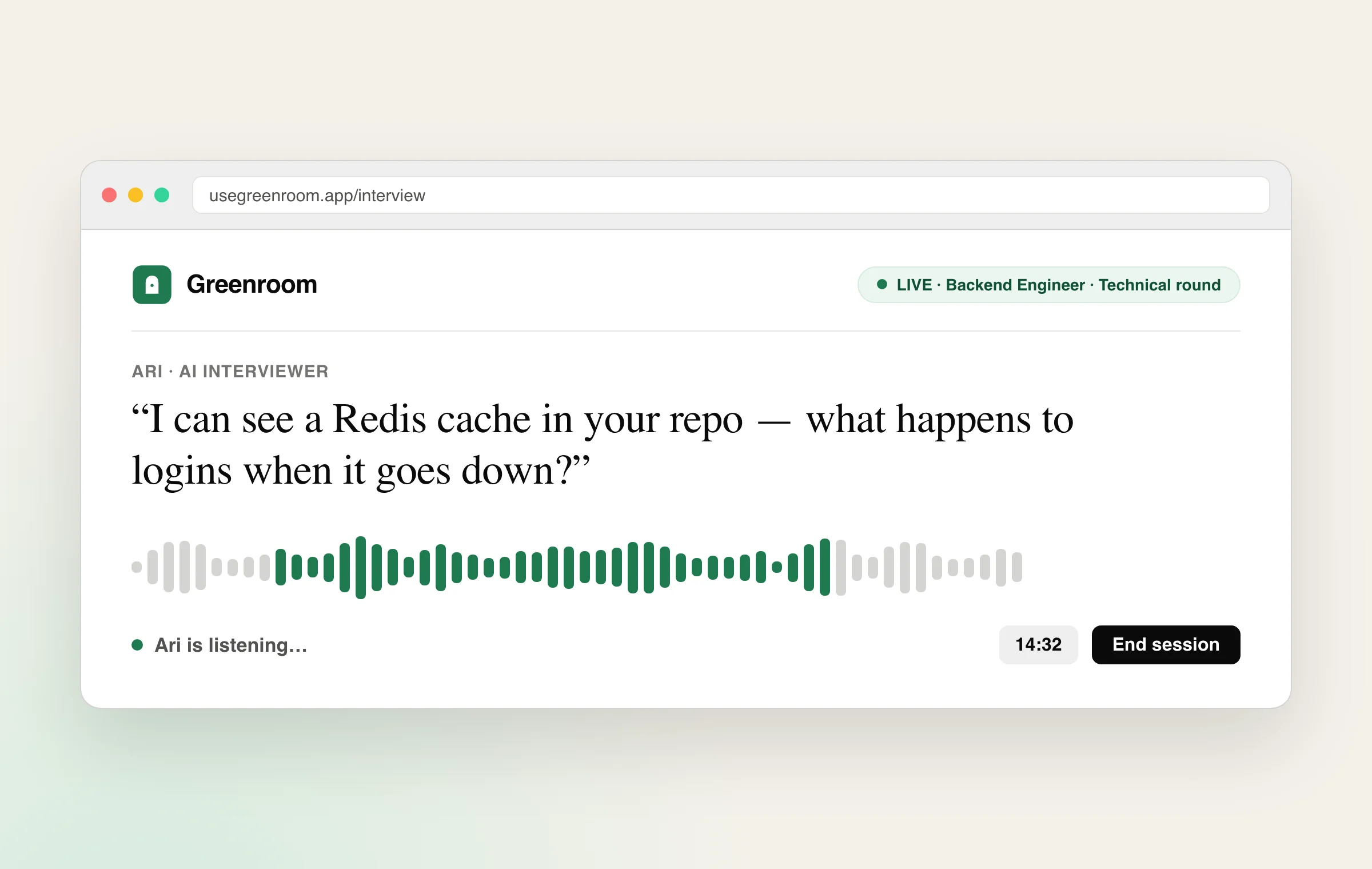
Projects without problems are projects that were not pushed hard enough. "I initially stored sessions in memory, which broke when I deployed to two servers. I moved to Redis-backed sessions to fix the statefulness issue" is an excellent interview answer. It shows real engineering thinking.
You know its limitations
"What would break at 10x traffic?" If your answer is "I don't know," that is a problem. If your answer is "My database would hit connection limits, and I'd solve that with a connection pool and read replicas," that is impressive — even for a personal project.
Project ideas that work well for Indian product company interviews
For github projects for interview india, these are consistently strong choices because they involve real engineering decisions:
- URL shortener with analytics — database design, redirect logic, basic analytics pipeline, rate limiting
- Job/task queue — asynchronous processing, worker pool, retry logic, dead letter queue
- Expense tracker with multi-user support — auth, data modeling, permissions, API design
- Webhook delivery service — reliability guarantees, retry with backoff, event log
- CLI tool that solves a real problem — argument parsing, file I/O, error handling, documentation
None of these need to be large. A URL shortener with 500 lines of well-written code is more impressive than a social network clone with 5,000 lines of copied tutorial code.
How to explain your projects in interviews
The skill of how to explain projects in interview is separate from the skill of building the project. Many engineers build good things and explain them badly. Use this structure:
The 90-second project overview
"I built [project name] to solve [specific problem]. It uses [stack] because [reason]. The most interesting technical challenge was [specific challenge] and I solved it by [specific solution]. If I were to improve it, I would [concrete next step]."
Practice this until you can deliver it without hesitation. Then the interviewer will almost certainly ask a follow-up, and you go deeper from there.
Answering "Why did you choose X?"
Never say "Because I knew it" or "Because it's popular." Always have a trade-off answer: "I chose PostgreSQL because my data has clear relationships and I needed transactions. If I were building at larger scale I might look at a document store for the user preference data specifically, since that's more flexible schema." Show that you considered alternatives even if you went with the simpler choice.
GitHub profile hygiene — the basics that many skip
- Profile README: Add a GitHub profile README (create a repo with your username). 3–4 sentences about what you build and what you are interested in.
- Pin your best repos: 4–6 pinned repositories. Remove anything you would not want an interviewer to click.
- Write READMEs: Every project should have: what it does, why you built it, how to run it locally, known limitations. This takes 30 minutes per project.
- Clean commit messages: "fix bug" is not a commit message. "Fix session expiry not propagating to Redis on logout" is. Future you and future interviewers both appreciate this.
Frequently asked questions
What kind of GitHub projects impress interviewers?
Projects that solve a real problem and show engineering judgment: a clear README, sensible commits, tests, and one or two non-obvious technical decisions you can defend. One deep, deployed project beats ten tutorial clones.
How many projects should I have on GitHub for interviews?
Two or three you know deeply. Interviewers probe depth — architecture, trade-offs, what broke — and a thin project you can't defend hurts more than an empty profile.
How do I explain my GitHub project in an interview?
Use a tight arc: what it does and for whom, the key technical decision, the trade-off you accepted, what broke and how you fixed it, and what you'd do differently. Rehearse it out loud — Greenroom literally reads your repos and interviews you on them.
Do interviewers at Indian product companies actually check GitHub?
Often, yes — especially for freshers and early-career engineers where there's little work history to probe. Even when they don't open it, "walk me through your project" is near-guaranteed, and that's your GitHub knowledge being tested.