He signed it on day one, in a room with two hundred other trainees, in a stack of papers handed over during an induction that also covered the cafeteria timings and the dress code. Twenty-two years old, first job, and a clause committing him to two years or ₹2 lakh. Nobody read it. Reading it was not really on offer.
Fourteen months later he had an offer from a product company and a genuine problem, and he did what everyone does: he searched at one in the morning and found four hundred strangers arguing with total confidence about whether training bonds are legally enforceable in India.
That argument is not useless. It is simply not the one that determines what happens to him. The practical power of a training bond is rarely litigation — it is that your employer controls the relieving letter, and your next employer's background verification wants to see it. The leverage is paperwork, not law.
Once you relocate the question from "can they sue me" to "what documents do I leave with", almost every decision here gets clearer.
What you actually signed
A service agreement or training bond commits you to remain for a defined period, typically one to three years, in exchange for training the company says it invested in. If you leave early, the agreement specifies an amount payable.
They are most common at large service companies hiring freshers in volume, and they appear elsewhere too — roles with expensive certification, sponsored higher education, and some overseas deputations.
The two things worth knowing about the document itself:
- How the amount was arrived at matters. Indian courts have generally distinguished between a genuine attempt to recover demonstrable, actual costs and a flat figure applied uniformly as a deterrent. That distinction is why enforceability is not a single yes or no, and why blanket internet answers are unreliable.
- The clause you care about may not be the money clause. Look for what the agreement says about issuing your relieving and experience letters, and about withholding full and final settlement.
None of this is legal advice, and the details genuinely matter. Agreements vary, and so do employers. If a meaningful amount is at stake, an hour with a lawyer who reads your actual document is worth considerably more than any article, this one included.
The two questions, separated
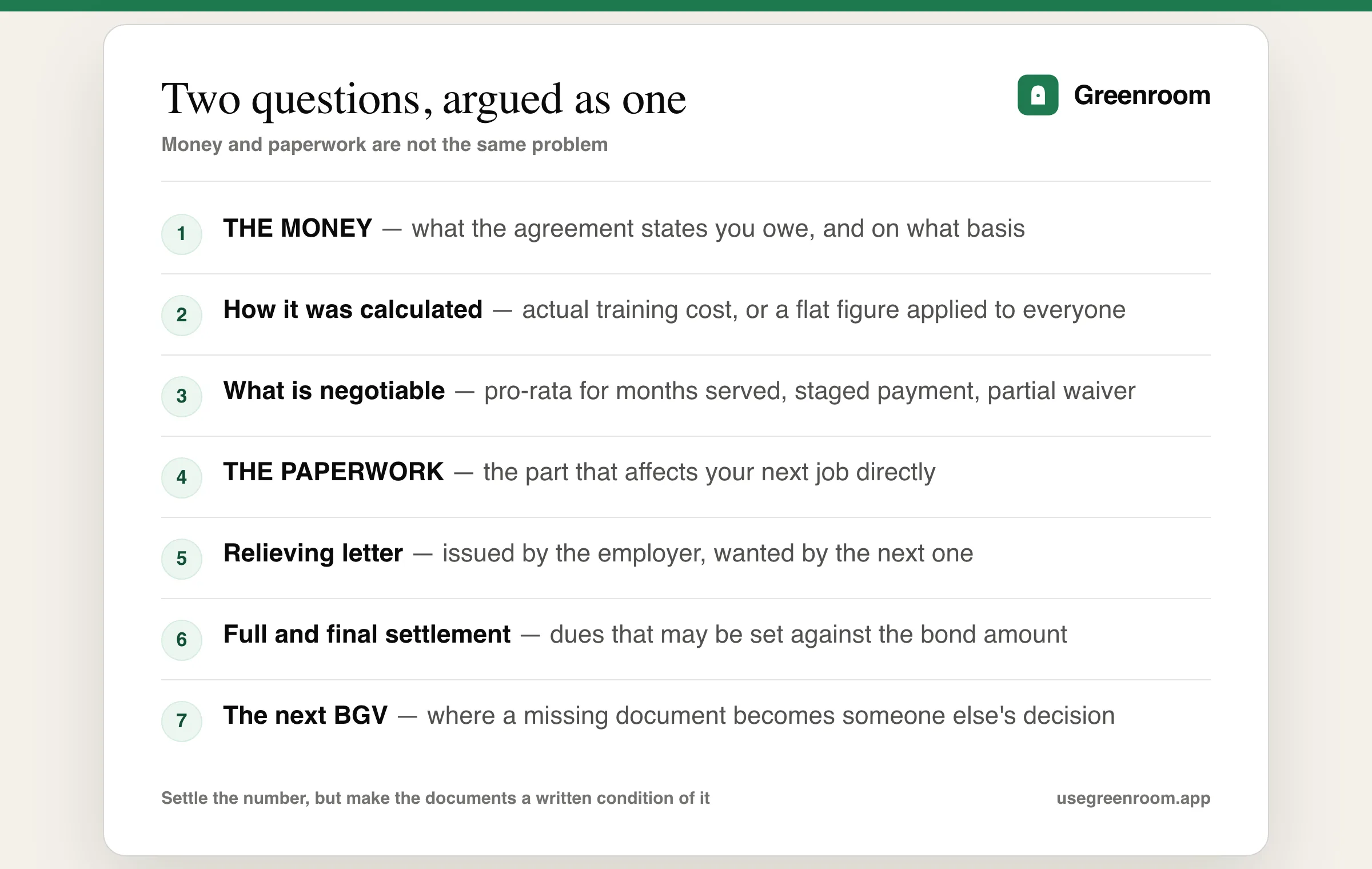
The money question. What does the agreement say you owe, how was it calculated, and what is negotiable? Almost always something is — pro-rata reduction for months already served is the most common concession, followed by staged payment.
The paperwork question. Who issues your relieving letter and your experience letter, will your full and final settlement be released, and what will your next employer's verification ask for? Our background verification in India guide covers what those checks examine, and why the relieving letter carries the weight it does here.
People spend their energy on the first question because it has a number attached. The second question is the one that shapes their next six months.
Why "just leave, they never sue" is bad advice
It is often true that companies do not pursue individuals through the courts for these amounts — the cost and time rarely justify it at that scale. It is also close to irrelevant, because litigation is not the mechanism that hurts you.
What can actually happen if you walk out mid-agreement:
- No relieving letter, which a great many Indian employers ask for as a condition of joining.
- Full and final settlement withheld, sometimes set against the claimed bond amount.
- An unfavourable exit record at the former employer, which can surface in verification.
- A gap in your documented history that your next employer's BGV cannot close.
Our how to resign professionally guide covers collecting documents on the way out, which is disproportionately important in India precisely because of this.
How to exit well
- Read the agreement properly, now. Find the period, the amount, the calculation basis, the notice terms, and every reference to documents and settlement.
- Check your dates. Bonds are frequently pro-rata in practice even when the document reads as a flat figure. Fourteen months into twenty-four is a materially different negotiation from four months in.
- Ask, in writing, what the actual payable amount is. Getting HR to state a figure converts an intimidating clause into a specific, negotiable number.
- Negotiate the things that are cheap for them. A reduced amount, instalments, serving a longer notice in lieu of part of it, or a waiver in exchange for a clean handover. Our notice period negotiation guide covers the adjacent conversation.
- Ask your new employer whether they will help. Some product companies and startups will reimburse a bond buyout, particularly for candidates they want. It is a normal request and worth making before you have accepted.
- Whatever you agree, get it in writing — the amount, the date of payment, and explicitly that the relieving and experience letters will be issued on settlement. This single sentence is the one to insist on.
- Keep every document. Offer letter, the agreement, payslips, resignation acknowledgement, settlement receipt, relieving letter.
If documents are being withheld
If you have paid or settled and the letters are not forthcoming, escalate in writing and keep a record: your manager, then HR, then whatever grievance or ombudsman channel the company has. Written requests create the trail that matters later.
Where a dispute is genuine and the amount is significant, that is the point to take proper advice rather than internet consensus. Options exist, and which are appropriate depends on facts this article cannot see.
If you end up joining somewhere without a relieving letter, tell your new employer before their verification does. Explain the situation factually — the bond, the dispute, what you paid and when. Candour ahead of a check lands very differently from a discrepancy found during one, which is the same principle covered in our job reference checks guide.
Before you sign one
If you are reading this holding an offer rather than a resignation:
- A bond is not automatically a bad offer. For freshers with limited alternatives, a role with real training attached is frequently worth it.
- Ask what the amount is based on, and whether it reduces pro-rata over the period. Ask before joining, when you have the most leverage you will ever have.
- Ask when the relieving letter is issued on early exit with the amount settled. Getting that in email is nearly free at offer stage and expensive later.
- Weigh the lock-in against the market. Two years is a long time in a market that moves as fast as this one; our service to product company switch guide covers what people typically want to do next.
Where the usual advice comes up short
"Bonds are illegal in India, ignore them." Overstated, unreliable as a blanket claim, and it ignores the document problem entirely. Acting on it can cost you a relieving letter.
"You must pay whatever they ask." Also wrong. The amount is frequently negotiable and the basis for it is a fair question to ask.
Reddit and Quora threads. Genuinely useful for how specific employers have behaved in practice, which is real information. No substitute for your own agreement.
Your seniors at the company. The best available source on what actually happens at that employer — who got a relieving letter, how long settlement took, what was accepted. Ask two or three.
Greenroom. The connection is narrow and honest: bond situations produce interviews where you have to explain an early exit or a missing document without sounding defensive or evasive. Ari, the AI interviewer, will ask why you left and follow up, which is the answer worth rehearsing. Honest tradeoff: Ari cannot read your service agreement, and that document is what actually governs your position.
The one-line version
Stop arguing about enforceability and read your own agreement; get HR to state the payable amount in writing; negotiate the number and the instalments; and make the release of your relieving and experience letters an explicit written condition of whatever you settle — because the document, not the lawsuit, is what your next employer will ask for.
Frequently asked questions
Are training bonds legally enforceable in India?
There is no single yes or no, which is why confident blanket answers online are unreliable. Indian courts have generally distinguished between agreements seeking to recover genuine, demonstrable training costs and flat amounts applied uniformly as a deterrent, so the basis on which your figure was calculated matters. More practically, enforceability is often not the mechanism that affects you, because litigation over these amounts is comparatively rare while the withholding of documents is common. If a significant sum is involved, have a lawyer read your actual agreement.
What happens if you break a training bond in India?
The consequence that most often bites is documentary rather than legal: the employer may decline to issue a relieving letter or experience letter, may withhold full and final settlement or set it against the claimed amount, and may record an unfavourable exit. Because many Indian employers ask for a relieving letter as a condition of joining, and because background verification examines employment history, a missing document can become your next employer's problem to decide on rather than a matter that stays between you and your former company.
Can a training bond amount be negotiated?
Frequently, yes. The most common concession is a pro-rata reduction reflecting the months you have already served, followed by payment in instalments, serving a longer notice period in lieu of part of the amount, or a waiver in exchange for a clean handover. Ask HR in writing to state the exact payable figure, which turns an intimidating clause into a specific number you can discuss. It is also worth asking a prospective new employer whether they will reimburse a buyout, as some product companies and startups do for candidates they want.
What is a relieving letter and why does it matter so much?
It is a document issued by your employer confirming that you have been released from your employment, and in India it carries unusual weight because many employers ask for it as a condition of joining and background verification processes look for it. This is why it, rather than the threat of a lawsuit, is the practical leverage in most bond disputes. Whatever you settle, make the issuing of the relieving and experience letters an explicit written condition of that settlement.
Should I join a company that requires a service agreement?
Not automatically a reason to decline, particularly for a fresher where the role includes genuine training and alternatives are limited. Before signing, ask what the amount is based on and whether it reduces pro-rata across the period, and ask in email when the relieving letter would be issued if you left early having settled the amount. Those questions cost nothing at offer stage, when your leverage is highest, and are considerably harder to raise later. Weigh the lock-in period against how quickly the market moves.
How do I explain leaving a company with a bond dispute in an interview?
Be brief and factual rather than defensive. State that there was a service agreement, what you did about it — settled, negotiated, or currently in discussion — and what documentation you have. If you are joining without a relieving letter, tell the employer before their verification surfaces it, since disclosing first shifts the conversation away from your candour. Avoid criticising the former employer at length, as the tone of that account tends to register more strongly than the underlying facts.