He resigned first and asked about early release afterwards. It seemed like the respectful order. HR informed him, entirely correctly, that the policy was ninety days, that buyout was at the company's discretion, and that the discretion in his case was no. His new employer had wanted him in six weeks. He spent the next three months watching that start date get renegotiated twice, and the whole situation was created by doing two things in the wrong order.
The single most useful thing to understand about resigning in India: your leverage is at its maximum in the minute before you hand in the letter, and close to zero immediately after. Before, you are an employee they would like to keep. After, you are a departure being processed under policy.
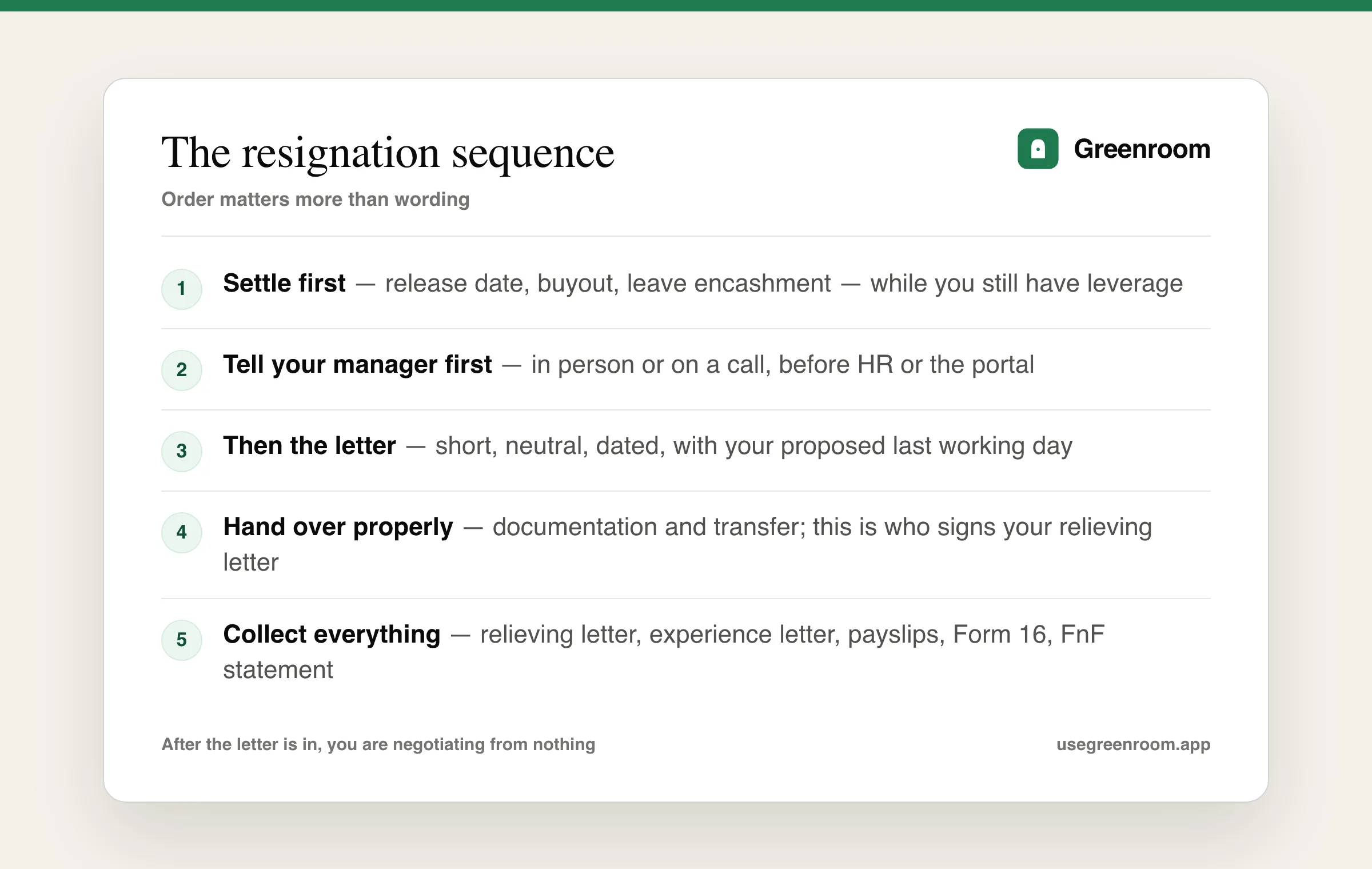
So everything negotiable gets settled first.
Settle these before you resign
- Your release date. Ninety-day notice periods are standard in Indian IT and sixty is common elsewhere. Find out — quietly, from your own offer letter and the HR policy document, not by asking HR a leading question — what the actual contractual period is.
- Whether buyout is possible, and at what cost. Many companies allow you to buy out part of the notice; the price is usually the basic salary for the remaining days, sometimes the full CTC. This is often discretionary, which means it is a negotiation, which means it happens before you resign.
- What happens to your leave balance. Encashment rules, and whether leave can offset notice — some companies allow it, many explicitly do not.
- Any bond or retention clause. If you took a joining bonus with a two-year clawback and you are leaving at twenty months, you need the number now, not in your final settlement.
- What your new employer actually needs. Get their required joining date and how much flexibility exists, because that determines how hard you need to push on the above.
Do this research before the conversation. Walking in already knowing the policy changes the conversation entirely.
The conversation and the letter
Tell your manager first, in person or on a call — never via the HR portal, and never by letting them hear it from someone else. This single courtesy does more for your relieving letter and your reference than anything else in this guide.
Keep it short and final: *"I wanted to tell you directly that I've decided to move on. I've accepted an offer and my last working day would be [date], subject to what we agree. I've really valued working here and I want to hand over properly."*
Then send the letter the same day. It should be short, neutral and dated. No grievances — this document is filed permanently and may be read by people who have never met you.
Dear [Manager],
I am writing to formally resign from my position as [title] at [company]. As per my notice period, my last working day would be [date].
I am grateful for the opportunities I have had here, and I am committed to completing a thorough handover before I leave.
Thank you, [Name]
That is the whole letter. Anything longer is either a grievance you should not put in writing or gratitude better said in person.
The notice period itself
- Do the handover properly. Documentation, knowledge transfer sessions, a written runbook for anything only you know. The person you hand over to is very often the person who signs off on your relieving.
- Do not check out mentally on day one. Ninety days of visible disengagement is remembered, and Indian tech is small enough that it follows you.
- Get the counter-offer decision done quickly if one comes. Our should you accept a counter-offer guide covers the test.
- Keep your new employer updated, especially if your last working day moves. Early notice is a scheduling issue; late notice is a trust issue.
- Do not badmouth anyone in your exit interview. It is not confidential in the way people assume, it changes nothing, and it can affect what gets recorded about you. Be honest but neutral: process feedback, not personal.
The documents you must collect
This is the part people underestimate, and it is the part that can block your next job.
- Relieving letter. The one that matters. Many Indian employers will not let you join without it.
- Experience letter, confirming dates and designation.
- Full and final settlement statement.
- All payslips, ideally the last twelve months, downloaded before your access is revoked.
- Form 16 for every year you were there.
- PF details — your UAN, and confirmation the account is updated so you can transfer rather than withdraw.
- Your offer letter and any increment or promotion letters, which establish your designation history for the next background check.
Download everything from the HR portal before your last day, because access is usually cut immediately. Chasing documents from a company you have already left is dramatically harder, and this is the most common avoidable problem in the whole process. Our background verification in India guide covers what the next employer will check, and our what to do after accepting a job offer before joining guide covers the window that follows.
Common mistakes
- Resigning before the new offer letter is signed. A verbal offer or an emailed intent is not an offer. This is the single most expensive mistake available.
- Announcing it publicly before telling your manager. A LinkedIn update or a team message that reaches them second is genuinely damaging.
- Negotiating release after resigning. Covered above.
- Leaving mid-project without a handover plan. It is the thing people remember, and it is the reference call you cannot control.
- Being honest in the wrong direction in the exit interview. Constructive and neutral; never personal.
- Not confirming the last working day in writing. Everything downstream depends on that date.
- Assuming the relieving letter is automatic. For most people it is. For anyone with a dispute, a shortfall, or an unreturned asset, it is not — settle those before your last day.
If they refuse early release
It happens, and the options are limited but real:
- Buyout, if the policy permits it. Get the amount in writing.
- Adjust leave against notice, where allowed.
- Ask your new employer to move the start date. Usually the least painful route, and most companies will accommodate a few weeks if told early.
- Escalate once, politely, if you have a genuine business case — a completed handover, a willing replacement.
- Serve it. Sometimes this is simply the answer, and it is better than an acrimonious exit that risks your relieving letter.
Our notice period negotiation in India guide goes into the negotiation in more depth.
Where each option actually helps
- Your own offer letter and the HR policy document — the source of truth, and you already have both. Read them before any conversation.
- A colleague who recently left — the most accurate account of how this specific company actually behaves, as opposed to what the policy says.
- Your new employer's HR — surprisingly helpful on timelines, and they have handled this many times.
- ChatGPT — fine for drafting the letter, though the correct letter is four lines and it will write you fourteen.
- Greenroom — not for this. Resigning is a process, not an interview. Ari is for the rounds that got you the offer, and for the next set whenever they come.
Frequently asked questions
What should you do before resigning in India?
Settle everything negotiable first, because your leverage is highest in the minute before you hand in the letter and close to zero afterwards. Establish your contractual notice period from your own offer letter and the HR policy rather than by asking a leading question, find out whether buyout is permitted and at what cost, check leave encashment rules and whether leave can offset notice, confirm any bond or joining-bonus clawback amount, and get your new employer's required joining date and their flexibility.
How do you write a resignation letter in India?
Keep it to four lines: state that you are formally resigning from your position, give your last working day as per your notice period, express brief gratitude, and commit to a thorough handover. No grievances and no detail — the document is filed permanently and may be read by people who have never met you. Send it the same day you tell your manager, and always after that conversation rather than before it.
Should you tell your manager before submitting a resignation letter?
Yes, in person or on a call, and before HR or the portal. It is the single courtesy that does most for your relieving letter and your future reference, and hearing it second — from HR, a colleague, or a LinkedIn update — is genuinely damaging to a relationship you may need. Follow the conversation with the written letter the same day.
What documents should you collect when leaving a job in India?
The relieving letter, which many Indian employers require before you can join elsewhere; the experience letter confirming dates and designation; the full and final settlement statement; all payslips ideally covering twelve months; Form 16 for each year; your UAN and confirmation your PF account is updated; and your original offer letter plus any increment or promotion letters that establish designation history. Download everything from the HR portal before your last day, because access is usually revoked immediately.
What if your company refuses early release from notice period?
Options are limited but real: buy out the notice if policy permits and get the amount in writing, adjust accrued leave against the notice period where that is allowed, ask your new employer to move the start date which is usually the least painful route if raised early, or escalate once politely with a genuine business case such as a completed handover and an identified replacement. Sometimes serving the notice is simply the answer, and it beats an acrimonious exit that puts your relieving letter at risk.
What should you say in an exit interview?
Be honest but neutral, and give process feedback rather than personal criticism. Exit interviews are not as confidential as people assume, they rarely change anything, and negative comments about specific individuals can affect what is recorded about you and how readily your relieving formalities proceed. If you want to be useful, describe a structural problem and what would have improved it, without naming who was responsible.