The interview was at a name everyone recognises. The office was theirs, the badge was theirs, the manager was theirs, the laptop had their sticker on it. He told his family he had joined them, because in every way that mattered day to day, he had.
The payslip said the name of a staffing firm he had needed to look up.
Two years later, interviewing elsewhere, he wrote that recognisable name on his resume and a background verification agency came back with a discrepancy, because that company had no record of ever employing him. Nothing he had said was untrue in spirit. It was simply not what his documents said, and documents are what BGV reads.
Almost everything written about this topic online is one of two over-confident claims: *"never take third-party payroll, it destroys your career"*, or the recruiter's *"it's the same thing, you'll convert in six months"*. Both are wrong. The useful question is narrower and entirely answerable before you sign: whose name goes on your experience letter? Every downstream consequence follows from that one fact.
What the arrangement actually is
You are employed by a staffing firm or consultancy — the employer of record. They pay your salary, hold your employment contract, run your PF, and issue your documents. You *work* at a client company, whose badge you carry and whose manager runs your day.
This is entirely legal and extremely common. Large staffing firms place enormous numbers of people this way, and plenty of GCCs, product companies and banks staff real teams through it. Our GCC jobs in India guide covers the channel it most often appears in.
The problem is never the arrangement. The problem is candidates who do not know which company is which until it matters.
The seven things to verify
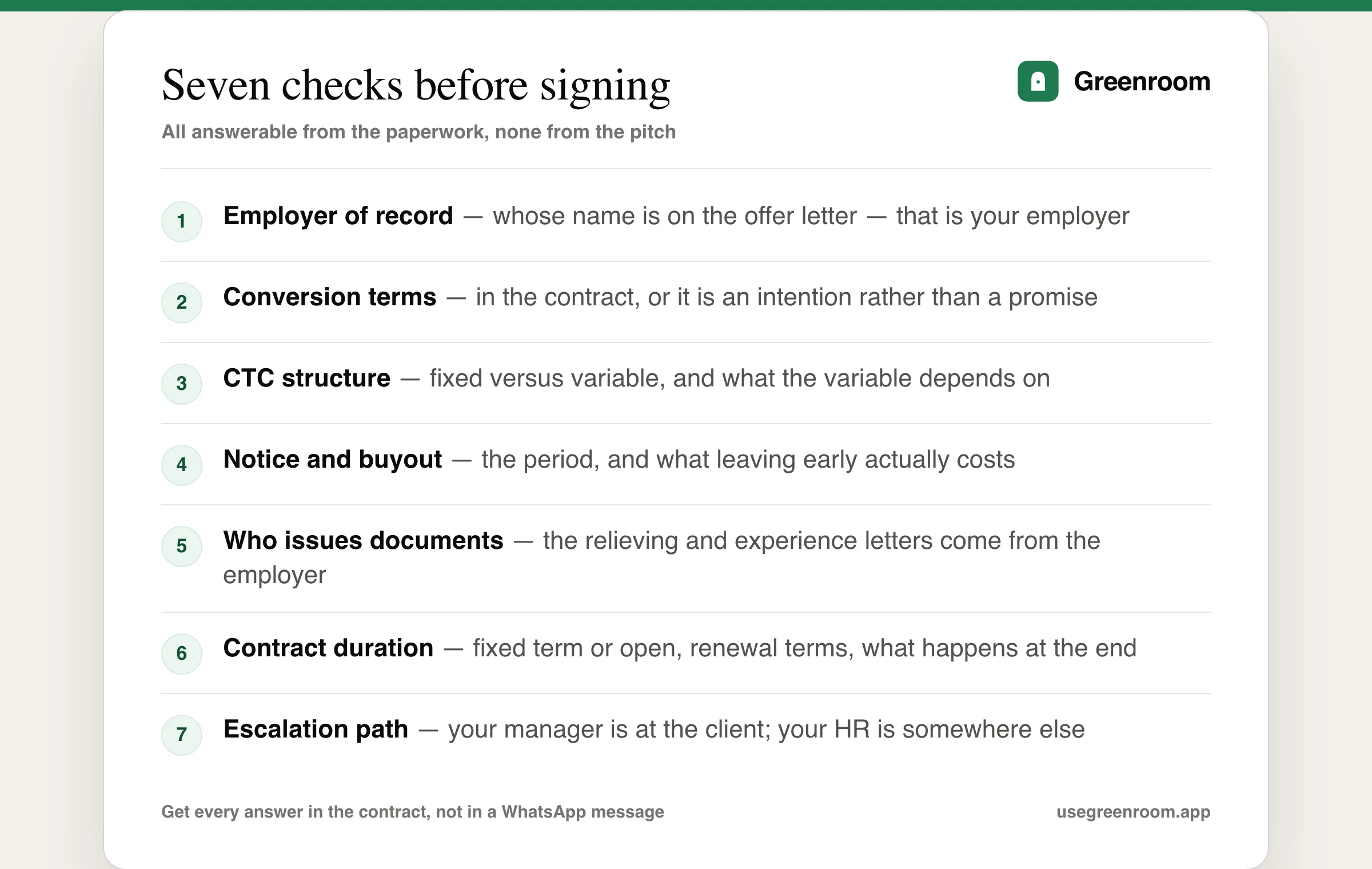
All seven are answerable from paperwork before you accept. Ask in email and keep the replies.
Who is the employer of record? Read the top of the offer letter. That name is your employer, and it is the name your next employer's BGV will check against. This is not a detail; it is the whole thing.
Is the conversion in writing? "You will move to client payroll in six months" is, absent a contract clause, a statement of intention by someone whose incentive is to get you to sign. Some conversions genuinely happen. Ask for the term in the contract, and if the answer is that it cannot be put in writing, you have learned what it is worth.
How is the CTC structured? Third-party offers frequently carry a larger variable component than the headline suggests, and sometimes the variable depends on the client contract continuing. Our CTC vs in-hand salary in India guide covers reading the structure properly.
What is the notice period, and is there a buyout? Check both directions — yours, and theirs. Our notice period negotiation guide covers the mechanics.
Who issues the relieving and experience letters? The employer of record does. Confirm they issue them as standard on exit, because these documents are the ones that unlock your next role.
What is the contract duration? Fixed-term or open-ended, renewal terms, and specifically what happens if the client ends the engagement — are you redeployed, benched, or released?
Who do you escalate to? Your manager sits at the client; your HR sits at the consultancy. Knowing which one owns leave, appraisal and grievances before you need to know is worth the question.
How to put it on your resume
This is the practical consequence, and getting it right costs nothing.
Write the employer of record as your employer, and name the client in the description. The shape is: [Staffing firm, as written on your offer letter] — *deployed at [Client], Payments Engineering*. It reads perfectly normally, it is completely honest, and it survives verification without a conversation.
What causes problems is writing only the client's name. It is understandable — that is where you sat and what you built — and it will be flagged by any agency that checks, because the client has no employment record for you. Our background verification in India guide covers what BGV actually checks, and job reference checks covers the adjacent call, where the same mismatch can surface.
Does it hurt your career?
The honest answer is: less than the forums claim, more than the recruiter claims, and it depends mostly on what you actually did.
What genuinely does not matter much. Good interviewers care about the work. If you built real systems at a real scale, that is real experience regardless of who processed your salary. Plenty of strong engineers have contract staffing in their history and it has cost them nothing.
What can genuinely cost you. Some product companies filter on employment history in a way that disadvantages long stretches of contract staffing, particularly for senior roles. Appraisal cycles and promotion paths at the consultancy are often thinner than the client's, so titles can lag the work. Bench periods between engagements are real at some firms. And repeated short deployments across several clients can read as instability, fairly or not.
Where it is a clearly good move. Getting into a company or a domain that would not otherwise interview you. Building a track record after a gap or a switch. A named client on your resume opening doors your previous employer would not. For a first job, for a career change, or after a break, taking the work and documenting it correctly is frequently the right call.
What the usual advice gets wrong
"Never take third-party payroll." Forum orthodoxy, usually stated by people with the luxury of alternatives. If it is your route into real work at a real company, take it and manage the paperwork.
"You'll convert in six months." Sometimes true, and not a term of your employment unless it is written in your contract. Treat it as upside, not as the basis for accepting.
Recruiters at the consultancy. They are useful and they are not neutral — they are paid on placement. Ask them the seven questions anyway; how willingly they answer in writing is itself informative.
Your own family and friends. Their instinct will be that the big-name badge is the job. That instinct is exactly the error that produces the resume problem two years later.
Greenroom. The interview connection is direct: candidates from contract staffing frequently undersell themselves, describing the arrangement apologetically instead of describing the work. Ari, the AI interviewer, will ask what you personally built and push until you answer specifically, which is the version of the story you want ready. Honest tradeoff: Ari cannot review your contract, and the seven checks above are a document exercise, not an interview one.
The one-line version
Read whose name is on the offer letter, get any conversion promise into the contract or discount it entirely, confirm who issues your relieving and experience letters, and then write that employer on your resume with the client named in the description — because the work is yours to claim, and the paperwork is what has to survive somebody checking. When you leave, our how to resign professionally guide covers collecting the documents on the way out.
Frequently asked questions
What is a third-party payroll job in India?
It is an arrangement where you are employed by a staffing firm or consultancy — the employer of record — while working day to day at a client company whose badge you carry and whose manager directs your work. The consultancy pays your salary, holds your employment contract, runs your provident fund and issues your relieving and experience letters. It is entirely legal and very common, including at global capability centres, banks and product companies, and the difficulty is not the arrangement itself but candidates not realising which company is their legal employer.
Is third-party payroll bad for your career?
Less damaging than forum consensus suggests and more consequential than a recruiter will admit. Interviewers who care about substance will weigh the work you actually did, and many strong engineers have contract staffing in their history without cost. The real risks are that appraisal and promotion paths at a consultancy are often thinner so titles lag the work, that bench periods between engagements occur at some firms, that repeated short deployments can read as instability, and that some companies filter on employment history for senior roles.
How do I show a third-party payroll job on my resume?
List the employer of record as your employer and name the client in the description — for example, the consultancy's name as the employer with 'deployed at [Client], Payments Engineering' beneath it. This reads normally, is completely accurate, and survives verification. Writing only the client's name is the common mistake and tends to be flagged, because the client holds no employment record for you, which appears as a discrepancy during background verification at your next job.
Will third-party payroll cause a background verification problem?
Only if your documents and your resume disagree. Background verification in India generally confirms employment with the employer of record, so a check against the client company will find no record of you. Listing the consultancy as your employer with the client named in the description avoids the issue entirely. Keep your offer letter, payslips, relieving letter and experience letter, since these are the documents the verification will be run against.
Should I trust a promise of conversion to the client's payroll?
Treat it as upside rather than as a reason to accept. Conversions do genuinely happen, but unless the terms appear in your employment contract the promise is a statement of intention made by someone whose incentive is to get you to sign. Ask for it in writing, and if you are told it cannot be documented, you have learned what it is worth. Decide whether the offer is acceptable on the terms actually written down.
What should I check before accepting a third-party payroll offer?
Seven things, all answerable from documents: which company is named as employer on the offer letter; whether any conversion promise appears in the contract; how the CTC splits between fixed and variable and what the variable depends on; the notice period in both directions and any buyout clause; who issues the relieving and experience letters and whether they are provided as standard; the contract duration, renewal terms and what happens if the client ends the engagement; and who handles leave, appraisal and grievances given that your manager sits at the client while your HR sits at the consultancy.