He did three courses, two certifications and a specialisation. He could explain attention, fine-tuning and quantisation. In his first AI engineering interview he was asked how he would tell whether a retrieval system was returning the right documents, and he realised that in nine months of studying he had never once built an evaluation set, because no course had made him.
AI engineering is reportedly the fastest-growing tech role in India right now. Hiring-tracker data circulating in mid-2026 puts AI engineer postings up around 21% month on month, with ML engineer and DevOps close behind, and reports average advertised compensation for AI engineers in the region of ₹18.8 LPA — the highest of the roles those trackers follow. Those are aggregator figures rather than audited statistics and the sample skews towards well-funded companies, so treat them as a direction rather than a promise. But the direction is real, and a lot of engineers are trying to move.
Here is what the job actually is, what the interviews genuinely test, and the switching plan that works from an ordinary software engineering job.
What an AI engineer actually does
The single most useful correction: most AI engineering is not model training. It is building products on top of models somebody else trained. In practice the work is:
- Retrieval — getting the right context in front of a model, which is mostly a search problem.
- Evaluation — deciding whether the output is any good, at scale, repeatedly.
- Orchestration — tools, agents, workflows, and the boundary between them.
- Serving — latency, cost per request, caching, fallbacks.
- Guardrails — prompt injection, permissions, and what happens when it produces nonsense.
Which means the role is closer to backend or platform engineering with a probabilistic component than it is to data science. That is good news if you are already a software engineer, and it is why the switch is more achievable than the course marketing suggests — but for the opposite reason to the one people expect.
There are genuinely different roles bundled under the title. Research requires a strong maths and publication background and is not a lateral switch. ML engineering trains and serves models, needs real statistics, and is the closest to the classic data science path. AI or LLM application engineering builds products on foundation models and is where nearly all the lateral hiring is. Aim at the third.
What the interviews actually test
This is where studied candidates get caught out. From what candidates report of these loops, the rounds are:
- A normal coding round. The software engineering bar does not go away. LeetCode medium, and being an AI candidate does not exempt you.
- System design, with a probabilistic twist. Serving, latency budgets, caching, and what the product does when the model is unavailable.
- A retrieval round. Chunking, hybrid search, reranking, and why pure vector search fails on exact identifiers. Our RAG interview questions guide covers this in depth.
- An evaluation round. The one that separates people. How would you know it works, what is your test set, what is the regression suite when the model version changes. Almost nobody prepares this and it is asked constantly.
- Cost and latency. Tokens per request, cost per thousand requests, and which parts you would route to a smaller model.
- Guardrails. Prompt injection, least privilege for tools, and human approval for irreversible actions. Our AI agent interview questions guide covers the agentic version.
- A depth round on your own project. Interrogated properly — what broke, what it cost, what you would change.
Notice what is mostly absent: transformer internals, backpropagation, and the contents of the courses. They come up occasionally and they are rarely decisive.
The switching plan that works
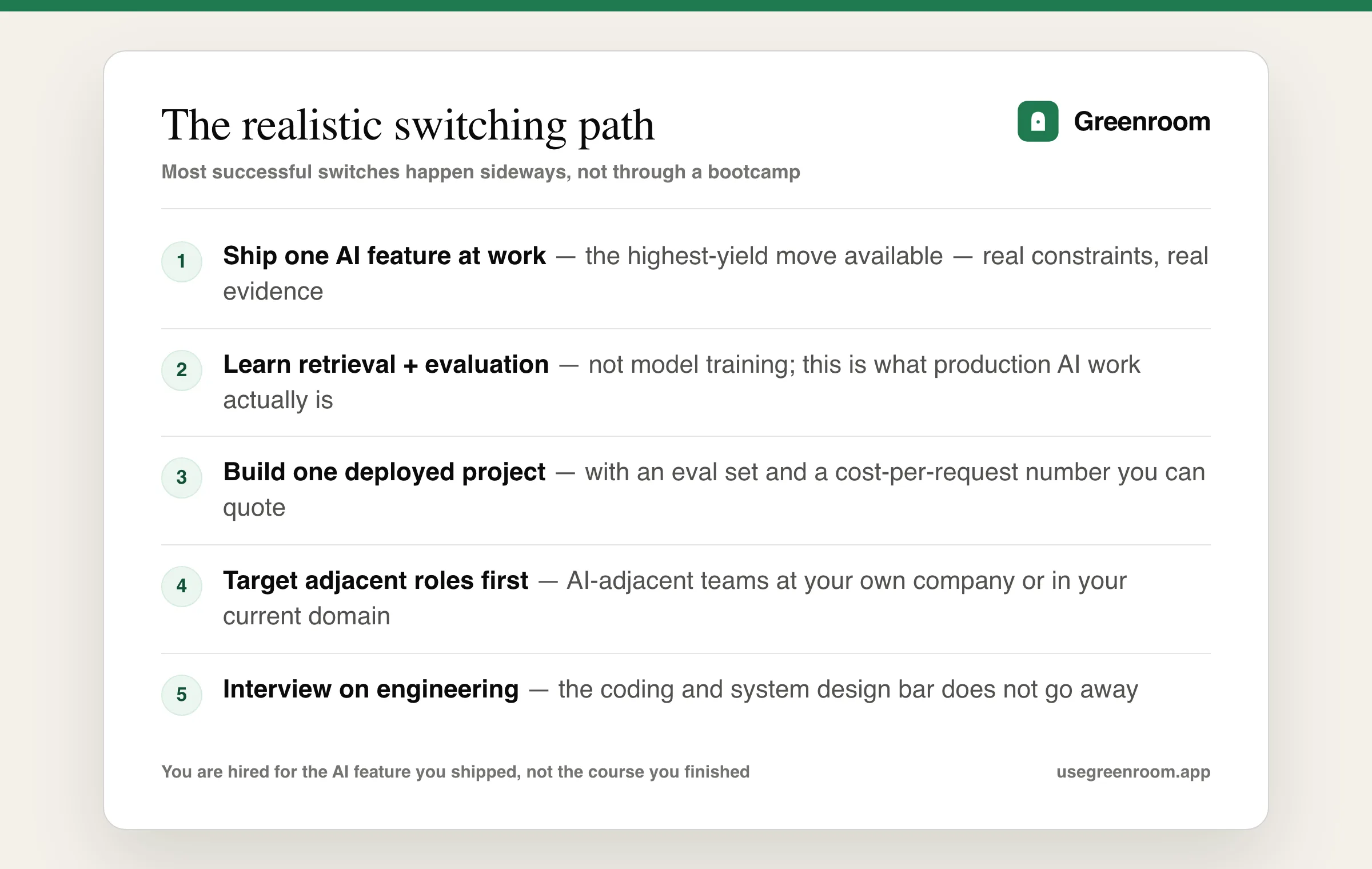
Step one — ship an AI feature inside the job you already have. This is dramatically the highest-yield move available and most people skip it because it feels like cheating. It is not: it is the fastest route to real constraints, a real user, a real cost line and real evidence you can talk about in an interview. Search over internal documents, a support-ticket classifier, a summarisation step in an existing pipeline. Small is fine. Shipped is the point.
If your current role genuinely offers no surface for this, propose one. In 2026 there are very few Indian engineering managers who will refuse a well-scoped proposal to add an AI feature.
Step two — learn retrieval and evaluation, in that order. Not model architecture. Build something with an embedding model and a vector store, then — the step everyone skips — build a set of fifty real questions with known correct answers and measure your recall. The day you can say "my retrieval recall was 61% and reranking took it to 84%" you are ahead of most candidates in this market. Our vector database interview questions guide covers the storage layer.
Step three — one deployed project, with numbers. Not four notebooks. One thing that is live, with an evaluation set, a latency figure and a cost-per-request figure you can quote from memory. The numbers are what make it credible.
Step four — target adjacent roles first. The easiest switch is inside your current company, into a team already doing this. The second easiest is a company in your existing domain — if you know fintech, an AI role at a fintech values that domain knowledge and will forgive a shorter AI history. Cold-applying to a pure AI lab from an unrelated background is the hardest possible path and it is the one most people try first.
Step five — keep your engineering sharp. You will be interviewed as a software engineer who does AI, not as an AI person. Our DSA coding interview preparation guide covers the coding round and our system design interview guide covers the design one.
What about certifications and courses?
Honestly weighted: they help at the resume-screening stage, they establish vocabulary, and they do not survive an interview on their own. A cloud provider's AI certification plus a deployed project is a strong combination. A certification alone is a weak one.
The specific gap courses leave — consistently — is evaluation. Courses teach you to build; they very rarely make you measure. That gap is exactly what the interview probes, which is why the studied candidate in the opening had a bad day.
Realistic expectations on compensation and timeline
- Timeline. Six to twelve months is realistic if you are shipping something at work alongside. Three months is realistic only if your current role already touches the area.
- Compensation. Reported averages for AI roles sit above general SDE bands in the same market, but the spread is enormous and the headline numbers are pulled up by a small number of very well-funded companies. Do not resign on the basis of an advertised average. Our how much hike to ask when changing jobs in India guide covers building a realistic number.
- Title inflation is rampant. Plenty of "AI engineer" roles are ordinary backend jobs with one API call in them. Ask in the interview what the team has actually shipped and what its evaluation process looks like — the answer tells you whether the title is real.
- The market can cool. A role category growing 21% month on month is not a stable state. Build transferable engineering skill underneath the AI layer so a correction does not strand you.
Where each option actually helps
- Your current job — the highest-yield and most-skipped step. Ship one thing.
- The provider documentation — Anthropic's and OpenAI's engineering guidance on tool use, agents and evaluation is more practical than most paid courses, and free.
- One good book — Designing Machine Learning Systems for the production mindset, even though it predates the current generation of models.
- Open source — contributing to a retrieval or eval library is disproportionately persuasive because it is verifiable.
- ChatGPT and Claude — genuinely useful for learning the material fast. The trap is that they make building easy enough that you never build the evaluation set, which is the thing you are actually being interviewed on.
- Greenroom — the spoken layer. Ari, the AI interviewer runs AI-engineering rounds out loud and asks the evaluation follow-up, which is precisely where course-trained candidates stall. Honest tradeoff: Ari cannot give you the shipped project — only your job can.
Our LLM production engineer interview questions and MLOps interview questions guides cover the two loops you are most likely to face, and our service to product company switch guide covers the adjacent move many people make at the same time.
Frequently asked questions
What does an AI engineer actually do?
Mostly not model training. The day-to-day work is building products on top of models someone else trained: retrieval to get the right context in front of a model, evaluation to determine whether outputs are good at scale, orchestration of tools and agents, serving concerns such as latency and cost per request, and guardrails including prompt injection defence and permissions. That makes it closer to backend or platform engineering with a probabilistic component than to data science.
How do you switch from software engineer to AI engineer in India?
Ship one AI feature inside your current job first, because it produces real constraints and real evidence faster than any course. Then learn retrieval and evaluation specifically rather than model architecture, build one deployed project with an evaluation set and a cost-per-request figure you can quote, and target adjacent roles — a team at your own company, or a company in a domain you already know — rather than cold-applying to a pure AI lab. Keep your coding and system design sharp, because that bar does not go away.
What do AI engineer interviews test?
A normal coding round at LeetCode medium, system design with serving and latency constraints, a retrieval round covering chunking, hybrid search and reranking, an evaluation round asking how you would know the system works and what your regression suite is, cost and latency questions, guardrails including prompt injection and least privilege for tools, and a depth round on a project you personally built. Transformer internals and backpropagation appear far less often than course marketing implies.
Are AI certifications worth it for switching careers?
They help at the resume-screening stage and establish vocabulary, but they do not survive an interview on their own. A cloud provider's AI certification combined with a deployed project is a strong combination; a certification alone is weak. The consistent gap courses leave is evaluation — they teach you to build and rarely make you measure — which is exactly the area interviewers probe hardest.
How long does it take to switch to an AI engineering role?
Six to twelve months is realistic if you are shipping something AI-related at work alongside your learning, and around three months only if your current role already touches the area. The timeline is driven far more by how quickly you can produce one deployed project with real numbers attached than by how much material you study, because the interview is largely a conversation about something you actually built.
Are AI engineer salaries in India really higher?
Reported averages for AI roles do sit above general software engineering bands in the same market — hiring trackers in mid-2026 have quoted figures around ₹18.8 LPA for AI engineers — but these are aggregator numbers rather than audited data, the spread is very wide, and the headline is pulled up by a small number of well-funded companies. Title inflation is also common, with plenty of AI engineer roles being ordinary backend jobs containing one API call, so ask what the team has shipped and how it evaluates output.