"What hike are you expecting?" He had a number in his head — 30%, because a colleague had got 30% — and he said it, and the recruiter said "sure, that works" so quickly and so cheerfully that he spent the next four months wondering what would have happened if he had said 60%. The answer, as it turned out when he found out what the person sitting next to him earned, was that 60% would also have worked.
Almost every article about how much hike to ask when changing jobs in India answers with a percentage, and the percentage is the wrong unit. A percentage is a fact about your current salary, which the new company does not care about and which may be badly below market to begin with. The number that should drive your ask is what the role pays other people at that level. Here is how to build that number, what ranges are actually realistic in 2026, and what to say when they ask first.
Why percentages are the wrong starting point
If you are currently underpaid — and many people who are switching are switching for exactly that reason — then anchoring your ask to your current salary preserves the underpayment forever. A 30% hike on a salary that was 40% below market is still below market.
Conversely, if you are already paid well, demanding 50% because "that's what people get" will price you out of roles you would have enjoyed.
The useful sequence is: find the market rate for the role, adjust it for scope and location, then check what percentage that implies. If the implied percentage is unusual, you now have a reason for it, which is the thing that actually gets it approved.
What is realistic in 2026
Ranges below are what candidates in Indian tech commonly report, and they vary enormously by company type. Treat them as orientation, not entitlement.
- Freshers to 2 years. Switching this early is more about the jump in company tier than a percentage. Service to product commonly doubles or better, because the starting base is low. Within the same tier, 20-40%.
- 3-6 years. The most liquid band. 30-50% is common for a straightforward switch, and 60-80% happens when moving from a service company to a product company or from a tier-2 product company to a top-tier one. Our service to product company switch guide covers that specific move.
- 7-10 years. 25-40% is typical. Larger jumps usually require a genuine scope change — first time leading a team, or a specialisation that is hard to hire.
- 10+ years and leadership. Percentages become less meaningful; compensation is negotiated against a band and often includes meaningful stock. Anchor on the band, not the hike.
- Any level, if you are badly underpaid. 80-100%+ is possible and does happen. It needs evidence: two other offers, or a clear market data point for your skills.
Two moderating facts. Companies do have internal bands and parity constraints, so a recruiter refusing your number is often genuinely constrained rather than negotiating. And a very large hike sometimes comes with a correspondingly large expectation, which is worth knowing before you accept.
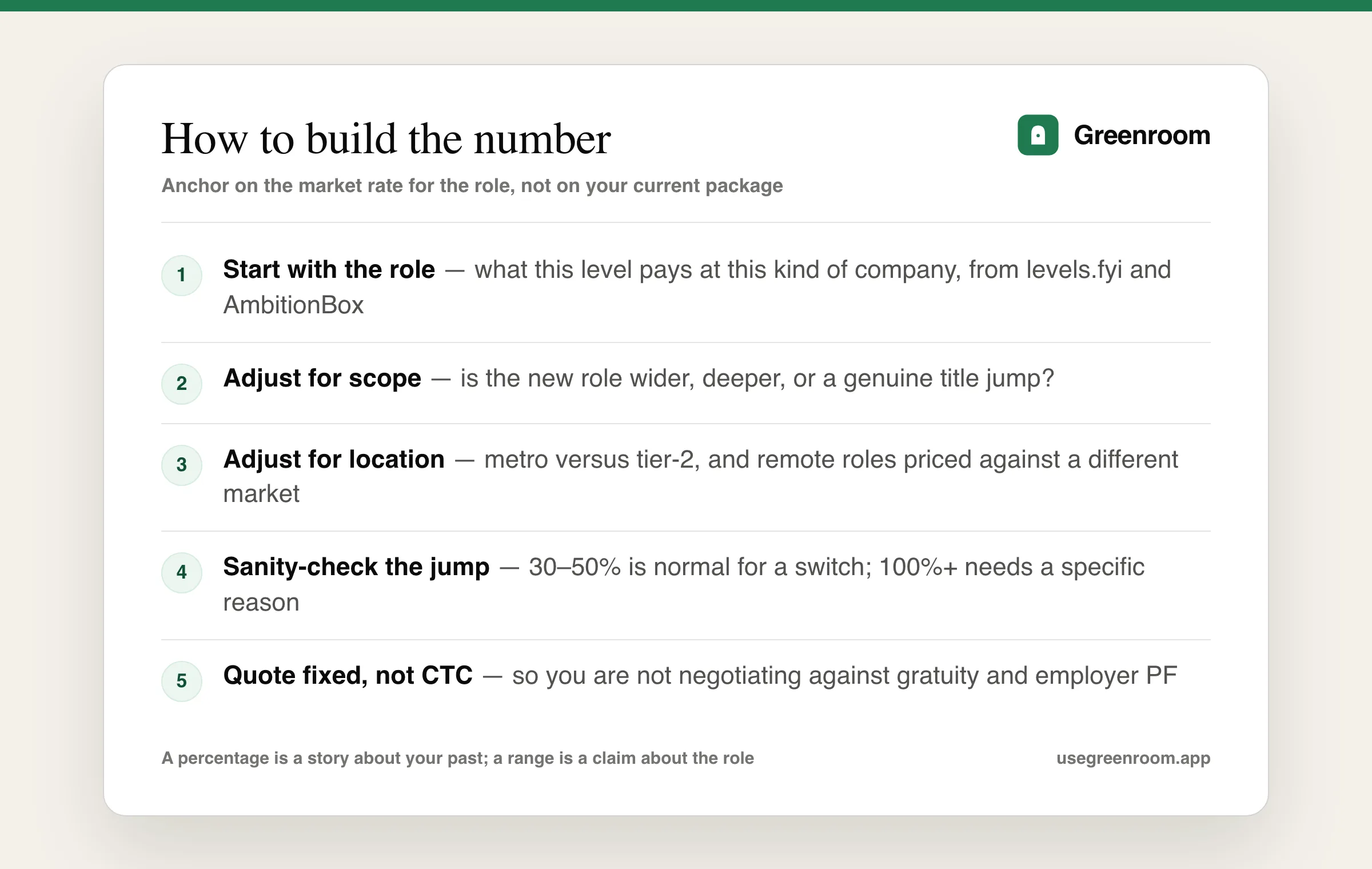
How to build your number in four steps
One: find the market rate. levels.fyi for product companies, AmbitionBox and Glassdoor India for a broader but noisier picture, and — best of all — two or three people actually doing that job. A direct message to someone at that company with a specific, polite question works more often than people expect.
Two: adjust for scope. Is the new role genuinely wider or deeper than your current one? A title jump, first-time ownership of a system, or a move into a specialisation with a hiring shortage all justify the upper end. Doing the same job at a different logo justifies the middle.
Three: adjust for location and structure. Bengaluru, Hyderabad, Pune, NCR and Mumbai are not one market. A remote role at a company headquartered elsewhere may pay against an entirely different band. And a 40% CTC hike with a 25% variable component may be a smaller fixed increase than a 30% hike with 5% variable — always compare fixed to fixed. Our CTC vs in-hand salary in India guide covers the components.
Four: set three numbers. Your target (ambitious but defensible), your realistic expectation, and your walk-away. Write them down before the conversation, because deciding under live pressure is how people accept numbers they later regret.
What to say when they ask first
They usually will, and going first is not automatically bad if your number is well-researched.
The deflection, once: "I'd like to understand the role a bit better first — could you tell me the band you have in mind for this level?" Many recruiters will simply answer, and now you know.
If they push, give a range in fixed pay with a reason attached: "Based on what I've seen for this level in Bengaluru product companies, I'm looking at ₹28-32 lakh fixed. That reflects the ownership this role has over the payments stack, which is a step up from my current scope." Notice that this is anchored to the role, not to your current salary.
If they ask directly for your current CTC, give the accurate number — inflating it is genuinely risky in India, where salary slips and Form 16 get collected during background verification — but immediately reframe: "My current CTC is ₹18 lakh, ₹16.5 fixed. That said, I'd rather anchor on the market for this role than on my current package, since I've been in the same band for two years." Our background verification in India guide covers what actually gets checked.
The mistakes that cost the most
- Naming a number in the first recruiter call with no research. The single most expensive four seconds in the process.
- Quoting CTC when you mean fixed. You will end up negotiating against gratuity and employer PF.
- Asking for a hike as a percentage. It invites the reply "we don't work off your current salary", which is both true and unanswerable.
- Accepting instantly. A fast yes from the recruiter means you were under their band. Always take at least a day.
- Negotiating only on salary. Joining bonus, notice-period buyout, level, start date and stock refresh are all real currency, and often easier for a recruiter to approve than base.
- Having no walk-away number. Without one you will talk yourself into anything by round four.
Justifying the number without sounding entitled
The wording that works is boring and factual. Three components: the market data point, the scope of the role, and your fit.
"For a senior backend role with this ownership in a product company here, the range I've seen is ₹30-36 lakh fixed. I'm asking for ₹32, which sits in the middle. I've run the same kind of system at my current company, so I'd expect to be productive quickly."
No apology, no aggression, no story about your rent. If they say the number is above band, ask what the band is and whether the level is fixed — sometimes the answer is that you are being considered a level below where you should be, and that is a much better conversation to have. Our salary negotiation for software engineers guide covers the endgame.
Where each option actually helps
- levels.fyi — the best single source for product-company bands in India, though thin for smaller companies.
- AmbitionBox and Glassdoor India — broad coverage, self-reported and skewed high. Use for shape, not precision.
- Two people doing the job — genuinely the highest-quality data you can get, and most people answer a polite, specific question.
- Your recruiter — will often tell you the band if you ask directly and early, before either side has anchored.
- ChatGPT — can structure your justification, but has no reliable current data on Indian salary bands. Do not let it produce your number.
- Greenroom — the spoken layer. Ari, the AI interviewer runs the recruiter conversation out loud, including the "what are you expecting?" opener, so the first time you say your number is not the time it matters. Honest tradeoff: Ari does not know that company's band; levels.fyi and your network do.
Rehearse saying the number
The reason people under-ask is not ignorance, it is that saying a large number out loud to a stranger is uncomfortable and the discomfort arrives before the sentence finishes.
Say your number out loud twenty times. Then have someone reply "that's higher than we had in mind" and practise the response, which is a question rather than a retreat: "What band did you have in mind for this level?" Twenty minutes of that is worth several lakh rupees, which is a better hourly rate than almost anything else you will do this month.
Frequently asked questions
How much hike should you ask when changing jobs in India?
Build the number from the market rate for the role rather than from a percentage of your current salary. As orientation, candidates in Indian tech commonly report 20 to 40 percent within the same company tier at junior levels, 30 to 50 percent at three to six years with 60 to 80 percent when moving from a service company to a product company, and 25 to 40 percent at seven to ten years where larger jumps usually require a genuine scope change.
Is a 50 percent hike realistic when switching jobs?
Yes, particularly in the three to six year band and especially when moving from a service company to a product company or from a mid-tier product company to a top-tier one. It is much less common when doing the same job at a similar company, where 25 to 35 percent is the more typical outcome. What makes a large number achievable is a market data point and a genuine change in scope, not the size of the percentage itself.
Should you tell a recruiter your expected salary first?
You can deflect once by asking what band they have in mind for the level, and many recruiters will simply tell you. If they push, give a range in fixed pay with a reason attached to the role rather than to your current package — for example that the range reflects the ownership this role has over a particular system. Going first is not automatically bad if your number is researched; naming an unresearched number in the first call is the expensive mistake.
Should you quote CTC or fixed pay when negotiating in India?
Quote fixed pay. CTC includes variable pay, employer provident fund and gratuity accrual, so negotiating on CTC means part of your increase is money that either never reaches your account or is conditional on performance. Stating your expectation as a fixed figure also makes it much easier to compare two offers honestly.
What do you do if the company says your expected hike is too high?
Ask what the band is for that level, and ask whether the level itself is fixed. Sometimes the real issue is that you are being considered one level below where your experience sits, which is a more productive conversation than arguing about a number. Also negotiate the components that are easier for a recruiter to approve — joining bonus, notice-period buyout, start date, or a stock refresh — rather than treating base salary as the only currency.
Is it bad to accept the first offer immediately?
It is usually a signal that you were below their band, because a recruiter who agrees instantly had room they did not need to use. Take at least a day on any offer, ask for the detailed salary structure, and come back with one considered counter. Accepting on the call removes the only moment in the entire process where you have real leverage.