Week one of a job search feels like a sport. You update the résumé at 11pm with the energy of someone who just discovered a new hobby. You apply to fourteen roles before lunch. You tell your friends "I'm finally doing this properly" with the specific confidence of a person who has not yet been ghosted by a recruiter named Priyanka who said "exciting next steps!" and then vanished for nineteen days. You are, in short, insufferable, and you don't yet know it.
Week six feels like a sport you're losing, in a stadium that's slowly emptying, while the scoreboard is broken. You've applied to ninety-something roles. Four replied. Two were "not moving forward at this time." One was a recruiter who scheduled a call and then didn't show up — no message, no reschedule, just silence, which is somehow worse than a rejection, because a rejection is at least an answer. You open LinkedIn to apply to one more role and forty minutes later you're reading a thread about someone's "exciting new chapter" at a company that rejected you eleven days ago, and you close the laptop and watch three episodes of something you don't remember the plot of by Thursday.
This is not a personal failing. It is the single most predictable shape of a long job search — and it has a name, a cause, and, more usefully, a fix that doesn't depend on finding more motivation. Because here's the thing nobody tells you at the start: motivation was never going to last twelve weeks. It wasn't designed to. The plan that gets you to an offer has to survive the weeks when you don't feel like opening the laptop at all — and a plan that only works when you're motivated isn't a plan, it's a mood.
This guide covers why job search motivation collapses on a predictable schedule, the difference between a search that runs on willpower and one that runs on a routine, a real weekly structure you can copy this week, what to actually do with rejection instead of either ignoring it or spiraling on it, and how to tell the difference between a normal dip and something that needs more than a routine fix.
Why motivation always drops around week four to six
There's a reason the slump has a roughly predictable onset, and it isn't bad luck. Three things compound at once, usually right around the same point in the search:
The novelty wears off. Early applications feel like progress because they're new — a new résumé version, a new cover letter angle, a new company you're excited about. By application sixty, the act of applying has become routine, but the outcome hasn't started arriving yet. You're doing the same motion with none of the early dopamine.
The feedback loop is brutally slow and one-sided. Most job applications never get a real response — not a rejection, just silence, which the brain reads worse than a "no," because at least a "no" closes the loop. Behavioral research on intermittent reinforcement (the same mechanism that makes slot machines and doomscrolling sticky) shows that unpredictable, sparse reward is the hardest pattern for motivation to sustain — and a job search, structurally, is exactly that: long stretches of nothing, occasional good news, no way to predict which application will be the one that lands.
Identity starts to wobble. By week six, "I'm job searching" quietly becomes "I can't get a job," which is a much heavier sentence to carry around all day. That shift in self-talk is doing real damage that has nothing to do with your actual skills or résumé — and it's worth reading imposter syndrome in interviews if that voice is starting to sound less like a passing thought and more like a verdict.
None of this means something is wrong with you, your résumé, or your approach. It means you've hit the part of the search where willpower — which is a finite, depletable resource, not a personality trait — has run out, and where what's left of the plan needs to be able to run without it.
How long a search "should" take (and why that number is making it worse)
Part of what makes week six feel like a crisis is that almost nobody has an honest number in their head for how long this is supposed to take. You started with a vague sense of "a few weeks, hopefully," absorbed from a friend's success story or a LinkedIn post that conveniently leaves out the eleven months it actually took, and now every week past that invented deadline feels like proof something's wrong.
It isn't. Hiring research consistently shows that a real, competitive job search — not "I sent one résumé and got lucky," but an actual search with multiple rounds per company — runs longer than most people expect going in, often stretching past two or three months even for strong candidates in a normal market, and considerably longer in a tight one. Recruiting-industry research from groups like LinkedIn's Talent Solutions team and Indeed's Hiring Lab has repeatedly found that time-to-hire has been lengthening over the past several years, not shortening, as more companies add screening rounds, take-home assessments, and additional interview loops before making an offer. None of that is something you did wrong. It's the actual shape of hiring in 2026, and going in with a six-week mental deadline is setting yourself up to feel like a failure on a totally arbitrary schedule that was never realistic to begin with.
The reframe that actually helps: stop measuring the search by "how long has it been" and start measuring it by "how many real attempts have I gotten through" — applications sent, screens completed, interviews attempted. A search is a numbers game with a long, lumpy tail, not a countdown timer, and the routine in this post is built around that fact: consistent weekly inputs you control, rather than a calendar deadline you don't.
Three searches, three routines
The structure above is a template, not a prescription — what it looks like in practice depends heavily on what kind of search you're actually running. Here are three common shapes, with the adjustments each one needs.
The campus/fresher search, common across Indian engineering colleges and common first-job hunts everywhere: high application volume is realistic and expected (you're competing in pools of hundreds for each opening), so the daily cap can be higher — 8-10 applications is reasonable — but the prep block matters disproportionately more, because freshers get judged heavily on fundamentals (CS basics, aptitude, communication) rather than a long track record. The weekly heavier session should lean hard into mock interviews for exactly this reason — you're being evaluated on how you explain things you've just learned, which is a skill that needs rehearsal, not just review. The off day matters just as much here, maybe more, because campus placement seasons are notorious for compressing months of pressure into a few intense weeks.
The mid-career lateral switch — you have a job, you're searching on the side, evenings and weekends only. The daily cap should be small and realistic (2-3 applications on a workday) because the bigger risk here isn't burnout from over-applying, it's the search quietly dying because "I'll do it this weekend" becomes a recurring lie you tell yourself. The fix is protecting a smaller, non-negotiable daily slot — even ten minutes after work — rather than betting everything on weekend energy that competes with everything else in your life. The weekly review matters more too, because you have less daily bandwidth to process each outcome as it lands.
The layoff or career-restart search — searching full-time, no current job providing structure to the day. This is the version most at risk of the willpower collapse described above, because there's no external schedule forcing the routine; you have to build the entire container yourself, including the start and end times of your "work day" of searching. The fix that helps most here specifically is treating the search like a job with fixed hours — start time, end time, lunch break — rather than something you can do "whenever," because "whenever" tends to quietly become "rarely" by week four. This is also the version where the once-a-week full off day is least optional, not most: a full-time search with zero scheduled rest burns out measurably faster than a part-time one, because there's no other structure in the week competing for your attention and forcing a natural pause.
Willpower vs. a routine — the actual difference
This is the single highest-leverage reframe in this whole post, so it's worth a side-by-side before anything else.
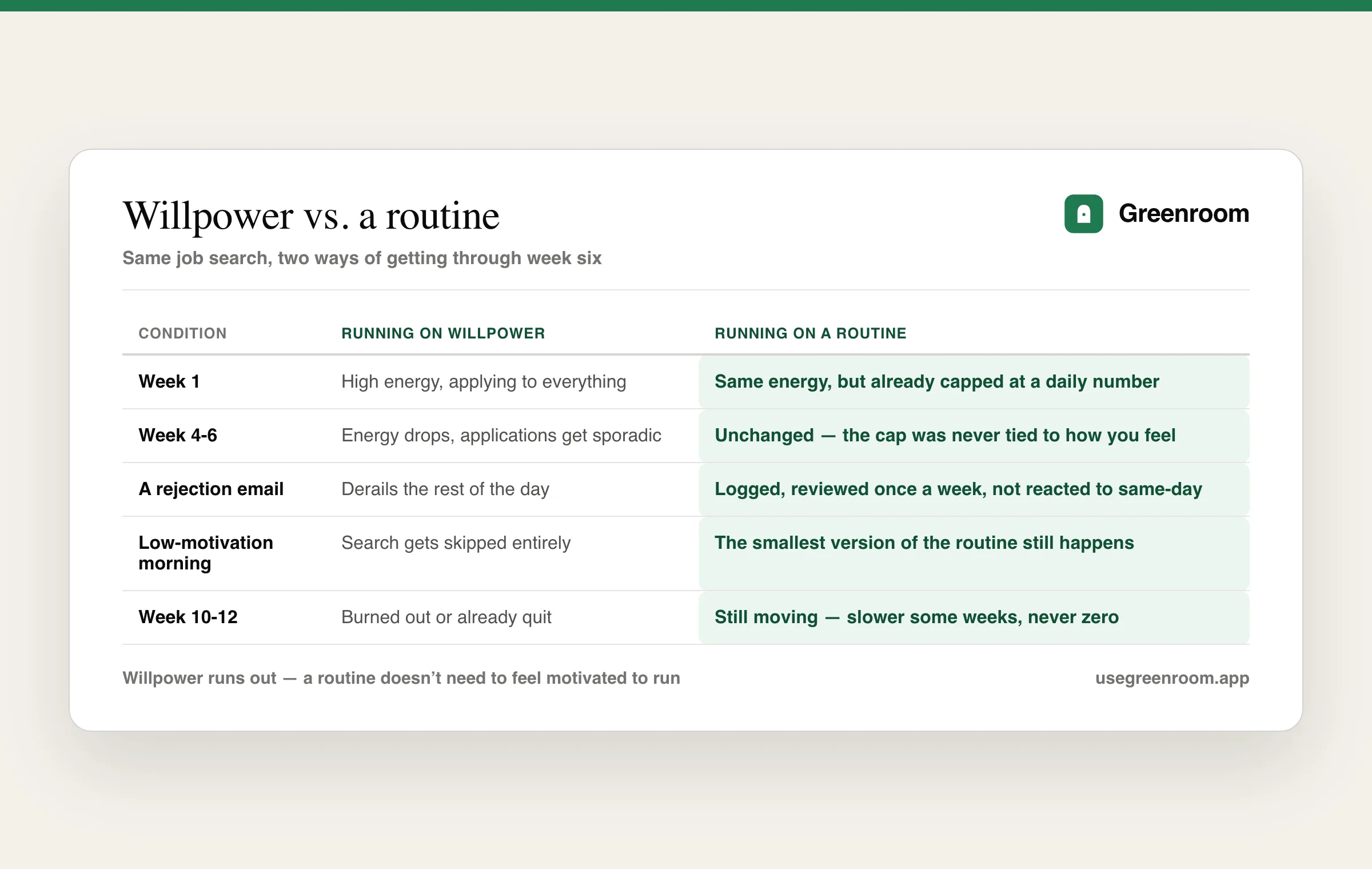
A willpower-run search has one input: how you feel that day. Feel good, apply to ten roles. Feel bad, apply to zero. Get a rejection, lose the rest of the day. This works great for exactly as long as you feel good, which — see above — is not very long.
A routine-run search has a fixed, small set of inputs that don't ask how you feel: a daily cap on applications (not a maximum to hit, a maximum not to exceed, which removes the guilt of "only" applying to three), a single weekly slot to review rejections instead of reacting to each one in real time, and a floor version of the routine — the smallest possible version you do even on the worst day — so that "I did nothing today" almost never happens, even when "I did everything today" definitely doesn't either.
The mechanism under this is the same one behind habit research from people like BJ Fogg at Stanford: motivation is unreliable and ability is variable, but a habit anchored to a fixed trigger — same time, same place, same small action — survives both. You're not trying to feel like job searching. You're trying to make job searching something that happens whether you feel like it or not, the same way brushing your teeth happens without you negotiating with yourself about it each morning.
A real weekly structure, not a vague "stay positive"
Here's a structure that fits an average serious job search — adjust the numbers, not the shape:
Daily (20-40 minutes, same time each day): apply to your capped number of roles (3-5 is plenty; more isn't better past a point of quality), and tick off whatever single prep task is on today's list — one practice question, ten minutes of mock interview, reviewing one company's product. That's it. The bar for "done today" is intentionally low.
Twice a week (30-45 minutes): a slightly heavier session — a real mock interview, a deeper company-specific prep block, or working through a system design or behavioral topic in depth rather than skimming it.
Once a week (15-20 minutes, same day, e.g. Sunday evening): the rejection review. This is the only time you look at all the week's outcomes together — not as they land, one gut-punch at a time, but batched, once, on a schedule you control. More on exactly how to run this below.
Once a week: a full off day. Not "I'll probably take it off if nothing comes up" — scheduled, written down, protected the way you'd protect a meeting. A search with no scheduled rest doesn't run longer, it just runs you into the ground faster, and the off day is what makes the other six sustainable.
The floor version — the one you run on the day you really don't want to — is just the daily block, nothing else. Three applications. Ten minutes of practice. Stop. The whole design goal of a floor version is that doing it on a bad day costs you almost nothing, but skipping it entirely costs you the habit.
What to actually do with rejection (instead of nothing, or everything)
Most people handle rejection one of two broken ways: they either absorb every single one in real time — read the email the second it arrives, feel terrible for the rest of the day, repeat — or they avoid looking at outcomes altogether, which feels protective but quietly erodes any sense of progress, because you genuinely don't know if anything is working.
The fix is the weekly batch review mentioned above, and it has three steps:
- Log it, don't react to it. When a rejection lands mid-week, note it in one line (company, stage, date) and close the tab. You're not ignoring it — you're deferring the processing of it to a time you control, rather than letting it control your Tuesday afternoon.
- Once a week, read them together. Looking at five rejections in one fifteen-minute sitting feels completely different from feeling five separate gut-punches across five separate days. Batched, you can actually see patterns — three of them stalled after the technical round, say — instead of five isolated wounds.
- Ask one honest question per pattern, not per rejection. "Did I stall at the same stage more than once this week?" is a useful, answerable question. "Why didn't they want me?" asked five separate times that week is not a question, it's a spiral. For the deeper version of this — including what to do when you genuinely can't tell why you didn't get an offer — see how to handle interview rejection.
This isn't about pretending rejection doesn't sting. It's about controlling when it gets to sting, so it has a contained fifteen minutes instead of an open-ended afternoon.
A worked example of a weekly log, the kind you can copy into a spreadsheet or a notes app in under a minute per entry:
Mon — Acme Corp, recruiter screen, "moving forward with other candidates"
Wed — Northwind, technical round 2, no response yet (flag: follow up Fri)
Thu — Globex, OA, auto-reject (likely a score cutoff, not a fit issue)
Fri — Initech, no response to application (1 week old)
Read individually, across five separate days, those four lines are four separate small wounds. Read together on Sunday, a pattern jumps out immediately: Acme and Globex were filtered at an early, mechanical stage (a recruiter screen, an automated OA score) — likely volume-driven, not a deep signal about your skills. Northwind got to round two, which is real progress worth noting, not nothing. The only genuinely actionable item in the whole week is the Northwind follow-up, and the log made that obvious in fifteen seconds instead of burying it under four days of separate disappointment.
Tracking progress without turning tracking into another stressor
A spreadsheet of applications is useful right up until it becomes a second source of dread — a growing column of "rejected" rows you're afraid to even open. The fix is being deliberate about which numbers you track and, just as importantly, which ones you deliberately don't.
Track: applications sent per week (a count, not a judgment), response rate (replies divided by applications — this tells you if your résumé/targeting is working, separate from interview performance), interviews reached per week, and mock-interview reps completed. These are all inputs you control, and watching them move over weeks is genuinely motivating in a way that watching a single outcome never will be — a rising response rate over a month is real, visible evidence that something in your approach improved.
Don't track, or don't dwell on: "days since I applied," "days since last response," or any version of a countdown clock. These numbers only ever go up, they carry no useful signal (a long gap between replies is completely normal, not diagnostic), and checking them obsessively is a low-effort way to manufacture dread out of nothing. If you notice you're refreshing your email or an applicant tracker multiple times a day hoping for news, that's a sign the tracking itself has become a doomscroll-shaped habit — worth reading doomscrolling and your job search if that's started to feel familiar.
What other people actually do (and where it falls short)
It's worth being honest about the alternatives, because "just stay positive" isn't a strategy anyone can execute, and most of the real alternatives people reach for solve one piece of the problem while leaving the motivation problem completely untouched.
A spreadsheet of applications, or a job board's built-in tracker (Naukri's, LinkedIn's, Indeed's). Genuinely useful for record-keeping, completely useless for motivation — a spreadsheet doesn't notice you've stopped opening it, and a tracker full of "applied" with no responses can quietly become exactly the kind of dread-inducing number described above. It's a record, not a routine.
A friend's WhatsApp PDF of "100 interview questions," or a GeeksforGeeks-style question dump. Cheap, fine for raw question exposure, and genuinely useful for building a base of what topics exist. But it's the same flashcard problem every static prep resource runs into: reading an answer and producing one out loud, under a clock, with a stranger watching you think, are different skills — and a PDF has no way to tell you which one you're actually missing. It also does nothing for the part of the search that's most often breaking by week six: the routine and the recovery from rejection, not the size of the question bank.
LeetCode or similar grinding platforms. Excellent, arguably essential, for the specific skill of solving coding problems under time pressure — there's no real substitute for the rep count it provides. But it's a narrow slice of what a real interview loop tests (most loops also weigh communication, behavioral rounds, and system design), and grinding problems in isolation, alone, at your own pace, doesn't rehearse the part that actually trips people up live: explaining your thinking out loud, in real time, to someone asking follow-ups.
ChatGPT or a generic LLM for mock Q&A. Better than nothing, and genuinely good for generating a first pass of likely questions for a role or company. But it doesn't push back the way a real follow-up question does, it has no memory of how your last five answers actually landed, and — the part that matters most for this specific post — it has zero opinion on whether you showed up today. It's a tool you have to bring your own motivation to; it doesn't supply any of its own.
Pramp, interviewing.io, or a peer mock-interview exchange. Genuinely strong for realistic pressure — a real stranger asking real follow-ups is hard to beat for authenticity. The tradeoffs are scheduling friction (you're coordinating around someone else's calendar, which is exactly the kind of friction that makes a habit die in week four) and inconsistent feedback quality, since your partner is also a candidate, not a trained evaluator.
A career coach. Excellent for accountability and a human who notices when you go quiet for two weeks — genuinely worth it if you can afford the ongoing cost, which is the real constraint for most people mid-search, and a meaningfully bigger commitment than anything else on this list.
Where Greenroom fits into this specifically: it's not a motivation app, and it won't pretend to be one. What it does is remove one specific source of the week-six dread — the fear that you're not actually ready, which makes every application feel heavier than it should. Spoken mock interviews with real follow-up questions and structured feedback mean prep stops being an open-ended, anxiety-inducing question mark and becomes a fifteen-minute task you can check off, same as anything else on the daily list above. It's the prep piece of the routine, not a replacement for the routine itself — pair it with practicing like you play rather than passively reviewing notes.
What twelve weeks actually looks like, mapped out
It helps to see the whole arc in advance, because the dip stops feeling like a crisis the moment you recognize it as a stage rather than a verdict on the search itself.
Weeks 1-2. High energy, possibly too high — this is when people over-apply to roles they're not excited about just to feel productive, and burn good cover-letter effort on companies they'd turn down anyway. The fix isn't to suppress the early energy, it's to channel it into setting up the routine properly (the daily cap, the weekly review slot, the off day) so it survives past this phase, rather than spending it all on volume.
Weeks 3-4. The first real wave of rejections and silence arrives, often all at once, because application-to-response lag means week one's applications are only now generating outcomes. This is usually the first moment the search "feels real" in an uncomfortable way. The routine should already be running by here — if it isn't, this is the week to build it, before the slump in weeks five and six hits a search with no structure underneath it.
Weeks 5-7. The slump described throughout this post. Energy is lowest, the gap between effort and visible outcome feels widest, and this is statistically where people are most likely to either quietly stop applying (without admitting that's what's happening) or swing the other way into compulsive, anxious overworking. The floor version of the routine matters most precisely here — it's the difference between "I did the bare minimum but I did it" and a multi-week gap that's much harder to restart than to maintain.
Weeks 8-10. For most consistent searches, this is when the lag between effort and outcome starts closing — interviews booked in weeks three and four are now resolving, one way or another, and a search that felt frozen for a month suddenly has visible movement again. This is also, not coincidentally, when people who did quietly stop searching in week six are furthest behind, because the pipeline they'd have built by now never got built.
Weeks 11+. Either an offer is close, or it's time for an honest review of approach — not motivation, approach: is the targeting too broad or too narrow, is the résumé converting to screens at a normal rate, is interview performance the actual bottleneck (worth confirming with structured mock interview feedback rather than guessing). A search running past ninety days isn't unusual or a red flag on its own — see the timelines discussed above — but it is the point where it's worth checking the inputs rather than just doing more of the same thing for another month.
Small wins that actually count (and the ones that don't)
One specific reason willpower drains faster in a job search than in almost any other long project is that the only "win" most people are counting toward is the final one — the offer. Everything else gets filed mentally as "not yet a win," which means weeks of genuine progress can pass with zero recognized wins at all, and a brain that never gets to register progress eventually stops trying to make any.
The fix is deliberately counting smaller wins as real wins, not as consolation prizes:
- Getting past a screen you'd have failed a month ago. If your résumé is converting to screens more often than it was in week one, that's your targeting or positioning improving — a real, measurable result, not nothing.
- A mock interview where you handled a follow-up question cleanly. This is the actual skill that compounds toward an offer; treat it like the rep it is, not a footnote.
- A rejection with specific feedback attached. Genuinely rare and genuinely useful — most rejections are silent or generic, so one with real detail ("strong on system design, came across hesitant on the behavioral round") is closer to a gift than a loss, even though it doesn't feel like one in the moment.
- A week where you hit the routine on every single day, including a bad one. This is arguably the most important win on this list and the easiest to dismiss, because it produces no external evidence — no email, no callback. Consistency through a low-motivation week is exactly the thing that determines whether you're still searching in week twelve, and it deserves to be noticed on its own terms.
What doesn't count as a meaningful signal, in either direction: a single rejection (tells you almost nothing about your overall trajectory), a single positive response (one good week doesn't mean the slump is over), or comparing your week six to someone else's week two on LinkedIn, which is comparing two different points on two different timelines as if they were the same race.
Telling people you're searching (and managing the well-meaning questions)
A genuinely underrated drain on motivation is the social layer of a long search — the relative who asks "any updates?" at every family gathering, the friend who means well but asks "still looking?" in a tone that lands like a verdict, the urge to either go quiet about the search entirely (which removes a source of real support) or over-explain it defensively every time it comes up (which is exhausting in its own way).
A short, prepared answer solves most of this: something like "Yeah, still in it — talking to a few places, it's a numbers game right now" closes the question without inviting a follow-up interrogation, and you can decide separately, deliberately, who actually gets the longer honest version. The people worth telling the real version to are the ones who can offer something concrete — an introduction, a mock interview partner, someone who's been through a long search themselves and can normalize the week-six dip instead of unintentionally amplifying it. Everyone else gets the short version, and that's not dishonesty, it's just boundary-setting around a genuinely difficult period.
When it's more than a normal dip
A week-six slump that responds to structure — a routine, a scheduled rest day, a batched rejection review — is normal and expected. It's worth being honest, though, about when "low motivation" has tipped into something a routine alone won't fix: if you're sleeping far more or far less than usual for more than two weeks, if you've stopped doing things you'd normally enjoy outside the search entirely, if the thought of applying triggers genuine dread rather than just reluctance, or if you're having thoughts of harming yourself — that's a different category, and it deserves a conversation with a doctor or a mental health professional, not a productivity hack. A job search routine is built for ordinary fatigue and ordinary discouragement. It is not a substitute for care when something heavier is going on, and there's no shame in needing the latter instead of the former.
FAQ
How do I stay motivated during a long job search?
Stop relying on motivation and build a routine instead — a small daily cap on applications, a twice-weekly prep block, a once-a-week batched rejection review, and one fully scheduled day off. A routine designed to run on a bad day matters more than a burst of energy on a good one, because the bad days are where most searches actually fall apart.
Why does job search motivation drop so much around week 4 to 6?
Three things compound at once: the novelty of applying wears off before results start arriving, the feedback (mostly silence, occasionally a rejection) follows an unpredictable pattern that's psychologically harder to sustain motivation against than steady bad news would be, and "I'm job searching" can start quietly curdling into "I can't get a job," which adds a heavier emotional weight to every single application.
How do I deal with constant rejection during a job search?
Log rejections as they land but defer processing them to one scheduled weekly review instead of reacting to each one the moment it arrives. Look for patterns across the batch (stalling at the same stage repeatedly, say) rather than relitigating each "why didn't they want me" individually — patterns are answerable questions; one-off rejections in isolation rarely are.
Is it normal to feel like giving up during a job search?
Yes — a slump around the six-week mark is one of the most common and predictable patterns in a long job search, not a sign you're doing it wrong. What matters is whether a structured routine and a scheduled rest day bring the motivation back to a workable level within a week or two. If it doesn't lift, or if it comes with disrupted sleep, loss of interest in everything (not just the search), or thoughts of self-harm, that's worth raising with a doctor or mental health professional rather than pushing through with willpower.
What's a good daily routine for a job search?
Something small enough to survive a bad day: a capped number of applications (3-5, not "as many as possible"), one short prep task, at the same time each day. Add two slightly heavier prep sessions and one batched rejection review per week, plus one fully protected day off. The floor version — just the daily applications and prep task, nothing else — is what you run on the days you don't feel like doing anything; it costs almost nothing and keeps the habit alive.
What should I track during a job search to stay motivated?
Track inputs you actually control — applications sent per week, response rate, interviews reached, and mock-interview reps completed — and watch them move over a month, which is real and motivating evidence of progress. Avoid tracking countdown-style numbers like "days since I applied" or "days since last reply," since they only ever increase, carry no real signal, and tend to manufacture dread rather than insight. Structured mock interview practice, like Greenroom's spoken sessions with real follow-up questions, also removes a quieter drain on motivation — not knowing if you're actually ready — by turning that open-ended anxiety into a fifteen-minute task you can check off the same way you check off the rest of the daily routine.