The recruiter email sat unread for two days. Not because the candidate was busy — because every time he opened it, the same thought arrived before any other: "what if I get to the technical round and it's obvious I don't actually belong there." So he didn't reply right away. Then he told himself he'd prep "properly" once he had a full free weekend, which kept not arriving. Then the interview got scheduled with four days' notice instead of the two weeks he'd told himself he needed, and he walked in having done a fraction of the prep he was capable of, performed accordingly, and walked out with a clean, simple lesson confirmed: see, I told you I wasn't ready for this.
That story has a name in clinical psychology — the avoidance cycle — and it's one of the most quietly destructive patterns in interview preparation, because it disguises itself as procrastination, busyness, or "just not having time," when what's actually running underneath is fear of failure directing behavior without ever announcing itself as fear. This post is about how that cycle works mechanically, why it's so good at manufacturing the exact outcome it's afraid of, and the specific moves that interrupt it — distinct from how to handle rejection after it happens, because this is about the fear that operates before you've even gotten there.
What fear of failure actually does — it drives avoidance, not just discomfort
Most discussions of fear of failure focus on how it feels: dread, a tight chest, intrusive "what if" scenarios. That's real, but it's not the part that does the damage. The damage comes from what the feeling makes you do — and overwhelmingly, what it makes people do is avoid: delay replying to the recruiter, push prep to "later" repeatedly, agree to an interview date that doesn't leave enough runway, half-commit to practicing rather than fully committing, or — in milder, more common form — technically prep, but never under any real pressure, never out loud, never in a way that actually tests whether you're ready, because testing it might confirm the fear.
Avoidance is attractive because it works immediately: the moment you close that recruiter email unanswered, the dread drops, at least for a few hours. That immediate relief is exactly why avoidance is so habit-forming — it's intermittently reinforced relief, the same mechanism behind a huge range of avoidance-based habits. The problem is what it costs later, every time: less actual preparation, a worse outcome than your real capability would have produced, and — critically — an outcome that then gets misread as confirming the original fear ("I knew I wasn't good enough") rather than correctly attributed to the avoidance that produced it ("I didn't prepare, because I was avoiding the fear, and that's why it went badly").
The avoidance cycle, mapped
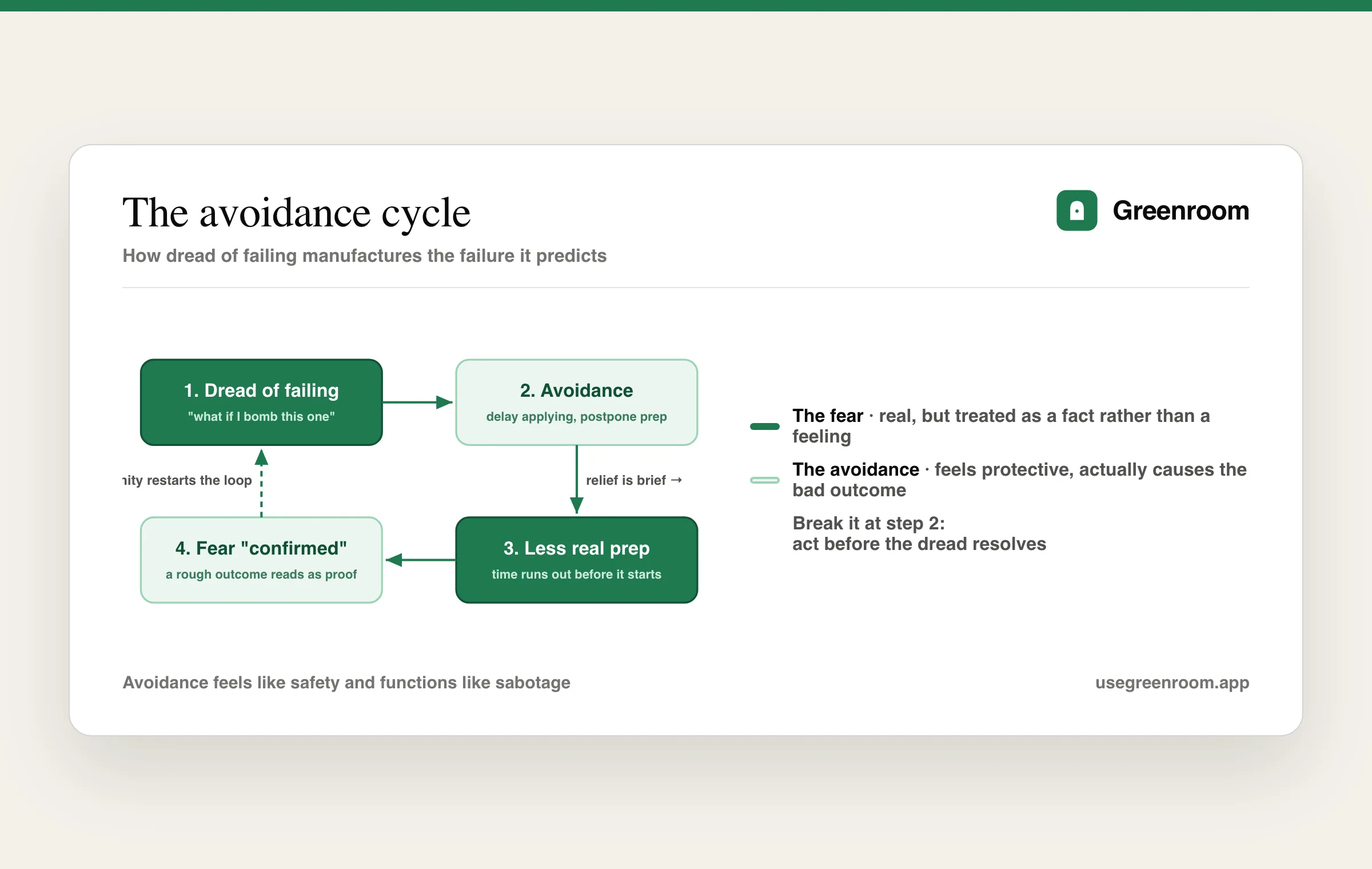
Step one — dread of failing. A real opportunity appears, and with it, a real possibility of a bad outcome. The mind generates "what if I bomb this one" before any rational assessment of actual odds. Step two — avoidance. Rather than acting through the dread, behavior routes around it: delaying the reply, deferring prep, scheduling the interview later than ideal, or committing to prep "once I feel ready" — a condition that, conveniently, the fear itself prevents from ever arriving. Step three — less real preparation. Time that should have gone to rehearsal goes instead to avoidance-adjacent activity (researching the company excessively without ever rehearsing an answer out loud is a particularly common, sneaky version — it feels like prep while functioning as another form of postponement). Step four — the fear reads as confirmed. A rough outcome, substantially caused by under-preparation, gets filed under "I was right to be afraid" rather than "I avoided preparing because I was afraid, and that's what actually caused this" — and the next opportunity restarts the cycle with the fear fully intact, often stronger.
Why this is so easy to miss in yourself
The cycle is hard to catch because every individual step looks reasonable in isolation. Not replying to an email right away looks like normal email-management, not avoidance. "I'll prep properly once I have a full weekend free" sounds like a sensible plan, not a fear-driven postponement. Researching a company for the eleventh hour instead of rehearsing answers looks like diligence. None of these read as fear from the inside — they read as scheduling, prioritization, or thoroughness. The tell, when you go looking for it, is usually a gap between the amount of time spent on prep-adjacent activity and the amount spent on the one thing that actually moves the needle: rehearsing real answers, out loud, under something resembling real conditions. A lot of avoidance hides inside busywork that resembles preparation closely enough to fool the person doing it.
How to break the cycle
1. Name the avoidance pattern specifically, not generally
"I'm just busy" or "I work better under pressure" can be true sometimes and a cover story other times — the way to tell the difference is to look at the actual pattern across several opportunities, not just this one. If postponement, late scheduling, and under-rehearsal show up specifically around opportunities that matter most, and not around lower-stakes ones, that's the signature of fear-driven avoidance rather than a genuine, content-neutral time-management issue.
2. Act before the dread resolves, on purpose
The cycle's actual leverage point is step two — the dread doesn't have to go away before you act on the email or start prep; you can act with the dread present, which is the only way it ever actually gets disconfirmed. Reply to the recruiter the same day, schedule the interview at the soonest reasonable date rather than the furthest comfortable one, and start a first rehearsal session within 24 hours of deciding to prep — not because the dread will be gone by then (it won't), but because acting through it is the only path that produces a real outcome the fear can be measured against, instead of an avoidance-shaped non-outcome that just confirms it by default.
3. Separate the fear from the forecast
The fear says "I will fail this." The forecast — your actual track record, skills, and the realistic base rate of how these things go for someone with your preparation — is a separate, checkable claim. Write down what you'd predict for a candidate with your actual experience and (planned) prep level, as if assessing someone else's odds rather than your own — this small distancing move tends to reveal that the fear's prediction and a fair forecast are much further apart than they felt from inside the dread.
4. Set a prep start date that doesn't depend on "feeling ready"
Because the cycle's condition for starting ("once I feel ready") is set by the very fear that's avoiding the work, waiting for that feeling means waiting indefinitely. Set a concrete start date and time for your first rehearsal session — independent of how you feel that day — the same fix used for overthinking's open-ended worry: a boundary set in advance survives a bad mood; a feeling-based threshold does not.
5. Get a real data point early, while there's still time to act on it
One of the reasons avoidance persists is that it postpones finding out anything concrete until the stakes are highest — the actual interview. A low-stakes mock interview, taken early, gives you a real, specific, time-stamped data point about where you actually stand, while there's still runway to act on it. This directly interrupts step three of the cycle (the "less real preparation" step), because a scheduled mock session is exactly the kind of rehearsed, out-loud, evaluated practice that avoidance otherwise routes around.
How this differs from generic "face your fears" advice
"Feel the fear and do it anyway" gestures at the right idea but skips the actual mechanism — it doesn't explain why avoidance feels so reasonable in the moment, or which specific step in the chain is worth targeting. Generic encouragement also tends to focus on emotional courage, when the more reliable lever is structural: a scheduled start date, an early low-stakes data point, and a same-day reply policy do more real work than willpower alone, because they don't require the fear to subside first — they just require a decision made in advance, before the dread has a vote.
ChatGPT can help you draft a reply email or a prep plan, which is useful, but it can't notice that you've been "researching the company" for three hours without rehearsing a single answer out loud, and it can't supply the actual early data point a real rehearsal under evaluation provides. Greenroom gives you that data point — a real, scored, spoken mock interview you can take early, while there's still time to act on what it tells you, which is the single most effective interruption to a cycle that depends on postponing all real information until it's too late to use.
When fear of failure is part of something larger
This post addresses fear of failure as it shows up around interviews and career opportunities specifically. If avoidance is broad and pervasive — affecting most areas of decision-making, accompanied by persistent low mood, or substantially limiting daily functioning — that pattern is worth discussing with a therapist, since it may reflect a broader anxiety or avoidance pattern beyond what interview-specific strategies are designed to address.
Frequently asked questions
Why do I keep delaying interview prep even when I know it's important?
This is frequently fear-driven avoidance rather than a time-management problem — the delay provides immediate relief from dread, which makes it habit-forming, even though it produces a worse outcome later. The signature to look for is whether delay and under-preparation cluster specifically around the opportunities that matter most to you.
How is fear of failure different from interview anxiety?
Interview anxiety is the physiological and cognitive experience during and right before the interview itself — racing heart, dread, difficulty focusing. Fear of failure is broader and operates earlier, often days or weeks out, primarily by shaping behavior (avoidance, delay, under-preparation) rather than producing acute physical symptoms in the moment.
Isn't avoiding a stressful task sometimes the right call?
Genuine, deliberate prioritization — choosing not to pursue a specific opportunity for real reasons — is different from fear-driven avoidance, which is marked by discomfort with the decision itself (postponing instead of choosing) and a pattern that recurs specifically around high-stakes opportunities rather than a one-time, reasoned call.
What's the fastest way to break the avoidance cycle for an upcoming interview?
Act on the smallest concrete step immediately — reply to the email today, schedule the soonest reasonable interview date, and book a low-stakes mock interview within the next 24 to 48 hours. Acting before the dread resolves, rather than waiting to feel ready, is what actually breaks the cycle's leverage point.
Can a mock interview really help with fear of failure, not just skills?
Yes — fear of failure persists partly because it postpones real information until the stakes are highest. A mock interview taken early gives you a concrete, scored data point about where you actually stand while there's still time to act on it, which interrupts the part of the cycle that depends on avoiding information.
Is fear of failure the same as imposter syndrome?
They're related but distinct: imposter syndrome is a belief that your competence isn't real even in the face of success, while fear of failure is anticipatory dread about a future outcome that primarily drives avoidance behavior. They commonly reinforce each other — a belief that you're a fraud feeds a fear that the fraud will be exposed — but you can have either without the other.