You sit down to fill out one more application. The portal asks you to re-enter your entire work history into seven separate text boxes that could have been a résumé upload, because apparently it's 2014 forever in enterprise hiring software. You hit a wall — a "describe a time you demonstrated synergy" box that demands 150 words minimum — and you think, reasonably, "I'll just take a five-minute break and come back to this."
Forty-one minutes later you are several layers deep into a thread about a tech layoff at a company you don't work for, you've seen four "humbled and excited to announce" posts from people who got jobs you applied for, you've read a stranger's hot take on why nobody can get hired anymore, and you have absolutely no memory of how you got from "open Instagram" to "read 1,400 words about quiet quitting in 2026." The application is still open in another tab, exactly where you left it, the cursor still blinking in the synergy box, judging you.
This is not a discipline problem, and it's not really about Instagram or LinkedIn or whichever app happens to be your particular flavor of it. Doomscrolling during a job search has a specific mechanism, and it's a worse trap during a search than at almost any other time in life, for reasons that have nothing to do with willpower. This guide covers why job searching makes doomscrolling specifically more compulsive, what the habit is actually doing to your search beyond "wasting time," the real difference between a break that helps and one that doesn't, a concrete swap you can make today, and how to tell when the scrolling is a symptom of something bigger than a bad habit.
Why a job search makes doomscrolling worse, specifically
Doomscrolling is a known phenomenon outside job hunting — most people recognize the pull of an infinite feed regardless of what else is going on in their life. But a job search adds three ingredients that make the pull stronger than usual, not weaker:
You're already in a state of uncertainty, and the feed promises (falsely) to resolve it. Part of what makes a job search exhausting is the not-knowing — will this application go anywhere, is the market actually this bad, is everyone else getting offers faster than you. Scrolling feels like gathering information that might answer those questions — a salary thread, someone's "what I wish I knew" post, a hiring-freeze headline — even though almost none of it is actually about your specific situation, and consuming it rarely produces an answer, just more raw material for anxiety.
The same platforms you have to use for the job search are the ones built to pull you in. This is the genuinely unfair part. LinkedIn is both a legitimate job-search tool — you have to be there, checking messages, browsing roles — and one of the more effective infinite-scroll feeds in existence, deliberately tuned the same way Instagram and X are tuned, because attention is the product regardless of the platform's stated purpose. You can't just "delete the app" the way you might with something purely recreational, because you genuinely need it for the search. That makes LinkedIn doomscrolling uniquely sticky: the same five-minute "just checking for replies" session that's a legitimate task can slide into forty-five minutes of feed-scrolling with almost no friction, because the tab was already open for a real reason.
Comparison is the entire design of the feed, and a job search is the worst possible time to be doing it. Every platform's feed is, structurally, a stream of other people's curated highlights — and during a job search, those highlights are disproportionately about exactly the thing you're anxious about: offers, promotions, "thrilled to announce." Social comparison theory, a well-established idea in social psychology, predicts that people evaluate themselves relative to others especially when they're uncertain about their own standing — which describes a job search almost perfectly. The feed isn't neutral background noise during a search. It's a continuous stream of upward comparisons at the exact moment you're least equipped to absorb them without it stinging.
The trap looks slightly different on every platform
The mechanism above is the same everywhere, but each platform sets the trap with a slightly different bait, which is worth naming so you recognize it the next time it happens rather than being surprised by it again.
LinkedIn baits with professional-flavored anxiety — the "open to work" banner that makes you wonder if anyone's silently judging you for having it on, the "people also viewed" sidebar that turns into an accidental hour of researching a competing candidate's entire career history, and the steady stream of "humbled and excited" announcements that land disproportionately often during a search, because the algorithm has no idea you're the one person in your network who doesn't want to see ten of those a day right now.
Instagram and similar feeds bait with lifestyle comparison that has nothing literally to do with jobs but everything to do with "everyone else seems to be doing fine" — which compounds the exact anxious story a job search is already writing in your head, even though a vacation photo has zero actual information about anyone's career.
X/Twitter-style threads bait with the doom-economy genre specifically — viral threads about "nobody can get hired in 2026," hot takes from people who got laid off once and are now self-appointed market analysts, and screenshots of rejection emails posted for sympathy that, ironically, you end up reading during the exact break that was supposed to be restorative.
WhatsApp or Telegram placement groups, common in campus and fresher job searches especially in India, bait with a different mechanism entirely — not an algorithmic feed but a constant low hum of other people's results ("got an offer from X!", "anyone heard back from Y?") that turns a group meant to share useful information into a comparison engine running all day in your pocket, impossible to mute without also losing the genuinely useful updates mixed in.
Naming which version you're most prone to is useful precisely because the fix below differs slightly by platform — an hour-limiter works well for an app-based feed, but a WhatsApp group needs a different move (muting notifications and checking it once, on your own schedule, rather than letting every ping interrupt the task you're on).
What it's actually doing to your search (beyond "wasting time")
The time cost is real but it's not the main cost. Three other effects matter more, and they're the reason this is worth a dedicated fix rather than a vague "spend less time on your phone" resolution:
It resets your nervous system to "alert" right before or after the parts of the search that need calm. A scroll session through layoff news and comparison content tends to leave you mildly wired — slightly anxious, slightly defensive — which is a bad state to be in five minutes before a phone screen, and an even worse one to be in for the next task on your list, whether that's writing a cover letter or doing a mock interview. The scroll doesn't relax you the way it promises to; it usually does the opposite, just slowly enough that you don't notice until you try to focus on something else.
It breaks the task you were actually doing, and breaking a task costs more than the time spent away from it. Returning to an abandoned application or a half-written cover letter after a 40-minute scroll isn't picking up where you left off — there's a re-entry cost, re-reading what you'd written, re-finding your train of thought, that often takes longer than the original task would have taken uninterrupted. The "just five minutes" break frequently costs more total time than just finishing the task first would have.
It quietly recruits as evidence for whatever your anxiety already wants to believe. If part of you already suspects the market is impossible or that you're behind everyone else, a scroll session is extremely good at finding three posts that confirm exactly that, and your brain treats them as data, not as a curated, attention-optimized sample of the loudest takes on the internet. This is the same mechanism that makes imposter syndrome so sticky — the feed becomes a steady supply of "evidence" for a story you were already inclined to believe, regardless of whether it's representative of anything real.
The doomscroll break vs. the actual break
Both feel, going in, like "I'll just take five minutes." They are not remotely the same five minutes, and the difference is worth seeing side by side.
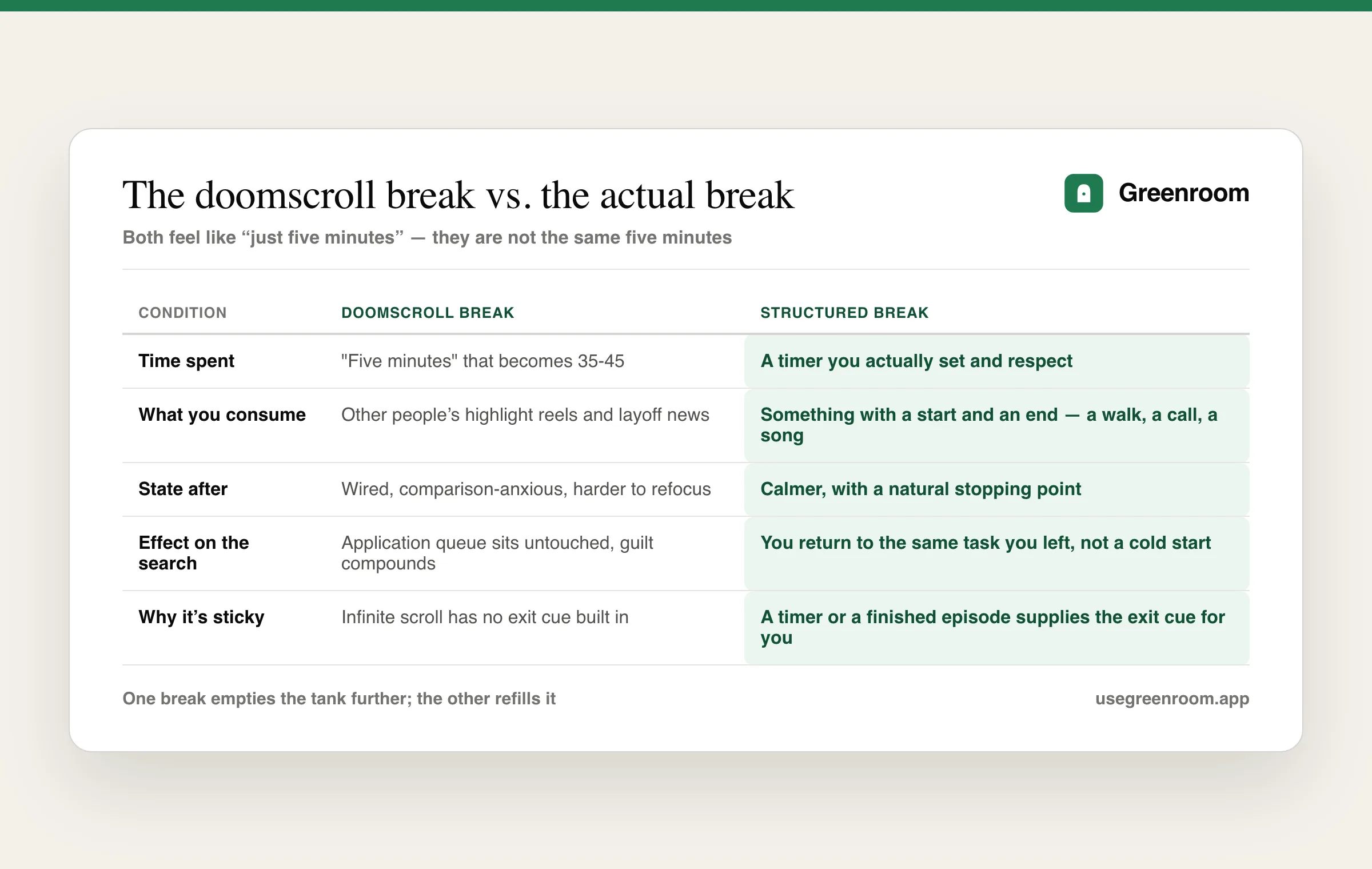
The structural difference is the exit cue. A real break — a walk, a phone call, a finished podcast episode, a song — has a built-in end point that tells you it's over. An infinite feed has no such cue by design; there is always one more post, which is precisely why "five minutes" so reliably becomes forty. This isn't a character flaw on your part. It's the entire point of how the product is built, and recognizing that takes some of the self-blame out of it — you weren't weak, you were using a tool engineered specifically to not let you stop.
What forty-one minutes actually looks like, broken down
Back to that synergy-box application, abandoned mid-sentence. Here's roughly what the 41 minutes actually contained, reconstructed the way most scroll sessions would look if anyone bothered to log them in the moment, which nobody ever does until afterward, ruefully:
0:00 — "I'll just check LinkedIn for five minutes"
0:02 — Three "humbled and excited" posts, one from a company you applied to
0:06 — A "people also viewed" rabbit hole on a candidate with your exact job title
0:14 — Switch to Instagram "just to clear my head" (this is the tell)
0:19 — A friend's trip photos, mildly nice, mildly comparison-inducing
0:24 — Switch to X because someone mentioned a "wild thread" about layoffs
0:33 — Read the wild thread, all 47 tweets, feel slightly worse than at 0:00
0:38 — Open the job application tab again, stare at the synergy box
0:41 — Close laptop, decide to "do it tomorrow with fresh eyes"
Nothing in that sequence was a single five-minute decision — it was eight or nine tiny, individually reasonable-feeling decisions, each one only a slight extension of the last, none of which felt like "I am now doomscrolling" in the moment. That's exactly why a pre-set timer beats willpower here: it doesn't ask you to notice the slide happening, it just ends the session at a fixed point regardless of which app you've drifted to by then.
The swap that actually works
The fix isn't "stop taking breaks" — breaks during a long, draining task are necessary, not optional, and trying to white-knuckle through application after application with zero breaks just produces a different kind of burnout. The fix is making the break something with a built-in exit, set up before you need it, so you're not relying on willpower to notice you've scrolled past the five-minute mark.
Set the timer before you open anything, not after. A 5-10 minute timer, started the second the break begins, removes the need to self-monitor — when it goes off, the break is over, full stop, no negotiation. This sounds almost too simple to be useful, and it's exactly the kind of trivially simple thing that works precisely because it doesn't depend on willpower in the moment.
Pre-select the break activity the night before, or at the start of the day. Decide in advance: "breaks today are a short walk, a glass of water, and texting a friend back" — anything with a natural stopping point. Deciding in the moment, scrolling-tired, is exactly when the path of least resistance (open the app that's already one thumb-tap away) wins by default.
If you must check a platform for a real reason, do the real task first, then close it — don't let "checking for replies" become "scrolling." Open LinkedIn, check messages, close LinkedIn. The danger window is the three seconds after the real task is done, when the feed is right there and the friction to keep scrolling is zero. Treat that moment as the actual decision point, not the original "I'll just check something" moment, which usually had a legitimate reason behind it.
Move the apps, or use a built-in limiter, for the hours you've designated as search-and-prep time. Most phones now have a native screen-time limiter (iOS Screen Time, Android Digital Wellbeing) that can hard-block or soft-block specific apps during set hours — set it for your daily search-and-prep block, not all day, since an all-day ban usually just gets disabled out of frustration within a week. The goal is removing the decision at the exact moments it's hardest to make well, not eliminating the apps from your life.
Batch your "checking for news/updates" into one scheduled slot a day, the same way you'd batch rejections. If you genuinely want to stay aware of market news, layoffs, hiring trends — fine, give it fifteen minutes once a day, at a time you choose, rather than letting it leak into every gap between tasks. The content isn't the problem; the unboundedness of consuming it is.
Where this connects to the rest of the search
This habit doesn't exist in isolation — it's usually a symptom of the same underlying pressure discussed in staying motivated during a long job search: uncertainty, a slow feedback loop, and an identity that's started to wobble under the weight of "still searching." If the routine described there — a daily cap, a batched rejection review, a scheduled off day — is in place, the urge to doomscroll usually drops on its own, because there's less raw, unstructured anxiety looking for an outlet. Doomscrolling fills a vacuum; a routine removes the vacuum.
It's also worth being honest about when the urge spikes hardest, because the pattern is usually predictable once you look for it: right after submitting an application (the "now what" gap), right before checking email for a response, and late at night when the search has been sitting unfinished all day and guilt about it is at its peak. Each of those moments has a more specific fix than "try not to scroll" — closing the application tab and physically standing up after submitting, batching email checks to set times instead of checking on impulse, and treating "the search day is over" as an actual, declared boundary rather than something that just trails off into a scroll session because nothing else was scheduled.
What other approaches get wrong
It's worth naming the usual advice here, because most of it isn't wrong exactly, it's just incomplete in a way that makes it fail in practice.
"Just delete the app." Works for purely recreational apps, doesn't work cleanly for LinkedIn during an active search, since you genuinely need it for messages, applications, and networking. Deleting it entirely just means reinstalling it within a week, often with extra guilt attached. The fix above — limiting hours, not access — works better precisely because it doesn't ask you to give up something you actually need.
A generic "digital detox" weekend. Fine as an occasional reset, but it doesn't change the daily pattern that's actually causing the problem — the post-application "now what" gap, the pre-email-check anxiety spike — and those triggers will be exactly as strong the Monday after the detox ends. A detox treats the symptom for 48 hours; the swap above is meant to hold up every single day.
Generic productivity apps that block all distracting sites. Genuinely useful as a blunt instrument, and worth using during the daily search-and-prep block specifically — but they tend to get uninstalled or disabled the first time someone "really needs" five minutes of a break, because they don't replace the broken break with a working one, they just remove the option entirely and leave the underlying urge unaddressed.
ChatGPT or a generic productivity bot as an accountability check-in. Mildly useful as a nudge, but it has no idea whether you actually took a real break or a doomscroll break — it can only go on what you tell it, and the whole problem is that in the moment, "I'll just check one thing" doesn't feel like the start of a 40-minute scroll. None of this is something a chatbot reminder fixes; it's a structural fix (the timer, the pre-decided activity, the app-hour limiter), not an awareness one.
Where Greenroom fits in, specifically: the highest-anxiety trigger for doomscrolling during a search is usually the gap between "I submitted something" and "I have no idea if I'm actually ready for the interview if it comes." Structured, spoken mock interview practice with real follow-up questions closes that specific gap — instead of an open-ended worry that has nowhere productive to go (and often ends up resolved by scrolling instead), you get a concrete, scheduled task that actually answers the "am I ready" question with real feedback. It won't fix doomscrolling generally, but it removes one of its biggest specific triggers during a search. Pair it with how to deal with interview anxiety for the rest of the pre-interview nervous energy.
When it's more than a habit
Reaching for the phone during a stressful task is a normal, common pattern, and the fixes above handle the ordinary version of it. It's worth a closer look, though, if the scrolling has started to feel less like a habit you fall into and more like something you can't stop even when you actively want to — if it's regularly displacing sleep, if you notice real physical anxiety symptoms (racing heart, tight chest) specifically while scrolling that don't resolve afterward, or if the content you're drawn to is making you feel hopeless rather than just anxious. That's a heavier pattern than a job-search-specific habit, and it's worth raising with a doctor or mental health professional rather than trying to timer your way out of it — the structural fixes in this post are built for ordinary compulsive scrolling, not for something that's tipped into a bigger mental health concern.
FAQ
Why do I doomscroll so much during a job search?
A job search adds uncertainty the feed falsely promises to resolve, forces you onto the same platforms (especially LinkedIn) that are also engineered to keep you scrolling, and surrounds you with other people's good news at the exact moment social comparison theory predicts you're most vulnerable to it. It's not a willpower problem — it's an ordinary habit made stronger by the specific conditions of searching for a job.
How does doomscrolling actually hurt a job search?
Beyond the lost time, it resets your nervous system to a mildly anxious state right before tasks that need calm focus, breaks your concentration in a way that costs more total time than finishing the original task would have, and tends to surface "evidence" that confirms whatever anxious story you already believed about the market or your chances — none of which is representative of your actual situation.
What's the difference between a doomscroll break and a real break?
A real break has a built-in exit cue — a finished walk, a finished song, a timer that ends the activity for you. An infinite feed has no exit cue by design, which is exactly why "five minutes" reliably turns into forty. The fix is choosing breaks with a natural stopping point and setting a timer before the break starts, not relying on noticing you've scrolled too long.
Should I just delete LinkedIn during my job search?
Usually not fully — you need it for messages, applications, and legitimate networking, so deleting it tends to lead to reinstalling within days, often with extra guilt. A better fix is limiting the hours you can access it (using your phone's built-in screen-time limiter) and treating "check for replies, then close it" as the actual task, rather than letting the feed become the default activity the moment the real task is done.
Which platform is worst for doomscrolling during a job search?
It varies by person, but LinkedIn is uniquely sticky because it's both a real tool you need (messages, applications) and an algorithmic feed engineered to hold attention, so a legitimate "check for replies" task slides into scrolling with almost no friction. Instagram and X tend to bait with lifestyle comparison and doom-economy threads respectively, and WhatsApp/Telegram placement groups bait through a constant low hum of other people's results rather than an algorithm — each needs a slightly different fix (an hour-limiter for feeds, muted notifications with scheduled check-ins for group chats).
Is doomscrolling during a job search a sign of something more serious?
Usually it's just an ordinary habit made stronger by the uncertainty and comparison built into searching for a job, and the structural fixes — a timer, pre-decided break activities, hour-limited app access — typically help within a week or two. If it's regularly displacing sleep, comes with physical anxiety symptoms that don't resolve afterward, or leaves you feeling hopeless rather than just anxious, that's worth a conversation with a doctor or mental health professional rather than a habit fix alone.