The answer was going fine. Genuinely fine — a clear situation, a real decision, a believable result. Then, mid-sentence, a slightly clumsy phrase came out, the kind every human says a dozen times a day without consequence. And a second voice, the one that's always running quietly in the background during anything evaluative, suddenly turned the volume up: that was awkward, they definitely noticed, you're losing them. The sentence after that one came out worse — shorter, faster, less sure — because half the available attention had just been redirected from "finishing this answer" to "listening to a running commentary about how badly this answer is going."
That's negative self-talk during interviews, and it's a different problem from the anxiety or the fear that usually gets blamed for a rough stretch in an interview. It's not a feeling — it's a live narration track, running in real time, commenting on your performance while you're still performing, and the content of that narration measurably changes what happens next. This post is about why the inner critic does more damage than the original stumble it's reacting to, and the specific reframe — critic versus coach — that keeps an answer on track instead of compounding.
Why the narration matters more than the stumble
Almost every real interview includes small imperfections: a pause, an imprecise word, a sentence that trails off and needs restating. By themselves, these are invisible — interviewers see hundreds of them across every candidate they talk to and rarely register any individual one as meaningful. What actually determines whether a small stumble stays small or snowballs into a visibly rattled answer is the internal narration that follows it, because that narration consumes cognitive resources that would otherwise go toward continuing the answer.
This is a real, measurable effect, not just a vibe: psychological research on self-talk consistently finds that the content of internal narration during a performance task changes outcomes on that same task — critical, judgmental self-talk tends to narrow attention and increase physiological arousal in a way that degrades performance on tasks requiring flexible thinking (exactly what an interview demands), while neutral or instructional self-talk tends to support continued performance instead of interrupting it. The stumble is a small, recoverable event. The narration is what decides whether it recovers or compounds.
Critic voice vs. coach voice
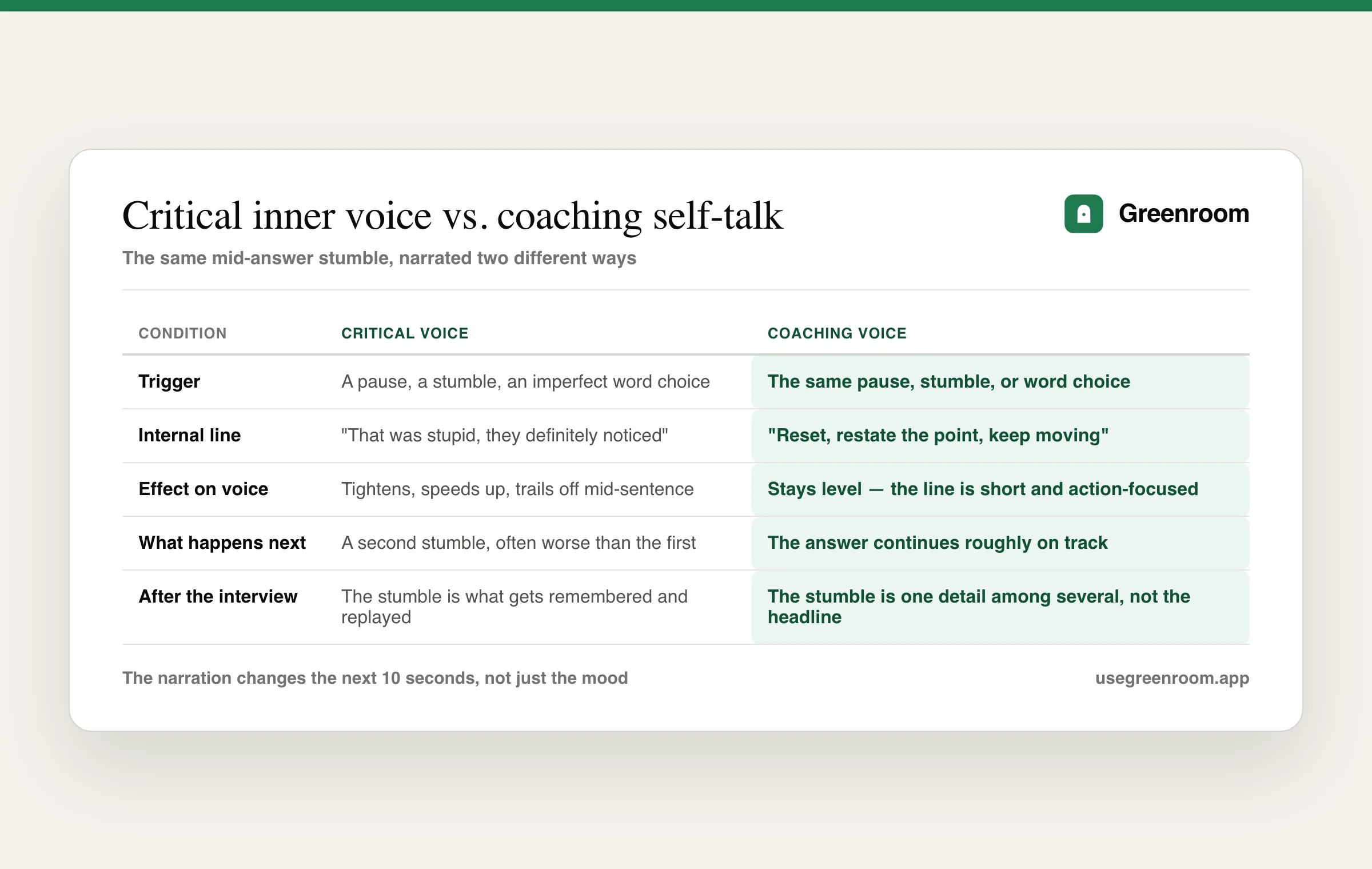
The same trigger — a pause, a stumble, an imprecise word — produces two completely different chains depending on which internal voice responds to it. The critic narrates a verdict: "that was stupid, they definitely noticed." It's evaluative, past-tense, and aimed at you as a person rather than at the next useful action — which is exactly why it doesn't help: a verdict gives you nothing to do next except feel judged. The coach narrates an instruction: "reset, restate the point, keep moving." It's short, action-focused, and aimed at the very next thing to do, which is the only thing that's actually useful mid-sentence.
The downstream effects diverge fast. Under the critic, voice tightens, pace speeds up defensively, and the next sentence often trails off — a second, often worse stumble, directly caused by attention being split between speaking and self-monitoring. Under the coach, voice stays roughly level, because the internal line was short enough not to compete with actually talking, and the answer continues close to its original track. And afterward, the critic's version is what gets replayed and remembered — disproportionately, because the emotional charge of self-judgment makes it more memorable than the actual five other things that went fine in the same answer.
How to actually swap the voice
1. Pre-write your coach line before you need it
Trying to invent a calm, useful response to a stumble in the half-second after it happens, while also still trying to talk, is asking too much of the moment. Pre-write two or three short coach lines in advance — "reset and restate," "keep going, finish the thought," "that's fine, next point" — so that when a stumble happens, you're retrieving a rehearsed line instead of authoring a new one under pressure. This is the same principle behind a pre-built scaffold phrase for mind freeze — the time to write the line is in advance, not mid-crisis.
2. Notice the critic without arguing with it
Trying to suppress or argue down the critical voice mid-answer ("no, that wasn't stupid, stop saying that") spends just as much attention as the criticism itself, because you're still engaging with its content. The more efficient move is simply noticing it ("there's the critic") and redirecting to the coach line, without debating whether the critic's claim was true — a debate you can't afford to have while you're also supposed to be finishing a sentence out loud to another person.
3. Practice the swap under real conditions, not in your head
Like any other interview skill, the critic-to-coach swap is far easier to describe than to execute live, and the gap between the two only closes with practice under conditions that actually produce stumbles — a timer, a real question you didn't choose, an audience. Rehearsing it silently, in your head, while calm, builds almost none of the actual skill, because the skill is specifically about executing the swap while under the load that triggers the critic in the first place.
4. Separate the content of the criticism from the fact that it showed up
It's worth distinguishing "the critic showed up" (normal, happens to almost everyone, not a sign anything is wrong) from "the critic is right" (usually not, since interviewers rarely register the small things the critic fixates on). The goal isn't to never hear the critical voice — it's to stop treating its appearance as evidence you should believe its content.
5. Build a short list of genuinely true counter-facts in advance
For your most common critic lines, prepare one or two short, accurate counter-facts you can retrieve fast: against "they definitely noticed that," the counter-fact "interviewers see dozens of small stumbles a week and rarely register any individual one" is both true and short enough to use live. This works better than vague reassurance ("don't worry about it") because it's specific and verifiable, which makes it easier to actually believe in the moment rather than dismiss as wishful thinking.
How this differs from generic "be positive" advice
"Just think positive" or "talk to yourself kindly" gestures at the right direction but misses the mechanism: the goal isn't a nicer internal voice, it's a shorter, more action-focused one. A kind but long internal monologue ("it's okay, everyone makes mistakes, you're doing great, just relax") can compete with active speech almost as much as a critical one does, because it's still pulling attention away from the answer in progress. The coach voice that actually works is closer to a sports cue than a comforting speech — brief, instructional, and over in under a second, which is the entire reason it doesn't interrupt the flow it's trying to protect.
ChatGPT can help you draft coach lines and counter-facts in advance, which is genuinely useful prep work — but it can't put you in a live, evaluative exchange and tell you, in the moment, whether your swap from critic to coach actually worked or whether the stumble compounded anyway. Greenroom runs spoken mock interviews specifically so you can rehearse the swap under real, evaluative pressure and get feedback on whether your recovery actually held — the only way to know if the technique works for you is to test it under the kind of load that triggers the critic in the first place, not in a quiet room reading about it.
Frequently asked questions
Why does my mind go negative the moment I make a small mistake in an interview?
This is a normal critical self-talk response, not a sign anything is uniquely wrong with you — most people have some version of an internal critic that activates under evaluation. The issue isn't that the critic shows up; it's that engaging with its content (rather than redirecting past it) pulls attention away from continuing the answer, which is what actually compounds a small stumble into a bigger one.
What's the difference between negative self-talk and interview anxiety?
Anxiety is a broader physiological and emotional state — racing heart, dread, difficulty concentrating — that can exist before you've said a word. Negative self-talk is a specific, real-time internal narration that responds to particular moments (a stumble, a pause) during the interview itself. They often occur together and intensify each other, but negative self-talk is the narration track specifically, not the underlying anxious state.
How do I stop the inner critic from talking during an interview?
The more reliable approach isn't suppression (which tends to backfire) but redirection: notice the critic showed up, don't engage with its content, and retrieve a pre-written, short, action-focused coach line instead ("reset and restate"). Trying to argue the critic down mid-answer spends attention you need for the answer itself.
Does negative self-talk actually affect interview performance, or is it just unpleasant?
It measurably affects performance — critical self-talk tends to narrow attention and increase physiological arousal in ways that degrade flexible thinking, which is exactly what answering an unplanned question requires. The stumble that triggers the critic is usually small and recoverable on its own; the narration is what frequently turns it into a second, worse stumble.
Is talking to yourself kindly during an interview enough to fix this?
Kindness helps emotionally, but the more important property is brevity and action-focus, not warmth alone — a long, comforting internal monologue can compete with active speech almost as much as a critical one, because both pull attention away from the answer in progress. Short, instructional coach lines work better specifically because they're over fast enough not to interrupt your flow.
Can practicing out loud actually change my internal self-talk pattern?
Yes — the critic-to-coach swap is a skill that's specifically about executing under real pressure, not something you can fully build by thinking about it calmly in advance. Rehearsing out loud, under realistic conditions that actually trigger stumbles, is what closes the gap between knowing the technique and being able to use it live.