She'd prepped for a music company. Rehearsed a line about growing up on Discover Weekly, practiced saying "squad" and "tribe" like she'd read the Spotify org chart cover to cover. Forty minutes into the onsite, the interviewer pulled up a dashboard and said: "Playlist load times just spiked 400% in the EU. You're the on-call engineer. What do you check first?" No whiteboard. No LeetCode. Just a broken system and a clock. She said "squad" one more time out of habit. It did not help.
Spotify interview questions span four genuinely different registers, and candidates who prep for only one walk in exposed: a coding round graded more on clean, production-shaped code than clever tricks; a system design round drawn straight from Spotify's real product surface — recommendations, shuffle, audio delivery, search; a live incident-response case study that no question bank rehearses; and a values round that survived Spotify's leanest years intact. This guide covers all four, with the specifics grounded in what candidates on Blind and Glassdoor consistently report and what Spotify's own engineering team has published — hedged, honestly, everywhere the exact structure isn't public record.
The Spotify interview process, round by round
The shape below is what's consistently reported across candidate write-ups from 2022 through 2026 — treat the exact round count and order as commonly reported, not a disclosed internal standard, since it varies by team, level and year:
- Recruiter screen (30–45 min). Background, motivation, comp expectations, and why Spotify specifically.
- Technical screening (~75 min). Unusually dense for a first technical round: a deep-dive discussion of a past project, some domain-specific trivia, and a live coding exercise, all in one sitting.
- Onsite loop (four rounds, ~45–60 min each). A coding round focused on clean, production-quality code over algorithmic tricks; a system design round built around a real Spotify feature; a case study built as a simulated production incident (backend and infra candidates report this specifically); and a behavioral/values round.
- Hiring decision. Feedback typically routes through a panel rather than a single interviewer's call, as at most companies this size.
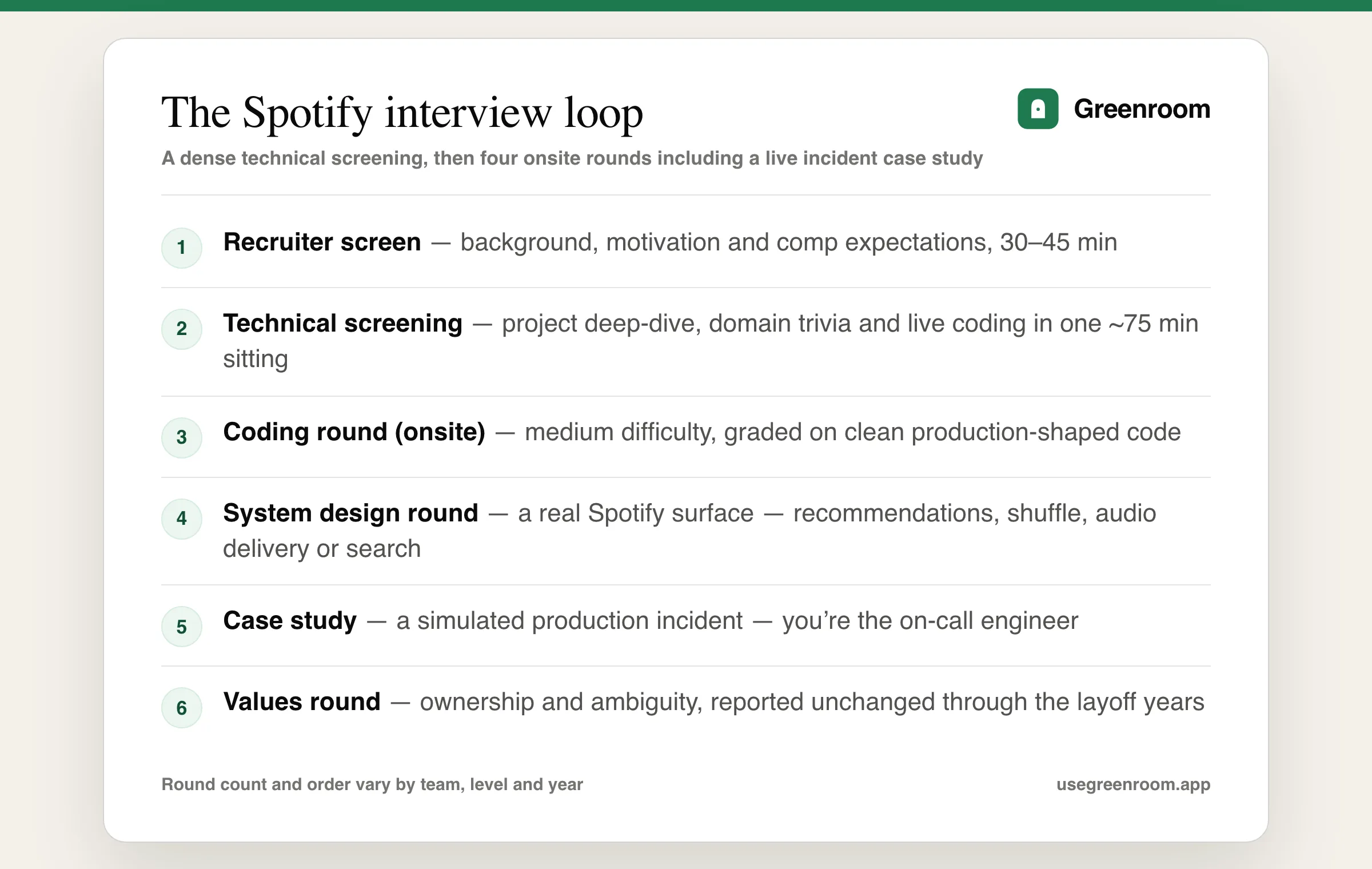
The technical screening is the round that trips people up first: it's not "one LeetCode problem," it's a project deep-dive, trivia, and live coding compressed into 75 minutes, so a candidate who only rehearses algorithms burns the first third of the round underprepared for the other two-thirds.
Spotify coding interview questions
Multiple candidate write-ups converge on the same description: problems are typically medium difficulty, and the round leans toward "would this code survive a real pull request review" more than "did you spot the trick." That's a real, verifiable difference in emphasis from a pure-algorithms shop — expect the interviewer to ask about edge cases, naming, and how you'd test the function, not just whether it passes.
Commonly reported topic areas:
- Arrays, strings, hashmaps — the standard baseline, same as most tech interviews.
- Queues and heaps — a natural fit for anything playback-shaped: play queues, priority-ordered recommendations, rate limiting.
- Practical, product-flavored prompts rather than pure abstract algorithms — candidates report problems phrased around things like deduplicating a play history or merging two sorted queues, not "reverse a linked list" in isolation.
- Code quality as a graded axis. Naming, structure, and whether you'd ship it, not just whether it's correct.
A worked example that fits the pattern — merging a user's two device queues (say, phone and speaker) into one ordered play queue without duplicate track IDs:
def merge_queues(queue_a, queue_b):
    # queue_a, queue_b: lists of (track_id, added_at) tuples, each already
    # sorted by added_at within its own device
    seen = set()
    merged = []
    i = j = 0

    while i < len(queue_a) and j < len(queue_b):
        a_track, a_time = queue_a[i]
        b_track, b_time = queue_b[j]
        next_item, advance_i = (queue_a[i], True) if a_time <= b_time else (queue_b[j], False)
        i += 1 if advance_i else 0
        j += 0 if advance_i else 1
        track_id = next_item[0]
        if track_id not in seen:
            seen.add(track_id)
            merged.append(next_item)

    for remaining in (queue_a[i:], queue_b[j:]):
        for item in remaining:
            if item[0] not in seen:
                seen.add(item[0])
                merged.append(item)

    return merged
The realistic follow-up isn't "what's the time complexity" — it's "what happens if the same track gets added on both devices within a second of each other," which is exactly the kind of production edge case the round is designed to surface.
Spotify system design interview questions — tied to the real product
This is where genuine Spotify-specific prep pays off, because the prompts are reported to draw directly from Spotify's actual product surface rather than a generic "design a scalable web service" template.
"Design a music recommendation system" (Discover Weekly-shaped)
Spotify's own public materials and third-party technical writeups describe the real system as a blend of collaborative filtering (behavioral signals — plays, skips, saves, playlist adds), content-based filtering, and audio analysis models that can recommend a brand-new track before it has accumulated listening history. A detail worth knowing and using in interview: Discover Weekly-style playlists are widely reported to be precomputed on a schedule (weekly) rather than generated live on open — a deliberate tradeoff that lets Spotify run heavier models than a real-time request could tolerate, at the cost of freshness. Treat any specific scale figure (event volume, user counts) you see in prep guides as directional, not disclosed — Spotify hasn't published exact infrastructure numbers, and neither should your answer pretend to know them.
- Signal sources. Collaborative filtering, content-based audio features, and NLP over text mentioning tracks/artists — naming more than one signal, and explaining why relying on only one fails (new tracks have no play history; pure collaborative filtering can't recommend them), is the actual signal interviewers listen for.
- Batch vs. real-time. Precompute the expensive personalization weekly; keep a lightweight online layer for freshness (recently played, session context).
- Cold start. New users and new tracks both need a fallback path — genre/audio-similarity for new tracks, onboarding taste surveys or popularity-weighted defaults for new users.
- Evaluation. Propose a real metric — completion rate, save rate, skip rate within the first 30 seconds — rather than "the recommendations are good."
"Design shuffle" — a real, published engineering problem
This one is worth knowing in more depth than most prep guides bother with, because Spotify has publicly written about it. Early versions used a straightforward Fisher-Yates-style random permutation — mathematically fair, but users reliably complained it didn't feel random, because true randomness clusters (two songs by the same artist back to back, a long gap before a favorite plays). Spotify's engineering blog has described the fix as scoring candidate sequences for perceived freshness — penalizing recently-played tracks appearing early — and picking the freshest-feeling sequence from a set of valid random orderings, rather than treating "more random" as the goal. It's a genuinely good real-world example of a system where the textbook-correct answer (pure randomness) was the wrong product answer, and it's fair game as a design prompt or a follow-up inside a broader playback-system question.
- The tension to name out loud. Statistically random ≠ perceived as random — this is the actual insight the question is testing whether you've thought about, not just whether you know Fisher-Yates.
- Constraints. Space out same-artist and same-album tracks; avoid replaying recently-heard tracks near the top of a session; keep it fast enough to run client-side or in a low-latency service, since shuffle needs to feel instant.
"Design audio delivery at scale"
- Adaptive bitrate. Serve different encodings based on network conditions (mobile data vs. wifi), the same core idea as adaptive streaming in any large video/audio platform.
- CDN and caching. Popular tracks are cache-friendly and get pushed to edge nodes; the long tail (a huge share of Spotify's catalog, given the platform's own reporting of tens of millions of tracks) doesn't, which shapes cache-hit-rate tradeoffs worth naming.
- Prefetching. Since the next track in a queue is often predictable, prefetching it during playback of the current track is a real, reasonable optimization to propose — and a natural bridge back to the shuffle/queue design above.
- Offline/downloaded playback. Worth a mention for mobile: sync, storage limits, and DRM-adjacent licensing constraints on offline tracks.
"Design search / personalized search"
- Two-stage retrieval-then-ranking, the standard pattern for search at scale: a fast candidate-retrieval stage (text match on track/artist/album/podcast metadata) followed by a personalized ranking stage.
- Personalization signals specific to a listening product — a user's own genre history, time-of-day listening patterns (workout playlists in the morning, wind-down music at night), and past search-to-play conversion.
- Cross-content-type ranking, since Spotify search spans songs, podcasts, audiobooks, and playlists in one result set — a real complexity most generic "design a search engine" templates don't address.
The case study round — Spotify's on-call incident simulation
This is the round most prep sites skip, and it's the one that most separates a Spotify loop from a generic big-tech one. Backend and infrastructure candidates consistently report a case study framed as a live production incident: something is broken, you're the on-call engineer, and the interviewer knows what's wrong but won't tell you — they reveal dashboards, logs, or command output only in response to what you actually ask for.
There's no question bank for this because the format punishes memorized answers by design. What candidates report actually works:
- Narrate your hypothesis before you ask for data. "I'd check whether this is isolated to one region first, because that would point at infrastructure rather than the application" — say it, then ask for the region breakdown, rather than firing off command names hoping one lands.
- Ask for the boring things first. Recent deploys, error rate by service, and latency percentiles are the equivalent of "check if it's plugged in" — interviewers report candidates who skip straight to exotic theories losing time they don't get back.
- Treat silence from the interviewer as information. If a hypothesis is wrong, most interviewers won't say "wrong" — they'll give you data that quietly rules it out. Noticing that and pivoting is part of what's graded.
- Prepare two or three real incident stories from your own work, with specifics — not to recite, but because thinking in "symptom → hypothesis → check → next hypothesis" out loud is a rehearsable skill even though the specific incident isn't.
Spotify behavioral and values questions
Every account of Spotify's post-2023 restructuring years agrees on one thing: the company got leaner, cut roughly 25% of its workforce across three rounds that year, and centralized engineering under a smaller leadership structure — and candidates report the values round kept its weight through all of it, functioning as a real filter rather than a soft formality. Expect direct questions about ownership, working with ambiguity, and how you've handled a project when priorities shifted underneath you — themes that map naturally to a company that has publicly described itself as leaner and "more focused" rather than pretending nothing changed.
One thing worth correcting before it costs you a round: Spotify is the company behind the famous "Spotify model" — squads, tribes, chapters, guilds — that spread across the industry as an agile-scaling framework roughly a decade ago. If you're tempted to reference it as current fact, hedge it: Spotify itself has publicly distanced from the model as originally described, and multiple retrospectives (including from people who worked there) note the company never actually operated exactly the way the famous 2012 model paper described, and has evolved substantially since. Bringing it up as "I love your squad-and-tribe structure" reads as prep from a decade-old blog post, not current knowledge of the company. If autonomy and ownership come up, talk about your own experience with autonomous work — that's the actual thing the round is testing, not trivia about an org chart.
- Ownership. "Tell me about something you drove without being asked" — a real theme across write-ups, consistent with a leaner org where fewer people cover more ground.
- Working through ambiguity. "Tell me about a project where the requirements changed midway" — expect a genuine follow-up on how you reprioritized, not just that you coped.
- Cross-functional collaboration. Product, design, and data science sit close to engineering at Spotify by most accounts; expect a story that isn't purely "I wrote the code," but shows you working with non-engineers toward a shared outcome.
How the loop differs by role
- Backend / infrastructure. The full loop above, including the case-study on-call round, which is reported most consistently for this track.
- Data engineering / ML. Expect the system design round to shift toward the recommendation pipeline itself — feature stores, batch vs. streaming pipeline design, and model-serving latency — rather than general product architecture. Given Spotify's public emphasis on personalization as a core differentiator, expect deeper follow-ups here than at a company where recommendations are a secondary feature.
- Frontend / mobile. Coding and design rounds shift toward client-side concerns — offline playback state, prefetching UX, and rendering a queue that updates in real time across devices — with the case-study round less consistently reported for this track.
Our system design interviews guide covers the general framework these role-specific rounds sit on top of, and frontend system design interview questions is the right companion if the design round for your Spotify loop is client-side.
Question dumps, GeeksforGeeks threads, and where they fall short
Search "spotify interview questions" and most results are a list of question titles with no worked answer, or a GeeksforGeeks-style thread of one-line "I was asked X" reports. LeetCode is genuinely useful for the coding round — the medium-difficulty, clean-code emphasis rewards real reps — but it does nothing for the two rounds that actually decide a Spotify offer: explaining why your shuffle design accounts for perceived randomness, not just statistical randomness, and narrating a live incident investigation out loud when nobody hands you the answer in advance.
A friend's WhatsApp PDF of "questions I got asked" has the same gap — it's a transcript of someone else's incident, not a rehearsal of the skill. Prompting ChatGPT to "ask me Spotify interview questions" gets you a list, not a real follow-up that pushes back when your hypothesis is wrong the way an actual on-call round will. Greenroom runs the system design and case-study-style rounds out loud, with Ari asking the kind of incremental follow-up a real interviewer would — "that would explain the EU spike, but why only EU, check the CDN region data" — because the real interview rarely accepts your first hypothesis. The honest tradeoff: Ari won't hand you a live production dashboard to debug, so pair spoken practice with your own incident post-mortems and real DSA reps.
How to prepare for the Spotify interview
- Weeks 1–2. DSA fundamentals with an emphasis on writing production-shaped code — clear naming, edge cases, a note on how you'd test it — not just getting to a correct answer fast.
- Week 3. Design the recommendation system, shuffle, and audio delivery out loud, from scratch, twice each. On the second pass, name the specific tension (freshness vs. compute, perceived vs. actual randomness, cache-hit-rate vs. catalog long tail) in the first two minutes instead of working up to it.
- Week 4. Write down two or three real incident or production-bug stories in "symptom → hypothesis → check → next hypothesis" form, then practice narrating one you haven't looked at in a week, cold.
- Final days. A full mock loop — one coding round, one system design round, one incident-style case round, one values round — back to back, the way the real onsite will actually feel.
For the DSA-heavy weeks, our DSA coding interview preparation guide is a solid base. For narrating your own projects under follow-up questions — the exact skill the case-study round rewards — talking about your GitHub projects in interviews and coding interview communication tips are worth a read before the onsite.
Frequently asked questions
What is Spotify's interview process for software engineers?
Candidates commonly report a recruiter screen, a dense ~75-minute technical screening that combines a project deep-dive, trivia, and live coding, and a four-round onsite loop covering coding, product-specific system design, a simulated production-incident case study (most consistently reported for backend/infra roles), and a values round. The exact structure varies by team, level and year.
What coding questions does Spotify ask?
Spotify's coding rounds are reported as medium difficulty with a real emphasis on clean, production-quality code — naming, edge cases, and testability — over algorithmic tricks. Common topics include arrays, strings, hashmaps, queues and heaps, often phrased around practical, playback-shaped scenarios like merging play queues or deduplicating listening history rather than abstract textbook problems.
What system design questions does Spotify ask?
Reported prompts draw directly from Spotify's real product: designing a recommendation system like Discover Weekly (collaborative filtering, content-based signals, and precomputed weekly personalization), designing shuffle (a real, published engineering problem about perceived versus statistical randomness), designing audio delivery at scale (adaptive bitrate, CDN caching, prefetching), and designing personalized search across songs, podcasts and playlists.
Does Spotify still use the "Spotify model" of squads and tribes?
Not as originally described. Spotify has publicly distanced itself from the model as it was popularized roughly a decade ago, and people who've worked there report the company never operated exactly the way the famous model paper described in the first place, evolving substantially since — including consolidating engineering leadership during its 2023 restructuring. Referencing it as current fact in an interview reads as outdated prep rather than current company knowledge.
What is the Spotify case study / on-call round?
Backend and infrastructure candidates consistently report a case-study round built as a simulated production incident: you play the on-call engineer, something is broken, and the interviewer reveals dashboards, logs or data only in response to what you specifically ask for. It rewards narrating a hypothesis-check-pivot process out loud over memorized answers, since there's no fixed question to prep from.
How many rounds are in a Spotify interview?
Most candidates report five to six total touchpoints: a recruiter screen, a combined technical screening, and a four-round onsite loop (coding, system design, case study, values). This varies by role and level, and the case-study round is reported most consistently for backend and infrastructure candidates specifically.