He was rejected in March, after the third round, by the one company he actually wanted.
So he waited. He had read somewhere that six months was the number, and six months sounded like the kind of thing that was probably true. In November he opened the careers page, found more or less the same role, and submitted more or less the same resume. Rejected in four days — faster than the first time, which he found genuinely insulting.
The speed was the tell. Nobody spent four days evaluating him. Companies keep your application history, and a recruiter opening your new application can usually see the old one: which role, which round you reached, and a short reason code someone typed in March. A resubmission with nothing changed does not get re-evaluated. It gets answered by the record.
Which means the advice everyone repeats is aimed at the wrong variable. The clock is not the gate. The delta is. Six months with nothing different is the same application arriving later. Two months with genuinely new scope is a different candidate.
What actually happens when you reapply
Practice varies by employer, and the general shape is consistent enough to plan around:
Your history is stored. Applicant tracking systems retain previous applications, the stage reached, and usually an internal disposition or reason code. That code is written for the company's records, not for you, and it is rarely something you will ever see.
Some companies publish a cooling-off period. Commonly six or twelve months, sometimes specific to the role or the stage you reached. Many companies have no formal rule at all. This is worth asking a recruiter directly rather than guessing, and it is a completely normal question.
The round you failed at matters more than the fact of the rejection. A failed online assessment is a different record from "reached the hiring manager round, strong technically, not aligned on the role." The second is a much better position to reapply from than most people assume — our interview process, stage by stage guide covers what each round was actually measuring, which tells you what the note against your name probably says.
What counts as a real change
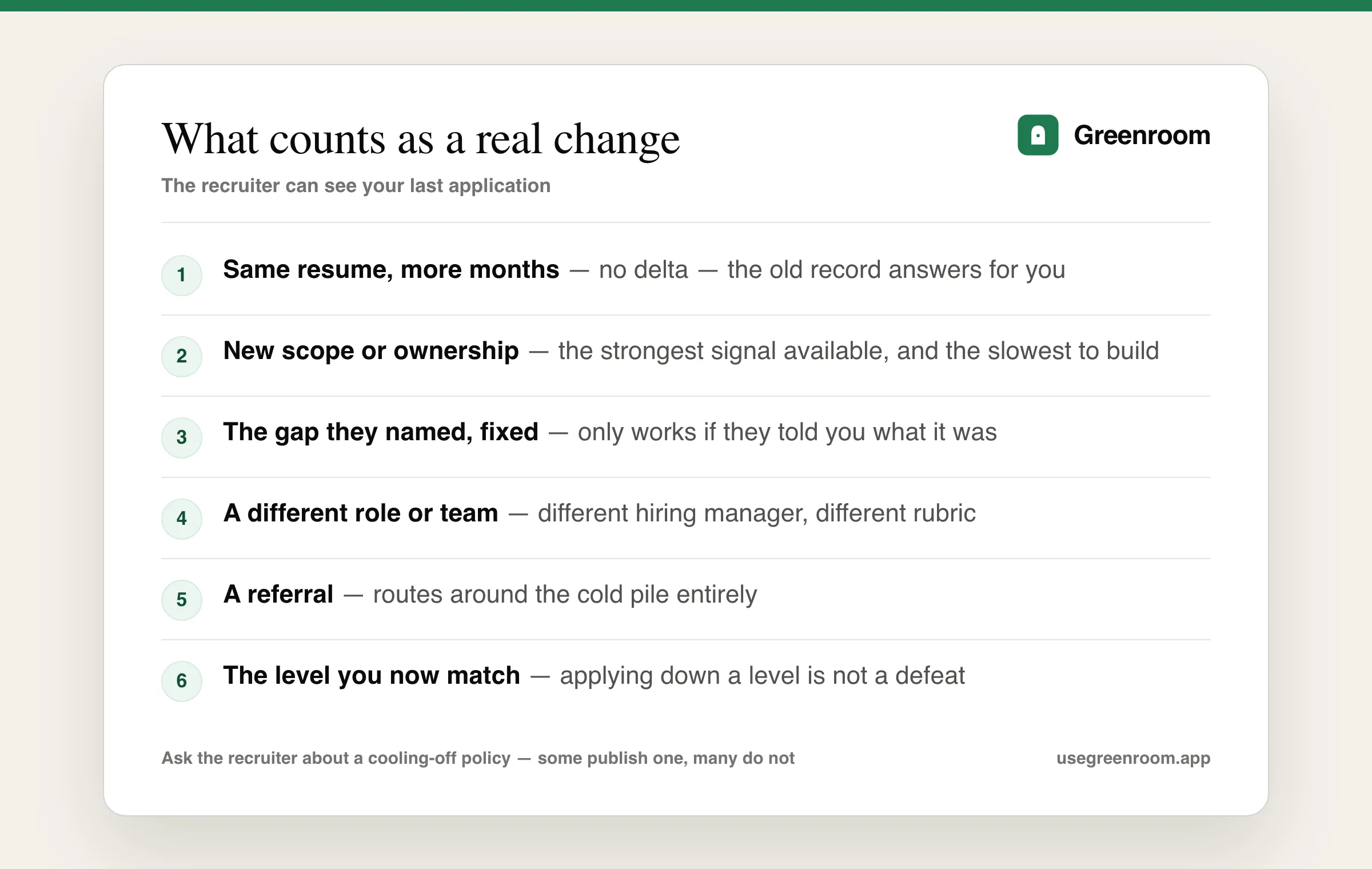
New scope or ownership. The strongest delta and the slowest to build. Owning something you did not own before — a service, a migration, a team's on-call — changes what your resume claims rather than how it is worded.
The specific gap they named, closed and evidenced. Only available if you got real feedback. If they said system design, then a design-heavy project you can talk about for twenty minutes is the answer. Our how to handle interview rejection guide covers extracting that feedback in the first place, which is the step most people skip.
A different role or team. Frequently the most effective move and the least considered. A different hiring manager applies a different rubric, and a rejection for one role is not a company-wide verdict. Large companies run near-independent hiring loops per org.
A referral. This routes around the cold application pile entirely, and a referrer's note carries more weight than an identical resume submitted through a form. Our how to ask for a referral guide covers doing it without it being awkward.
Applying at the level you actually match. If you were rejected as a senior and the feedback was about scope, applying at the level below is not a defeat. It is frequently the fastest route in, and internal moves upward are usually easier than external ones — as our internal transfer interviews guide covers.
What does not count: rewording bullet points, a new resume template, more months, or applying to four roles at the same company in the same week. The last one is actively harmful — it reads as spraying rather than targeting.
When it is worth reapplying
- You were rejected late in the loop. Reaching the hiring manager or final round means you cleared the filters most people do not. That record is an asset.
- The rejection was about fit or headcount, not capability. "We went with someone with more payments experience" is not a judgment on you.
- You have a specific, nameable change. If you cannot state it in one sentence, it is probably not there yet.
- A different team is hiring, particularly at a large company.
When it is not
- You failed the online assessment and have not practised since. The assessment does not care how you feel about it; our online coding assessments guide covers what actually moves that score.
- The feedback was about behaviour — how you handled disagreement, or a defensive reaction to being wrong. That is fixable, and it takes longer than a resume line and is harder to evidence.
- Nothing has changed and you are hoping the interviewer has forgotten. They may well have. The record has not.
How to actually do it
Apply, and add one short note — to the recruiter if you have a contact, in the cover-letter field if not:
*"I interviewed for the backend role in March and reached the final round. Since then I've taken over the payments reconciliation service end to end, which was the area the feedback pointed at. I'd welcome another conversation whenever there's a fit."*
It works because it does three things: it acknowledges the previous application rather than hoping nobody notices, it names a specific change, and it is short. Do not relitigate the rejection, do not ask why you were rejected months later, and do not apply to five roles simultaneously to increase your odds.
If you hear nothing, our how to follow up after no response guide covers the one follow-up worth sending.
Where the usual advice comes up short
"Wait six months." A reasonable default and not a rule. It is aimed at time when the thing that matters is change — and it leaves people waiting out a clock instead of building the delta.
"Just apply again, they won't remember." The individual interviewer may not. The applicant tracking system does, and that is what the recruiter opens first.
Reddit threads about specific companies. Genuinely useful for whether a particular employer enforces a cooling-off period, because policies do vary. Treat individual anecdotes as anecdotes.
Rewriting your resume. Worth doing if it was the filter — our ATS resume tips guide covers that properly. It does not help if you were rejected in round three, because the resume was never the problem.
Greenroom. Honest fit: if the rejection came from an assessment, practice problems matter more than anything Greenroom does. Where it helps is the case above — rejected late, told you were strong technically but something in the conversation did not land. That is a spoken-delivery gap, and Ari, the AI interviewer will make you repeat the answer until the follow-up stops catching you out. Honest tradeoff: Ari cannot tell you what reason code is sitting against your name.
The one-line version
Find out whether the company publishes a cooling-off period, work out which round you actually failed at, and reapply when you can name one specific thing that is different — new scope, the named gap closed, a different team, or a referral — because the recruiter opening your new application is looking at your old one, and more months is not an answer to it.
Frequently asked questions
Can you reapply to a company after being rejected?
Usually yes. Some employers publish a cooling-off period, commonly six or twelve months and sometimes specific to the role or the stage reached, while many have no formal rule at all. Because policy varies, asking a recruiter directly is reasonable and more reliable than guessing. What matters more than the waiting period is whether anything about your application has genuinely changed, since companies retain application history and a recruiter can typically see your previous application and the round you reached.
How long should you wait before reapplying to a company?
The common advice of six months is a reasonable default rather than a rule, and it points at the wrong variable. Time alone does not change how your application reads, because the previous record — the role, the stage you reached and an internal reason code — is attached to your file. A reapplication two months later with genuinely new scope is stronger than one twelve months later with the same resume. Check whether the company has a stated policy, then focus on the change rather than the calendar.
Do companies keep a record of rejected candidates?
Generally yes. Applicant tracking systems retain previous applications along with the stage reached and usually an internal disposition or reason code written for the company's records rather than for the candidate. This is why an identical resubmission is often answered quickly — it is being matched against the existing record rather than evaluated afresh. Retention practice and how much a recruiter sees varies by employer and by the system in use.
What should change before I reapply?
Something you can state in one sentence. The strongest change is new scope or ownership — work you did not previously do — because it alters what your resume claims rather than how it is phrased. Closing a specific gap they named in feedback is next, followed by applying to a different role or team where a different hiring manager applies a different rubric, obtaining a referral, or applying at the level you now actually match. Rewording bullet points and waiting longer do not count.
Is it worth reapplying if I failed at the final round?
Often it is one of the better positions to reapply from. Reaching a late round means you cleared filters most applicants do not, and if the rejection was about fit, headcount or a competing candidate with more directly relevant experience, it was not a judgment on your capability. That history sits in your record as an asset rather than a liability, particularly if you can point to a specific change since.
How do I mention my previous application when reapplying?
Acknowledge it briefly and name what is different. A short note to the recruiter, or in the cover-letter field, stating which role you interviewed for and when, how far you got, and the one specific thing that has changed since, works better than hoping nobody notices. Keep it to a few sentences, avoid relitigating the rejection or asking why you were rejected months after the fact, and do not apply to several roles at the same company simultaneously, which reads as untargeted.