He sent forty-one messages. All of them said, more or less, "Hi sir, I am looking for opportunities in your esteemed organisation, kindly refer me, resume attached." He got two replies. One said "sure, apply on the careers page" — which is not a referral — and the other said nothing further after asking which role, because he did not know which role.
The reframe that fixes referrals permanently: you are not asking for five minutes of someone's time. You are asking them to put their name on a stranger. Most companies pay a referral bonus and, more importantly, track who referred whom. If you interview badly, that is mildly embarrassing for them. If you are hired and do poorly, that is genuinely costly for them.
Once you see the request that way, every rule below is obvious — and every rule is about reducing *their* risk and *their* effort, not about being more polite.
What you are actually asking for
- Their reputation, staked on someone they may not know well.
- Their effort — the internal form, which at some companies is genuinely tedious and asks how they know you and why they recommend you.
- Their judgment, on record, in a system their colleagues can see.
They get a bonus if you are hired, which is real but usually smaller than people assume and paid months later, after probation. Do not treat the bonus as the reason they should help. It is not.
The four moves
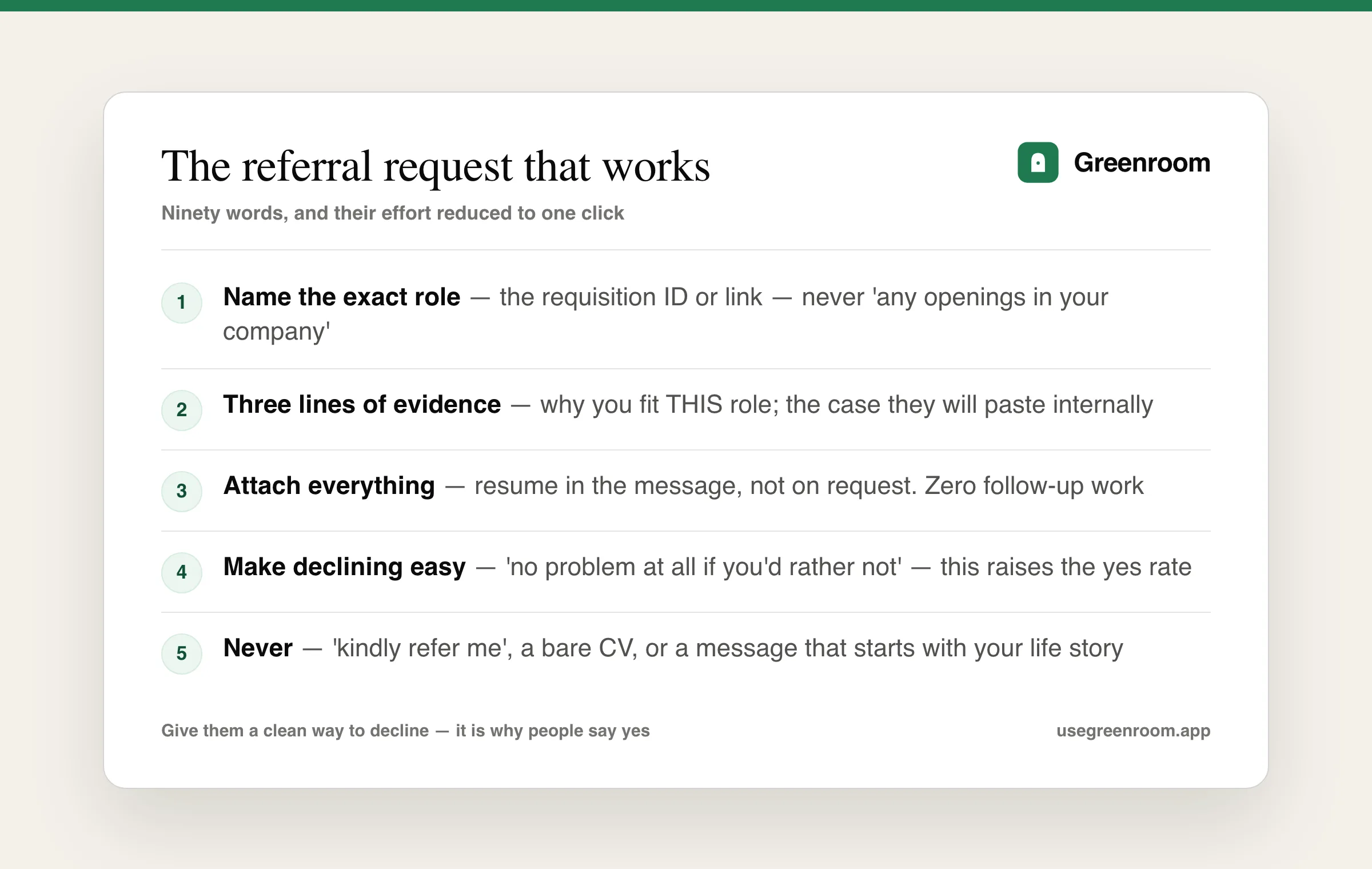
One — name the exact role. A requisition ID or a job link. Never "any suitable openings in your company". A vague request forces them to do the work of finding you a job, which is a much bigger ask than passing along a name, and it is the single most common reason these messages are ignored.
**Two — three lines of evidence for *that* role.** Not your biography. The specific case for why you fit this requisition, written so they can paste it straight into the internal form. You are drafting their justification for them.
Three — make it one click. Resume attached in the first message, not "I'll send it if you're interested". Link to the role. If your LinkedIn is relevant, mention it. Zero follow-up work required from them.
Four — give them a clean way to say no. Counter-intuitively this raises your success rate. "Completely understand if you'd rather not — no hard feelings either way" removes the social cost of declining, which is exactly what makes a hesitant person say yes instead of going quiet. People ghost because refusing is awkward; remove the awkwardness and they answer.
Templates
A former colleague or manager — the strongest case:
Hi Priya — hope things are good at Razorpay.
I saw a Senior Backend Engineer opening on your payments team (req #4821). I've been doing similar work at [company] for the last two years — owned the settlement service, took p99 from 900ms to 210ms, and handled the reconciliation rewrite.
Would you be open to referring me? Resume attached, and happy to send anything else useful. Completely fine if you'd rather not.
Thanks either way, Arun
Someone you know slightly — a batchmate, a conference contact, a mutual:
Hi Karthik — we met briefly at the Bengaluru React meetup in March (I asked you about your migration off Redux).
I'm applying for the Frontend Engineer role on your platform team (link below). Three years on React and TypeScript, and I rebuilt our design system last year — which is the part of that JD that caught my eye.
If you're comfortable referring me, that would help a lot. If not, no problem at all — even knowing whether the team is actively hiring would be useful.
Resume attached. Thanks!
Note the fallback: asking for information rather than only a referral gives a hesitant person something easier to say yes to, and that often turns into a referral anyway.
A stranger at the company — the hardest, and it does work:
Hi Meera — I hope you don't mind the cold message.
I'm applying for the Data Engineer role on your team (req #2290) and noticed you've been on that team for a while. I've spent four years building Spark pipelines at [company], most recently cutting our daily batch from six hours to ninety minutes.
I know a referral is a real ask from someone you don't know, so no expectation at all — but if you're open to it, my resume is attached. Either way, if you have any sense of what that team values in the interview, I'd genuinely appreciate it.
Thanks for reading, Sanjay
The key move in the cold version is naming the ask as an imposition yourself. It shows you understand what you are asking for, which is precisely the signal that makes someone willing to do it.
Who to ask, in order
1. Former colleagues and managers. Highest conversion by a wide margin — they can vouch honestly, which is the whole point.
2. College seniors and batchmates. The strongest network in India and the most underused. A shared college is a real connection and people respond to it.
3. People you have interacted with genuinely — a meetup, an open-source thread, a comment exchange.
4. Second-degree connections, via a mutual who will make the introduction rather than you cold-messaging.
5. Strangers on LinkedIn. Lowest rate, non-zero, and worth doing at volume *only* once your message is right.
Our off-campus placement strategy for India guide covers building this network from a standing start.
What kills a referral request
- "Kindly refer me." Ubiquitous in Indian job-seeking and completely ineffective, because it asks for the outcome without giving any material to justify it.
- No specific role. You have handed them your job search.
- A wall of text. Your biography from 2018. Nobody reads it.
- Attaching nothing, or attaching a resume that does not match the role you named.
- Asking six people at the same company. They talk, and duplicate referrals look bad in the system.
- Following up three times in a week. One follow-up after five to seven days. Then stop.
- Disappearing afterwards. Whether you get the job or not, tell them what happened. This is the entire mechanism by which a network becomes a network.
After they say yes
- Say thank you immediately, and again when the process concludes either way.
- Do not make them chase. Apply through whatever link they send, on the same day.
- Tell them the outcome. Rejected included. People remember the candidate who closed the loop, and they refer that person again.
- Prepare properly. A referral gets you the interview and nothing more. Failing badly after being referred is the outcome that costs them, which is why the next section matters more than everything above it.
What a referral actually buys you
An honest accounting, because it is widely oversold.
A referral usually gets your resume looked at by a human, sometimes skips a screening step, and occasionally gets a faster decision. It does not lower the technical bar, does not guarantee an interview at most large companies, and is worth much less at companies drowning in referrals for a well-known team.
Which means the ratio matters: an hour spent making your interview answers hold up under a follow-up is worth more than another twenty referral messages, because the referral only moves you to the round you then have to pass. That is the part Ari, the AI interviewer exists for — a spoken round where the second question depends on your first answer. Honest tradeoff: it cannot get you the referral; only the message above can.
Our how to follow up after no response guide covers the nudge when the referral goes quiet, and our how to get a job without experience guide covers building something worth referring in the first place.
Frequently asked questions
How do you ask someone for a referral?
Keep it to about ninety words and do four things: name the exact role with a requisition ID or link rather than asking about openings generally, give three lines of evidence for why you fit that specific role written so they can paste it into the internal form, attach your resume in the first message so no follow-up work is needed, and explicitly give them an easy way to decline. That last part raises your success rate, because people go quiet when refusing feels awkward.
Why do referral requests get ignored?
Usually because the request asks the person to do the work. A message saying kindly refer me for any suitable openings hands them your entire job search, when the actual ask should be passing along a specific name for a specific requisition. The other common causes are a long biography nobody reads, no resume attached, and not acknowledging that a referral means staking their reputation on you rather than spending five minutes.
Can you ask a stranger on LinkedIn for a referral?
Yes, and it works more often than people expect, provided you name the ask as an imposition yourself. Mention the specific role, give a short concrete reason you fit it, acknowledge that a referral is a real request from someone who does not know you, and offer an easier alternative such as asking what that team values in interviews. The fallback question often converts into a referral anyway because it gives a hesitant person something simpler to say yes to.
Who is most likely to refer you?
In order: former colleagues and managers, who convert best because they can vouch honestly; college seniors and batchmates, which is the strongest and most underused network in India; people you have genuinely interacted with at a meetup or in an open-source thread; second-degree connections reached via a mutual who introduces you; and finally strangers, which has the lowest rate but is worth doing at volume once your message is right.
What should you do after someone refers you?
Thank them immediately, apply through whatever link they send on the same day so they never have to chase you, and tell them the outcome whichever way it goes — including a rejection. Closing the loop is the entire mechanism by which a network becomes useful, because people remember the candidate who told them what happened and they refer that person again.
How much does a referral actually help?
Less than it is usually sold as. A referral typically gets your resume in front of a human, sometimes skips a screening step, and occasionally speeds up a decision. It does not lower the technical bar, does not guarantee an interview at most large companies, and is worth noticeably less at well-known teams that receive a flood of referrals. Since it only moves you to a round you still have to pass, preparation is usually the better use of an hour than another twenty messages.