The role went up on the internal job board on a Monday. Platform team, one level up, exactly the work he had been trying to get near for a year.
He spent the evening rewriting his resume, which was a reasonable thing to do and almost entirely beside the point. By Wednesday the hiring manager had already spoken to his current manager in a corridor, asked a staff engineer who had reviewed his code twice what he thought, and formed a view. The interview happened eleven days later and lasted forty-five minutes, and by then it was largely ceremonial.
He got it, as it happens. But not because of the resume.
This is the part that makes internal moves different from every other round on this site. An external candidate is evaluated on the evidence they present in the room. An internal candidate is evaluated on a reputation that already exists — and the hiring manager can simply ring people up and ask. That back-channel outranks anything you say in an interview, because it is unfiltered, it comes from people they trust, and it covers two years rather than forty-five minutes.
Which sounds discouraging and is actually the opposite, once you know where the real levers are.
What actually decides it
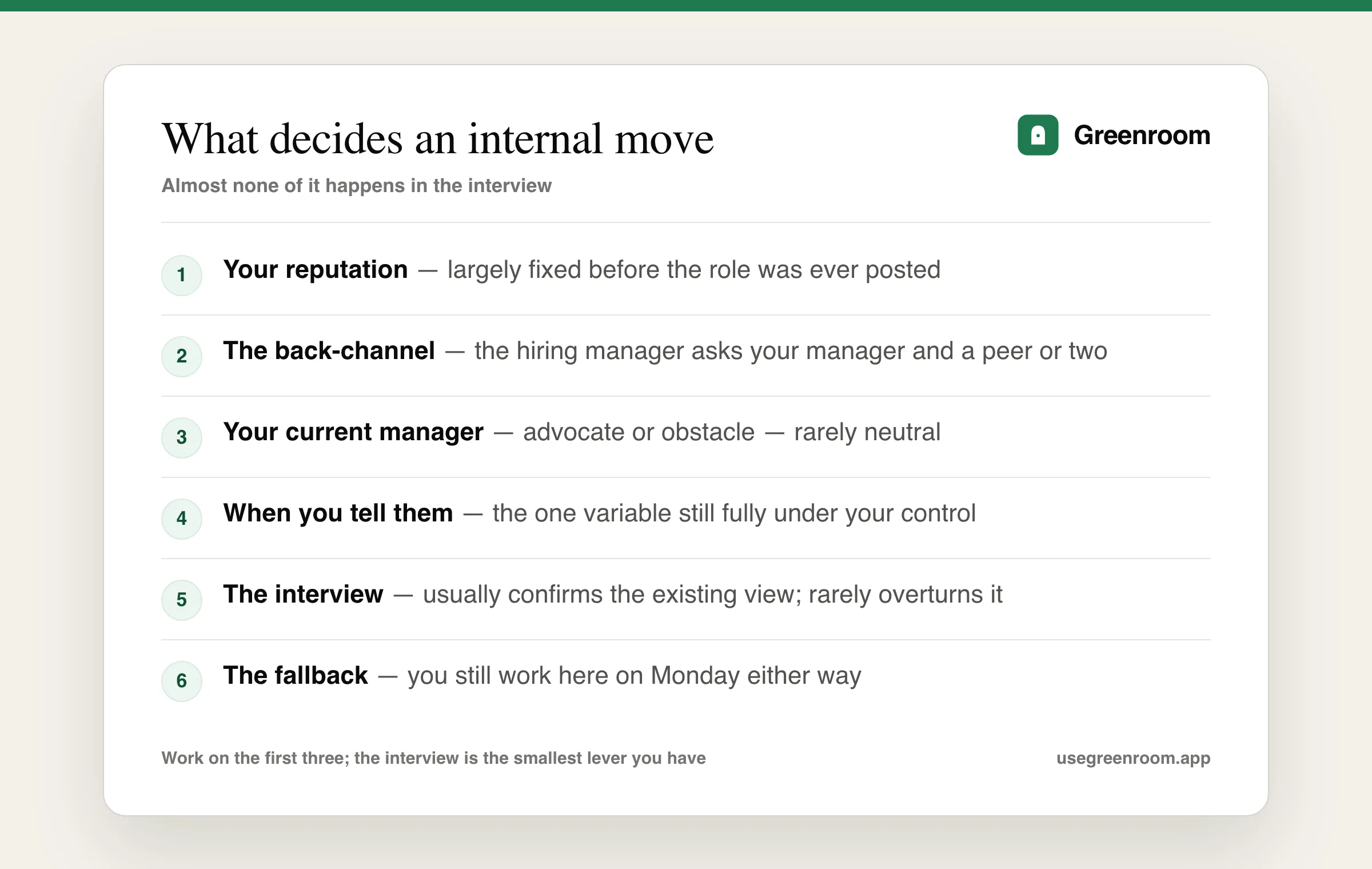
Your reputation, fixed well before the req opened. Whether you are the person who finishes things, who is easy to review with, who flags problems early. None of that is decided during a hiring process. It is decided over the preceding year, which is why the best time to prepare for an internal move is long before one is available.
The back-channel. Expect the hiring manager to speak to your current manager and one or two people who have worked with you directly. This is not a formal reference check and there is no process governing it — it is two people in a kitchen. Its content is your existing reputation, delivered without editing.
Your current manager, who is rarely neutral. They are either going to advocate for you or quietly slow it down, and which one you get is heavily influenced by how they find out.
When you tell them. This is the single variable still fully under your control, and the section below is about it.
The interview, which typically confirms the existing view rather than overturning it. Worth preparing properly, and not the biggest lever you have.
The fallback, which is genuinely different from an external process: if it does not work out, you are back at your desk on Monday, working with everyone involved.
Telling your current manager
Most internal processes require it eventually, and many require it early. Even where policy does not, they will find out — internal hiring is not confidential in practice.
Tell them yourself, before they hear it elsewhere. This is the whole game. A manager who learns from a peer that you applied to another team experiences it as something done behind their back, and their back-channel comment reflects that. A manager told directly, first, usually behaves well even if they would rather keep you.
How to frame it. Not as an escape, and not as a complaint about them:
*"I want to be straight with you — I'm going to apply for the platform role. It's the direction I've wanted to move in for a while and this is the first time it's been open. I'm not unhappy here, and I'd rather do this with your support than around you."*
What to expect. Some managers advocate immediately. Some ask you to wait for a delivery milestone, which is often reasonable and sometimes a stalling tactic — ask for a specific date if so. A few take it personally. That last reaction is itself useful information about the team you are in.
If the relationship is already bad, tell them anyway. The version where they find out from someone else is strictly worse.
What to do in the year before
If you are reading this without a specific role in mind, this is the section that matters most:
- Do visible work near the team you want. Fix something in their codebase, join their design review, take the on-call handover that touches their system. The back-channel needs someone on that team who has an opinion about you.
- Build one relationship there, not ten. A single person who has actually worked with you is worth more than being generally known.
- Be the person who finishes. The single most repeated line in back-channels is some version of "they get things done" or "they need chasing." That reputation is built in small increments over months.
- Say what you want, out loud, to your manager, in a one-on-one, well before any role exists. Managers cannot advocate for a preference they do not know about, and it converts a future application from a surprise into a continuation. Our how to ask for a raise guide covers the adjacent conversation, which runs on a similar logic — the decision happens away from the room you are in.
The interview itself
It is a real interview and people under-prepare it, on the assumption that being known is enough.
Do not assume they know your work. The hiring manager knows your reputation, not your specifics. Bring examples as you would externally.
Answer "why this team" seriously. Internally this question carries more weight than externally, because leaving one team for another inside the same company invites the reading that you are running from something. Lead with what you are moving toward. Our why do you want to work here guide covers the shape of that answer.
Do not criticise your current team. Anything you say will get back — internal boundaries are porous, and this is the fastest way to convert a strong candidacy into a reputational problem.
Expect the same rigour, or nearly. Some companies run a shortened loop internally; many do not. Our hiring manager round guide applies directly here, since the manager conversation is usually the core of an internal loop.
Be ready for the transition question. "How long would your current team need?" is asked in nearly every internal process, and an answer that shows you have thought about the handover reads well.
If you do not get it
The genuinely awkward part, and the one nobody prepares for. You still work there.
- Ask for specific feedback, which is far easier to get internally than externally and is the main consolation prize.
- Ask whether it is a "no" or a "not yet." These are different, and internally you can actually find out.
- Go back to your team properly. Sulking after a failed internal move is noticed, and it becomes part of the back-channel for the next one.
- Give it one more cycle if the feedback was concrete and the door was left open. If the answer is vague twice, that is real information about your ceiling there — at which point our how to resign professionally guide becomes the relevant one.
Internal move or leave — honestly
Internal usually wins on: speed of ramp-up, keeping your relationships and context, no notice period, no background verification, and the fact that you already know whether the company treats people well — which is the thing you cannot learn about a new employer until you have joined.
Leaving usually wins on: money, since internal moves rarely come with the jump a switch produces; a clean reset of a reputation you would rather not carry; and access to work your current employer simply does not do.
The uncomfortable middle case: if you want the internal move mainly because you are unhappy with your manager rather than drawn to the new work, be honest with yourself. That is a legitimate reason to move teams and a bad reason to pretend enthusiasm for a role you do not want.
Where the usual advice comes up short
"Just network internally." True, vague, and usually offered too late to act on. The specific version is one relationship on the target team and visible work they can see.
"Internal moves are easier." Easier in some ways — no BGV, no notice period, no unknowns about the company — and harder in one important way: an external interviewer only knows what you tell them, while an internal one can ask around.
Your company's internal mobility policy. Read it for the process and the timelines. It will not tell you the part that decides it.
Greenroom. Honest fit: this is an internal conversation with someone who may already know you, so a mock interview cannot simulate the back-channel. What it does train is the part that is identical — describing your own scope and impact specifically, and answering "why this team" without drifting into criticism of your current one. Ari, the AI interviewer will follow up until that answer is clean. Honest tradeoff: Ari cannot tell you what your manager will say when the hiring manager asks.
The one-line version
Tell your current manager yourself before they hear it elsewhere, spend the months before doing visible work near the team you want and building one real relationship there, prepare the interview as though they know nothing about your specifics, and never criticise your current team — because the decision is mostly made in a conversation you are not in, and the only thing you control at that point is what people already believe.
Frequently asked questions
How is an internal transfer interview different from an external one?
The decisive input is different. An external interviewer only knows what you present in the room, whereas an internal hiring manager can simply speak to your current manager and colleagues who have worked with you directly. That back-channel is informal, unfiltered and covers years rather than an hour, so it usually outranks the interview itself. The practical consequence is that an internal move is largely shaped by your reputation in the months before the role was posted, and the interview more often confirms an existing view than changes one.
Should I tell my manager before applying for an internal role?
Yes, and telling them yourself first is the single most important thing you control. Internal hiring is rarely confidential in practice, and a manager who hears from someone else that you applied tends to experience it as going behind their back — which colours what they say when the hiring manager asks about you. Frame it as moving toward something rather than escaping them, and say plainly that you would rather do it with their support than around them.
What should I do if my manager blocks my internal move?
Distinguish between a delay and a block. Being asked to wait for a delivery milestone is often reasonable, in which case ask for a specific date rather than an open-ended postponement. If the reaction is personal or the postponement repeats without a date, that is meaningful information about the team you are in. Most companies have an internal mobility policy and an HR contact for exactly this situation, and a manager taking it personally is itself a reason the move may be right.
How do I answer 'why do you want to move teams' internally?
Lead with what you are moving toward rather than what you are leaving, because internally this question carries more suspicion than externally — moving between teams in the same company invites the reading that you are running from something. Name the specific work, problem or skill area that attracts you and why now. Critically, do not criticise your current team or manager: internal boundaries are porous, anything you say will get back, and it converts a strong candidacy into a reputational problem.
What should I do if I do not get the internal role?
Ask for specific feedback, which is much easier to obtain internally than externally, and ask directly whether the answer is a no or a not-yet, since internally you can actually find out. Then return to your current work properly, because visibly sulking after a failed internal move becomes part of what people say about you in the next one. If the feedback was concrete and the door was left open, one more cycle is reasonable; vague answers twice suggest a real ceiling.
Is it better to move internally or change companies?
Internal moves usually win on ramp-up speed, retained relationships and context, no notice period or background verification, and the fact that you already know how the company treats people. Changing companies usually wins on compensation, since internal moves rarely match the jump a switch produces, and on access to work your employer does not do. A useful honesty test is whether you want the new role itself or mainly want to escape your current manager — the second is a legitimate reason to move teams but a poor basis for feigning enthusiasm about specific work.