---
title: Publicis Sapient Interview Questions (2026 Guide)
description: Real Publicis Sapient interview questions — the online assessment, DSA round, machine coding, system design and HR — with answers and a four-week prep plan.
url: https://usegreenroom.app/blog/publicis-sapient-interview-questions
last_updated: 2026-07-30
---
← Back to blog
India · Publicis Sapient
# Publicis Sapient interview questions and process
July 30, 2026 · 11 min read
Ninety minutes into a machine coding round, a candidate had a working parking-lot system. Classes, enums, a fee calculator, the lot. The interviewer asked him to add electric-vehicle charging bays. He looked at his own code, found the seventeen places a vehicle type was hard-coded as a string, and made the noise a person makes when they realise the design was the test.
That is the centre of Publicis Sapient interview questions: they are less interested in whether you can solve the problem than in whether the thing you built can survive a change of requirement. Sapient builds digital products for enterprise clients, and requirements change constantly. I built Greenroom after freezing in an interview I had genuinely prepared for, so this guide covers the Sapient loop round by round and what to say while you are typing.
## The Publicis Sapient interview process in 2026
Publicis Sapient (formerly Sapient, now part of Publicis Groupe) hires heavily in Gurgaon, Bengaluru and Noida, mostly into the Associate Technology L1/L2 and Senior Associate tracks, plus data, experience-design and product-management roles. The reported Publicis Sapient interview process:
- Online assessment — aptitude, logical reasoning, and a coding section with two or three problems. Campus drives weight aptitude more heavily; lateral hires often skip it.
- Technical round 1 — DSA — arrays, strings, hashmaps, trees and a little dynamic programming, at LeetCode easy-to-medium difficulty, with the interviewer watching you think.
- Technical round 2 — machine coding or low-level design — build a small working system in 60–120 minutes: parking lot, elevator, splitwise, library, cab booking. This is Sapient's signature round.
- Technical round 3 — core fundamentals and system design — Java or JavaScript deep dive, OOP, databases, REST, and for seniors an HLD conversation.
- Client / managerial round — agile ways of working, how you handle a shifting requirement, and how you talk to a non-technical stakeholder.
- HR round — why Sapient, location, notice period, compensation.
Freshers report five or six rounds across a campus day; laterals report three or four spread over two weeks. The machine coding round is the one that distinguishes Sapient from most Indian services and consulting firms — it is closer to a product-company loop.
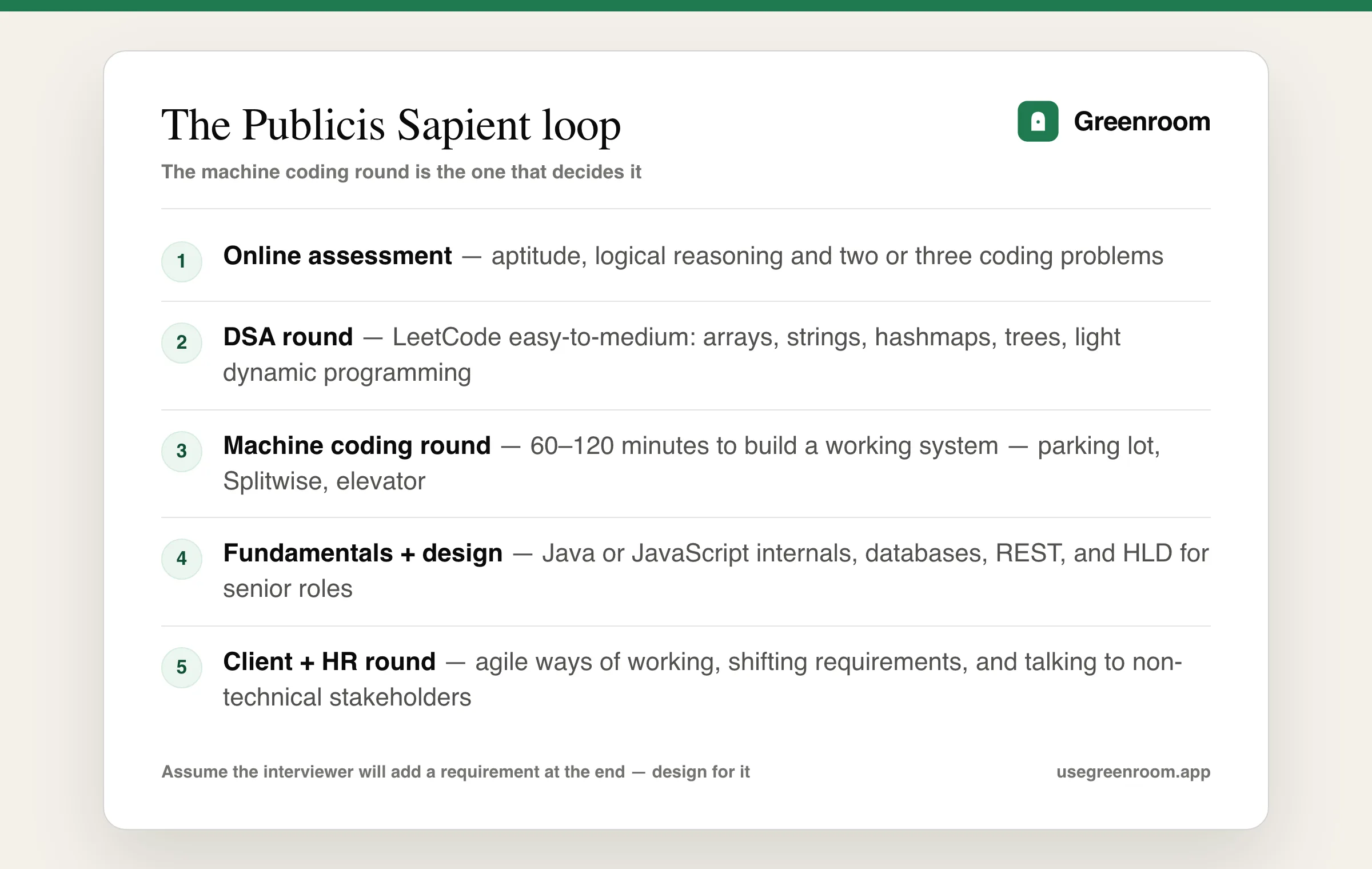
The Publicis Sapient loop: the machine coding round is the signature stage and the most common failure point.
## Publicis Sapient online assessment and DSA questions
The Publicis Sapient online assessment mixes quantitative aptitude, logical reasoning and a verbal section with two or three coding problems, usually solvable in any mainstream language. The coding half is not exotic: string manipulation, array traversal, hashmap counting, sometimes a matrix problem.
The Publicis Sapient DSA round that follows sits at LeetCode easy-to-medium. Reported topics: two-pointer and sliding-window array problems, string anagram and palindrome variants, hashmap frequency problems, linked-list reversal and cycle detection, binary tree traversals and level-order printing, and basic dynamic programming such as climbing stairs or coin change.
The differentiator is narration. Sapient interviewers explicitly say they want to hear your thinking, and a candidate who solves it in silence and then presents a finished answer scores worse than one who reasoned aloud to the same place. State the brute force, state its complexity, say what you want to improve and why, then optimise. Our how to think out loud in interviews guide covers the mechanics, and the data structures interview questions guide covers the topic list.
## The Publicis Sapient machine coding round
This is the round to prepare for specifically. The Publicis Sapient machine coding round gives you a loose problem statement and 60–120 minutes to produce working, runnable code — usually console-based, no UI, no database required. Reported problems: parking lot, elevator system, Splitwise-style expense sharing, library management, cab booking, vending machine, tic-tac-toe, snake and ladders.
### What is actually scored
- It runs. A half-finished but working system beats an elegant design that does not compile. Get an end-to-end path working early, then deepen.
- Clean class boundaries. Separate the model, the service that holds the rules, and the thin main that demonstrates it. One 400-line class is the most common fail.
- Extensibility. Interfaces and enums where a new type will obviously appear — vehicle types, pricing strategies, payment methods. The interviewer will add a requirement at the end. Assume it.
- No hard-coded strings. The electric-vehicle moment in the opening story is a scored event, not an anecdote.
- Stated assumptions. Say aloud what you are excluding — persistence, concurrency, authentication — and why, rather than silently omitting them.
- Basic tests or a demo main. Even three assertions signal that you think in terms of verification.
A workable skeleton for the parking lot, in the shape interviewers expect:
```
public enum VehicleType { BIKE, CAR, TRUCK, ELECTRIC_CAR }
public interface FeeStrategy {
BigDecimal calculate(Ticket ticket, Duration stay);
}
public class ParkingLot {
private final Map> freeSlots;
private final FeeStrategy feeStrategy;
public Ticket park(Vehicle vehicle) {
Deque pool = freeSlots.get(vehicle.type());
if (pool == null || pool.isEmpty()) {
throw new LotFullException(vehicle.type());
}
return Ticket.issue(vehicle, pool.pop(), Instant.now());
}
}
```
Note what the design buys you: adding electric-vehicle bays is a new enum constant and a slot pool, and changing weekend pricing is a new FeeStrategy. Say that out loud while you write it — "I'm using a strategy here because pricing rules are the thing clients change most." Our machine coding round guide covers timeboxing and the full checklist, and the design patterns interview questions guide covers the patterns worth knowing by name.
## Core fundamentals: Java, JavaScript, databases and system design
The fundamentals round follows your stack. For Java candidates: collections and their internals (how HashMap resolves collisions is asked constantly), the difference between == and equals, immutability and why String is immutable, exception hierarchy, streams, and Spring Boot basics — dependency injection, annotations, and the request lifecycle. For frontend candidates: closures, the event loop, promises versus async/await, React hooks and re-render behaviour, and state management.
Database questions cover normalisation, indexing and when an index does not help, joins, transactions and ACID, and SQL versus NoSQL tradeoffs. REST questions cover idempotency, status codes, versioning and pagination. For senior roles a Publicis Sapient system design conversation appears: design a URL shortener, a booking system, an e-commerce checkout — scoped to a client-product scale rather than a billion users.
Our Java interview questions guide, Spring Boot interview questions guide and system design interview guide for India cover this material properly. Oracle's own Java documentation and the MDN web docs remain the best free references for the language-level questions.
## The client round: agile, ambiguity and stakeholders
Sapient is a consultancy, so the managerial round is about project reality rather than culture-fit filler. Recurring questions: a time the requirement changed mid-sprint, a time you disagreed with a technical decision on your team, how you would explain a delay to a client, and how you estimate work you have not done before.
Good answers name the mechanism, not the sentiment. For a changed requirement: you confirmed the change in writing, restated the timeline impact plainly, and raised it in the stand-up rather than absorbing it. For a delay: early, with an option attached. Our tell me about a time you disagreed guide has the structure, and the questions to ask at the end of an interview guide covers the close — asking which client account the role is staffed to is a genuinely good question here.
## LeetCode, GeeksforGeeks, ChatGPT — where each fits
- LeetCode — the right tool for round one, and the wrong tool for round two. Easy-to-medium is the correct band; grinding hards is wasted time for this loop.
- GeeksforGeeks and AmbitionBox interview experiences — good for the round order and the recurring machine coding problems. Treat process details as approximate and dated.
- Low-level design repositories and books — the highest-yield preparation for the signature round. Build three machine coding problems end to end yourself; do not just read solutions.
- Official documentation — Oracle's Java docs and MDN for JavaScript answer the fundamentals questions more accurately than any prep site.
- ChatGPT — genuinely useful here for reviewing a machine coding design and suggesting where it would break. Its limit is the same as everywhere: it accepts your first explanation instead of asking you to defend it aloud under time pressure.
- Greenroom — the spoken layer. Ari, the AI interviewer, runs the DSA narration, fundamentals and client rounds out loud, pushes when your explanation skips a step, and scores structure and clarity. Fair tradeoff: Ari will not compile your parking lot — build that yourself.
> The core truth: Sapient's machine coding round is a requirements-change test wearing a coding-problem costume. Build something small that runs, keep the extension points obvious, and narrate why — that combination clears the round far more reliably than a clever algorithm.
## How to prepare for the Publicis Sapient interview
- Week 1: LeetCode easy-to-medium daily across arrays, strings, hashmaps, linked lists and trees — each one solved out loud, brute force stated first.
- Week 2: three machine coding problems built end to end under a timer — parking lot, Splitwise, elevator. After each, add a requirement you did not plan for and see how much you have to rewrite.
- Week 3: language fundamentals and databases, plus one system design conversation a day spoken aloud at client scale rather than internet scale.
- Final week: five behavioral answers in first person about changed requirements and disagreements, two full spoken mocks, and a reread of your own machine coding solutions — not new material.
Comparing offers across Indian consulting and analytics firms? The ZS Associates interview questions guide, the Fractal Analytics interview questions guide, the Mu Sigma interview questions guide and the Tiger Analytics interview questions guide cover the analytics-heavy end of the same market, and the Accenture interview questions guide covers the nearest large-consultancy comparison.
## Frequently asked questions
### What is the Publicis Sapient interview process?
Candidates report an online assessment with aptitude, logical reasoning and two or three coding problems; a DSA technical round at LeetCode easy-to-medium difficulty; a machine coding or low-level design round lasting 60 to 120 minutes; a fundamentals round covering Java or JavaScript, databases and REST, with system design for senior roles; a client or managerial round on agile ways of working; and an HR round. Freshers typically get five or six rounds, laterals three or four.
### What is asked in the Publicis Sapient machine coding round?
You are given a loose problem statement and 60 to 120 minutes to build working console-based code. Commonly reported problems are parking lot, elevator system, Splitwise-style expense sharing, library management, cab booking, vending machine and tic-tac-toe. Scoring favours code that actually runs, clean separation between model and service classes, extension points such as interfaces and enums, stated assumptions, and a demo main or basic tests.
### What DSA questions does Publicis Sapient ask?
The DSA round sits at LeetCode easy-to-medium. Reported topics include two-pointer and sliding-window array problems, string anagram and palindrome variants, hashmap frequency counting, linked-list reversal and cycle detection, binary tree traversals and level-order printing, and basic dynamic programming such as climbing stairs or coin change. Interviewers explicitly want to hear your reasoning as you go.
### Is the Publicis Sapient interview difficult?
The algorithmic bar is moderate — easier than a product-company loop — but the machine coding round is genuinely demanding and is where most candidates fail. It rewards design judgment and speed rather than algorithmic cleverness, and many candidates arrive having practised only LeetCode, which does not prepare you for building a small system under a timer.
### What is the Associate Technology L1 role at Publicis Sapient?
Associate Technology L1 is the main entry-level engineering role at Publicis Sapient in India, typically for freshers and candidates with up to about two years of experience. The work is client-facing product engineering in agile pods, most often on Java and Spring Boot backends or JavaScript and React frontends, delivering digital products for enterprise clients across retail, financial services and travel.
### How should I prepare for the Publicis Sapient machine coding round?
Build three problems end to end under a timer rather than reading solutions — parking lot, Splitwise and elevator cover most of the patterns. After each build, add a requirement you did not plan for, such as a new vehicle type or a weekend pricing rule, and see how much you have to rewrite. If the answer is more than a couple of files, your class boundaries need work.
Sapient's rounds reward the engineer who explains the design while building it. Greenroom runs mock technical and client interviews out loud with Ari — design follow-ups included — and scores structure, clarity and depth. Free to start. Curious how it works? See how AI mock interviews work.