The email arrived on a Tuesday, eleven days before he was due to start, and it used the phrase "due to a realignment of hiring priorities" — six words doing the work of one much shorter sentence.
He had resigned four weeks earlier. He had told everyone. His replacement had already been hired. He read the email three times looking for the part where it said this was a mistake, and then he sat on the edge of his bed and worked out that he was, as of that Tuesday, unemployed for the first time since he was twenty-two.
Two things are true about this and they sit awkwardly together. A withdrawn offer is almost never a verdict on you — it is a decision made about a budget line by people who have probably never met you, and it happens to strong candidates constantly. And the consequences are entirely yours, because you are the one who resigned. Self-blame is misplaced and the clock is real, which is a genuinely unpleasant combination.
*If this has not happened to you yet and you are in the gap between accepting and joining, you want the prevention version instead: our after accepting an offer, before joining guide covers protecting yourself before there is anything to recover from.*
Why it happens, and what it says about you
Common causes, roughly in order of frequency: a hiring freeze or headcount cut arriving after the offer was extended, budget being reallocated between teams, a reorganisation that dissolves the role, the hiring manager leaving, a funding round landing differently than planned, or a background verification discrepancy.
Only the last of those is about you specifically, and it is the least common — our background verification in India guide covers that case, which usually turns out to be a documentation mismatch rather than anything sinister.
The rest are portfolio decisions. That is not consolation exactly, and it does matter for one practical reason: it determines what you say next. A candidate who explains a revoked offer as a headcount decision, calmly, is describing something interviewers have seen many times. A candidate who sounds like they are hiding a reason invites the question of what it was.
The first 72 hours
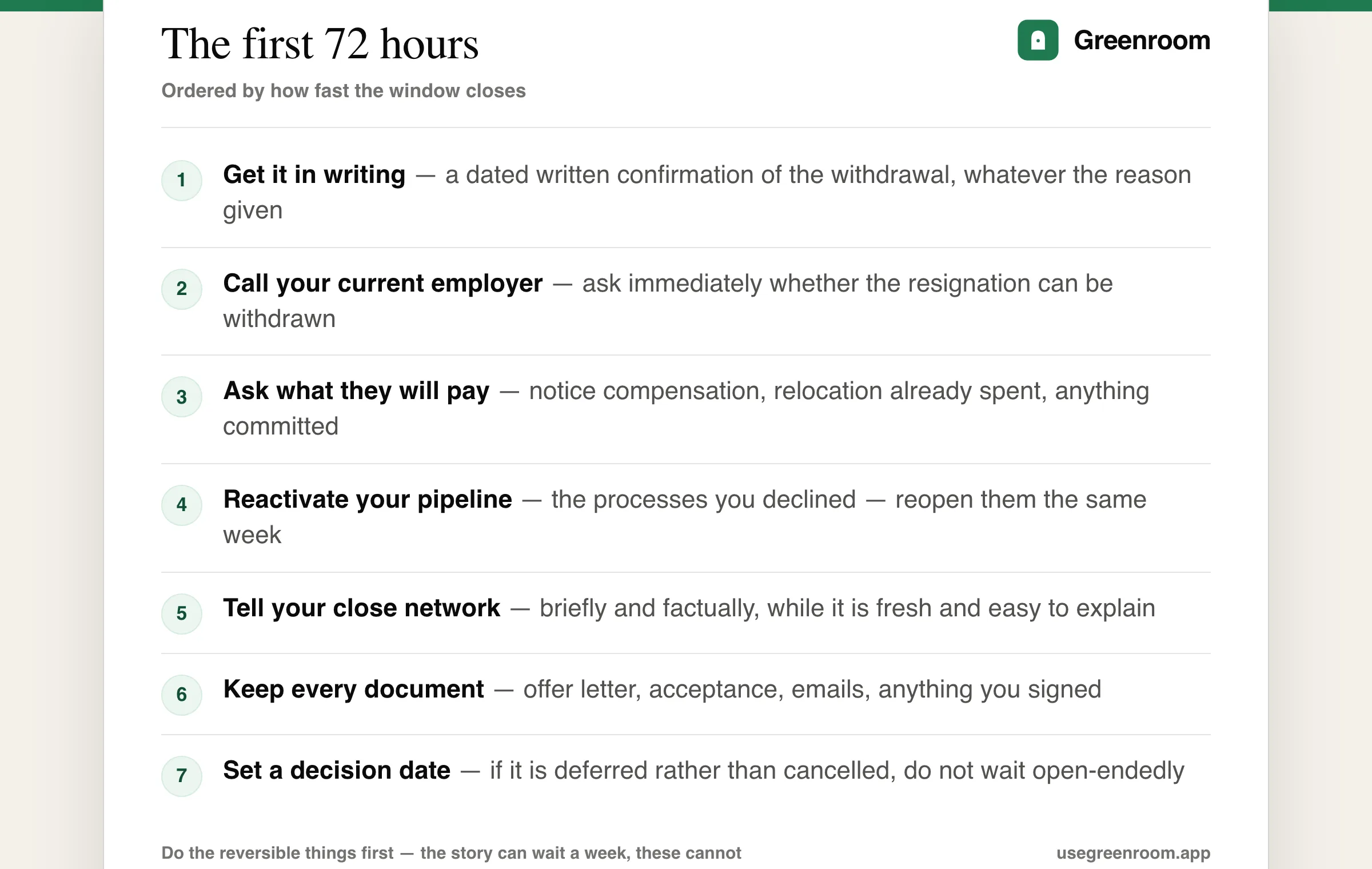
Do the reversible things first. Most of these get harder every day you wait, and the first two have windows measured in days.
Get the withdrawal in writing. If it came by phone, send an email confirming your understanding and ask them to confirm. You want a dated record of what was said and why, before anyone's memory becomes convenient.
Call your current employer today. Ask whether your resignation can be withdrawn. This feels humiliating and is frequently successful — you are a known quantity, they have hiring costs to avoid, and your replacement may not have started. If you are still serving notice, the odds are considerably better. Ask before the seat is filled, not after; our how to resign professionally guide covers keeping that relationship in a state where the call is possible at all.
Ask the withdrawing company what they will do about it. Some companies pay something — a month's compensation, relocation costs already incurred, a joining bonus already committed. Many pay nothing. Whether you are owed anything depends on what you signed and where you are, and it varies a great deal, so check your own documents and take proper advice if the sum is significant. What is universally true is that nobody offers unprompted. Ask, in writing, politely and specifically.
Reopen the processes you declined. Every company you turned down, that same week. Say plainly that your offer was withdrawn in a restructure and ask whether the role is still open. This is a normal message that recruiters receive regularly. Our how to negotiate multiple offers guide covers the earlier stage where those relationships are formed and worth keeping warm.
Tell your close network early and factually. Not a public post — a handful of messages. Referrals move faster than applications, and the story is easiest to tell while it is fresh and unembellished.
Keep every document. Offer letter, your acceptance, the withdrawal email, any correspondence about relocation or a joining date.
Set a decision date if it is a deferral rather than a cancellation. See below, because this is the one that quietly eats months.
The deferred joining date
There is a softer version that is common in India and elsewhere: the offer is not withdrawn, the joining date is simply pushed. Then pushed again. Freshers at large service companies have at times waited many months between an offer letter and an actual joining date.
This is harder than a clean revocation, because hope is expensive. You keep the offer, so you do not fully re-enter the market, and each deferral costs you another month of not looking.
What helps:
- Ask for a date in writing, and ask what it depends on. A specific answer is a signal; vagueness repeated twice is also a signal.
- Set your own deadline — a date after which you treat it as a no and search accordingly. Write it down, because the whole difficulty here is drift.
- Keep applying regardless. Holding a deferred offer and continuing to interview is completely reasonable, and it is what the company is doing with its own options.
- Ask whether they will confirm the offer stands at each deferral. Firms that intend to honour it will usually say so.
The story you will need
You will be asked, in every interview for the next six months, why you left your last job. The answer needs to be brief, unembarrassed, and free of villains:
*"I accepted an offer at [Company], resigned, and they withdrew it before my start date in a hiring freeze. So I'm back in the market sooner than I planned."*
That is the whole answer. Do not editorialise, do not name and criticise, and do not sound wounded — interviewers are listening for whether you are stable and reasonable, not for whether you were wronged. Most of them have seen this before and some have done it themselves.
Two related notes. If you were mid-notice and stayed put, there may be no gap at all to explain. And if there is a gap, it is a short and completely explicable one; our what to do after a layoff guide covers the longer-gap version of the same conversation.
The part that is not logistics
This one lands harder than an ordinary rejection, and it is worth naming why: you had already told people. You had already started imagining the job. The loss is of a future you had committed to out loud, which is a different experience from not getting something you never had, and it is reasonable to feel genuinely shaken by it.
Give it a couple of days, and then be careful about the specific trap — a withdrawn offer removes your job *and* the structure of your week at once, which is exactly the isolation our job search loneliness guide covers. Rebuilding a routine early is worth more than it sounds.
Where the usual advice comes up short
"Sue them." Occasionally appropriate, usually disproportionate, and almost never the first move. Whether anything is owed depends on your documents and jurisdiction, and the answer is worth getting from someone who reads them rather than from a forum.
"Just move on, it happens." True and not a plan. The 72-hour actions above are time-limited and skipping them costs real money.
"Post about it on LinkedIn." Sometimes generates genuine leads, and it is a permanent public artefact attached to a bad week. If you do it, keep it short, factual and free of grievance — write it two days later rather than that evening.
Company review sites. Useful for spotting a pattern before you accept somewhere. Not useful now.
Greenroom. The narrow honest fit: you are about to explain this in a series of interviews, and the difference between sounding stable and sounding aggrieved is delivery rather than content. Ari, the AI interviewer asks why you left and then follows up, which is exactly the moment people over-explain. Honest tradeoff: Ari cannot get your old job back or tell you whether the deferred offer is real.
The one-line version
Get the withdrawal in writing, ask your current employer today whether you can stay, ask the withdrawing company in writing what they will cover, reopen every process you declined this week, and rehearse a two-sentence explanation with no villain in it — because it was a budget decision, and the only part you control is what happens in the next seventy-two hours.
Frequently asked questions
Can a company revoke a job offer after you accept it?
In many cases yes, particularly before you have started, and it happens more often during hiring freezes and restructures than most candidates expect. Whether you have any recourse or entitlement to compensation depends on what you signed and on the jurisdiction, and it varies considerably, so the sensible steps are to obtain a dated written record of the withdrawal, keep your offer letter and correspondence, and take proper advice if a significant sum such as relocation costs is involved.
What should I do first if my job offer is withdrawn?
Two things with short windows. Get the withdrawal confirmed in writing, sending your own email to confirm the details if it was communicated by phone. Then contact your current employer the same day to ask whether your resignation can be withdrawn — this feels awkward and frequently works, because you are a known quantity and your replacement may not have started, and the odds are much better if you are still serving notice. After those, ask the withdrawing company in writing what they will cover, and reopen the processes you declined.
Will a revoked offer look bad in future interviews?
Generally not, provided you explain it plainly. Withdrawn offers are usually headcount or budget decisions rather than judgements about the candidate, and most interviewers have seen it before. A brief factual answer — that you accepted, resigned, and the offer was withdrawn in a hiring freeze — reads as ordinary bad luck. What creates doubt is sounding evasive or aggrieved, since that invites the question of whether there was another reason.
Can I get compensation if my offer is revoked?
Sometimes. Some companies pay a month's compensation, reimburse relocation costs already incurred, or honour a committed joining bonus, particularly where you had already resigned. Many pay nothing. Entitlement depends on what you signed and where you are, so check your documents and take advice where the amount matters. The consistent point is that companies rarely offer unprompted, so it is worth asking specifically and in writing rather than assuming the answer is no.
What should I do if my joining date keeps getting delayed?
Treat it as a live risk rather than a settled offer. Ask for a date in writing and ask what it depends on, since a specific answer is informative and repeated vagueness is too. Set your own deadline after which you will treat it as a no, and write it down, because the real danger here is drift rather than any single deferral. Keep applying and interviewing throughout — holding a deferred offer while continuing to look is entirely reasonable, and the company is keeping its options open in exactly the same way.
How do I explain a withdrawn offer in an interview?
Keep it to two sentences, factual and without blame: that you accepted an offer, resigned, and it was withdrawn before your start date during a hiring freeze, so you are back in the market earlier than planned. Avoid criticising the company by name, avoid sounding wounded, and do not over-explain — interviewers are assessing whether you are stable and reasonable rather than adjudicating whether you were treated unfairly. Over-explanation is the most common way a perfectly good answer goes wrong.