He had one offer in hand with a Friday deadline and a final round on Tuesday at the company he actually wanted. So he did what most people do, which is nothing — he sat on it for three days hoping the problem would resolve itself, then accepted the Friday offer at 4:55pm, and got the Tuesday company's offer eleven days later.
Almost every multiple-offer disaster is a timing failure, not a negotiation failure. Learning how to negotiate multiple offers is mostly learning to make two uncomfortable phone calls early instead of one comfortable decision late. This guide covers aligning timelines, using leverage without lying, comparing offers properly, and declining in a way that keeps the door open.
Get the timelines aligned before you get the offers
The work starts during interviews, not after. Two habits fix most of the problem:
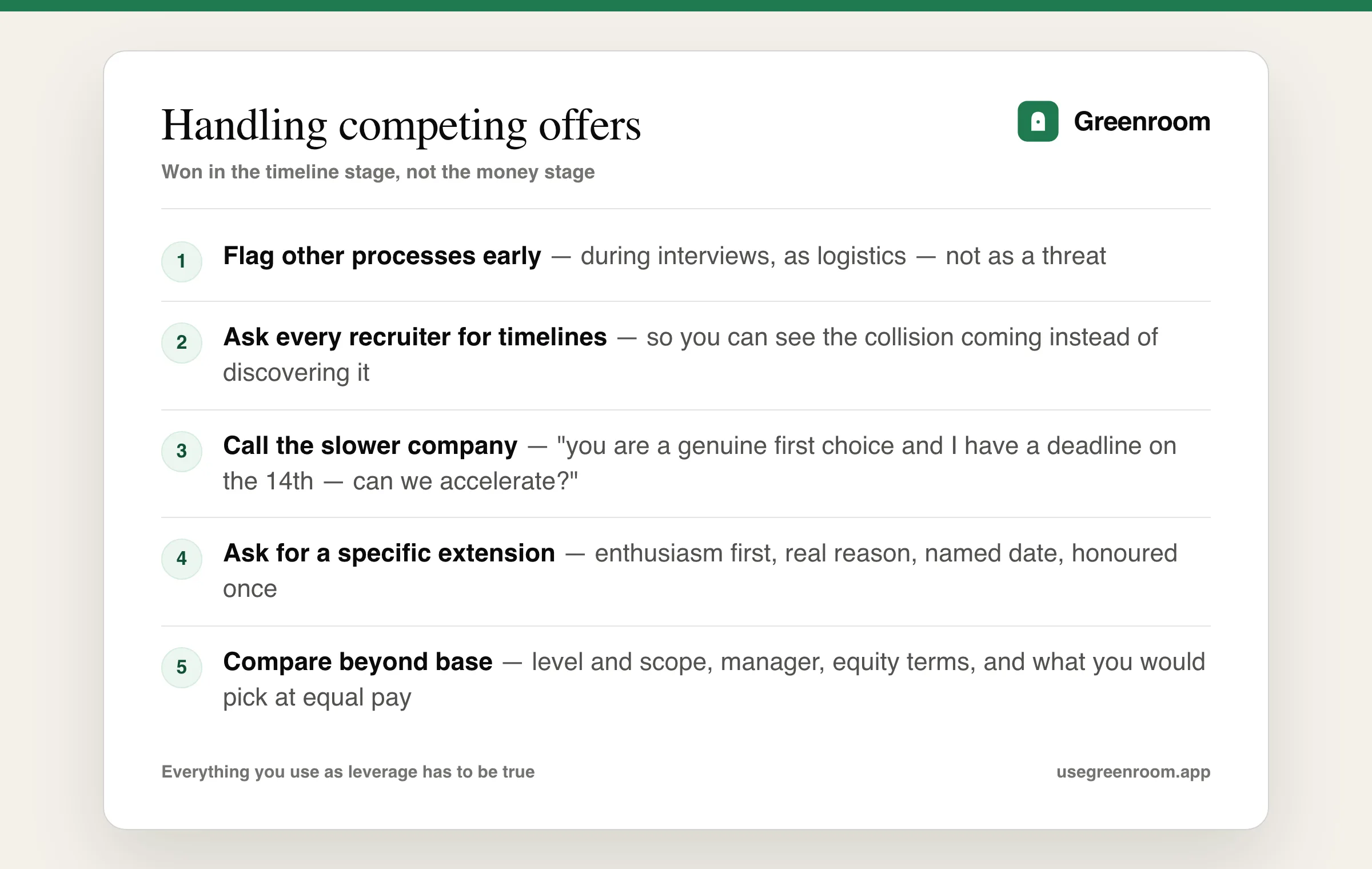
- Tell every company you are in other processes. Not as a threat — as logistics. "I'm in final stages with a couple of other companies, so I wanted to flag that early" is normal and universally understood.
- Ask each recruiter for their expected timeline and when they expect to make decisions. Recruiters answer this readily and it lets you see the collision coming.
Then, the moment a process is clearly moving faster than the others, call the slower companies. The script is short and it works far more often than people expect: "I've really enjoyed this process and you're a genuine first choice. I've received an offer elsewhere with a deadline of the 14th. Is there any way to accelerate the remaining rounds?"
Companies compress timelines for candidates they want. Interviews get scheduled in two days instead of two weeks; approvals get chased. The reason candidates do not ask is a fear of looking demanding, and that fear costs people jobs every week.
Asking to extend a deadline
"Exploding offers" — accept in 48 hours or lose it — are less common and less rigid than they appear. Most deadlines are administrative, and most companies will extend for a candidate they want.
How to ask, and the elements that make it work:
- Be enthusiastic first. "I'm genuinely excited about this role" — because a deadline request without warmth reads as disinterest.
- Give a real reason. "I'm in a final round elsewhere on Tuesday and I want to make a decision I'm fully committed to."
- Name a specific date. Vague requests get vague answers. "Could I confirm by Thursday the 16th?"
- Commit to that date and honour it. Asking twice damages you far more than the first ask.
If a company genuinely refuses any extension on a compressed deadline, treat that as information about how they operate. A team that will not give you four days to make a multi-year decision is telling you something about internal pressure.
Using leverage without lying
This is where people get into real trouble. The line is simple: everything you say must be true. Not because of ethics alone, but because the Indian and global tech markets are small, recruiters talk, and an invented competing offer that gets checked ends the process instantly.
What works:
- Name the real situation, and be specific about what you want. "I have a competing offer at ₹X base. I'd prefer to join you — if you can get closer on base I'll sign today" is direct, honest and highly effective because it tells them exactly what closes the deal.
- Negotiate on your genuine priority. If the competing offer is stronger on base but you care more about scope, ask for scope or level rather than money.
- Ask once, clearly, and be prepared to accept the answer. Rolling negotiations exhaust goodwill.
What does not work: inventing an offer, inflating a number, or playing companies against each other repeatedly. Also avoid using an offer purely as leverage at a company you have no intention of joining — recruiters remember, and you may want them in two years. Our salary negotiation guide covers the mechanics of the money conversation itself.
Comparing offers properly
Base salary is the number everyone anchors on and rarely the number that matters most over three years. Build an actual comparison across:
- Total compensation — base, bonus (and whether it is guaranteed or performance-linked), equity, and the joining bonus that inflates only year one.
- Equity reality — for a startup, ask about the strike price, the latest valuation, the vesting schedule and cliff, and what happens on leaving. Unlisted equity is a lottery ticket with paperwork; value it accordingly.
- Level and scope — the single most underrated factor. A slightly lower offer at a higher level, with ownership of something real, usually compounds faster than a raise into a narrow role.
- Who you report to. Your manager will affect your daily experience more than the logo. Ask to speak to them again before deciding; good companies allow it.
- The work itself — what you'd build, what tech, how much of your week is meetings.
- Practicalities — location and commute, remote policy in practice rather than on paper, notice period and joining date, and job security given the company's funding or profitability.
A useful forcing question: if both offers paid identically, which would you take? That usually reveals the real preference, and then the negotiation is about closing the gap on the one you actually want.
Declining an offer without burning the bridge
You will decline at least one, and how you do it is worth real money later. The rules:
- Do it promptly. The moment you decide, tell them. Every extra day is a day they cannot make an offer to their second choice, and delay is what actually damages relationships.
- Call, then email. A short call to the recruiter or hiring manager, followed by a written confirmation.
- Be warm and brief, and do not over-explain. Thank them specifically, say you have accepted another role, and stop. You do not owe a detailed comparison, and volunteering one invites a counter-offer conversation you have already finished having.
- Leave the door open genuinely. "I'd be glad to stay in touch" — and mean it. People move companies; today's hiring manager is a future colleague.
Never accept an offer and then renege after signing, unless something has genuinely changed. In India this can affect your background verification and reputation; everywhere it burns the relationship permanently. If you must, do it immediately and personally rather than by email on your start date. Our thank-you email guide covers the tone that works for this kind of message.
Levels.fyi, recruiters, Blind, ChatGPT — where each fits
- Levels.fyi and Glassdoor — useful for compensation bands, particularly at large companies. Indian data is thinner and skews toward larger employers, so treat startup figures cautiously.
- AmbitionBox — better India coverage for salary and interview process, with the same caveat about self-reported data.
- The recruiter at the company you want — an actual ally, because their job is to close you. Tell them your real constraint and they will often solve it internally.
- Blind and similar forums — good for market signal, terrible for calibration, because the loudest posts are the highest offers.
- A trusted senior in your field — worth more than any site for judging whether a level and scope are genuinely good.
- ChatGPT — fine for drafting the decline email or structuring a comparison. It will not sit opposite you while you say "I have a competing offer at ₹X" without your voice wobbling.
- Greenroom — the spoken layer. Ari, the AI interviewer, rehearses the negotiation and deadline conversations out loud so the words are already in your mouth. Fair tradeoff: Ari does not know your market rate — use the data sites for that.
A practical sequence
- During interviews: tell every company you are in other processes, and ask each for their decision timeline.
- When the first offer lands: thank them, ask for it in writing with full details, and immediately call the other companies to accelerate.
- If the timing still collides: ask for a specific extension date, warmly and once.
- Before deciding: compare total package, level, manager and scope — not base salary alone — and ask yourself which you'd pick at equal pay.
- After deciding: decline promptly by phone, confirm in writing, and stay in touch genuinely.
Also useful: our salary negotiation guide covers the money conversation, the notice period guide covers the joining-date problem that follows, the salary expectations guide covers the earlier question, and the first 90 days guide covers what happens after you sign.
Asked about your alternatives before you are ready to discuss them? Our do you have any other offers guide has four honest scripts.
Once you have chosen, close the others properly: our how to decline a job offer politely guide has templates for every version.
Your current employer is sometimes one of the offers: our should you accept a counter-offer guide covers testing it honestly.
Frequently asked questions
How do you handle multiple job offers with different deadlines?
Start before the offers arrive by telling every company you are in other processes and asking each recruiter for their decision timeline. When one offer lands with a deadline, immediately call the other companies, express genuine interest, state the deadline date and ask whether the remaining rounds can be accelerated. Companies frequently compress timelines for candidates they want, and the main reason candidates lose offers is waiting instead of asking.
Can you ask a company to extend an offer deadline?
Yes, and most companies will extend for a candidate they want, because deadlines are usually administrative rather than rigid. Lead with genuine enthusiasm for the role, give a real reason such as a final round elsewhere, and name a specific date rather than asking vaguely for more time. Commit to that date and honour it, because asking twice damages you far more than the first request.
Should you tell a company you have another offer?
Yes, provided it is true. Naming a real competing offer and being specific about what would close the deal — such as saying you would prefer to join them and will sign today if they can move closer on base — is direct and highly effective. Never invent or inflate an offer: recruiters talk, the market is small, and a fabricated offer that gets checked ends the process immediately.
How do you compare two job offers beyond salary?
Compare total compensation including bonus structure, equity terms and any one-off joining bonus that only inflates year one. Then weigh level and scope, which compound faster than a small pay difference, who you would report to, the actual work and technology, and practicalities such as commute, genuine remote policy, notice period and company stability. A useful test is asking which offer you would take if both paid identically.
How do you decline a job offer without burning the bridge?
Decline promptly the moment you decide, because delay is what actually damages the relationship. Call the recruiter or hiring manager first and follow up in writing. Be warm, thank them specifically, say you have accepted another role, and stop there — over-explaining invites a counter-offer conversation you have already finished. Offer to stay in touch and mean it, since hiring managers move companies.
Is it bad to accept an offer and then back out?
It is a serious step and should be rare. Reneging after signing burns that relationship permanently, and in India it can also complicate background verification and follow you through a small market. If circumstances genuinely change and you must withdraw, do it immediately and personally by phone rather than by email close to your start date, and accept that you will not be considered there again.