The thing nobody mentions about a long job search is how quiet it gets.
Four months in, he realised at about 4pm that the only human being he had spoken to that day was an automated recruiter chatbot, and that he had won the argument. His friends were at work. His parents asked about applications in a tone that made him not want to answer. He had stopped telling people he was looking, because the follow-up question was always the same one, and he was tired of the face people made at the answer.
He assumed this was a motivation problem, because that is what the internet had told him. It was not. A job supplies two things so quietly that you only notice them when they stop: a place you are expected to be, and people who notice whether you turned up. Employment bundles your social life in with your income, and unemployment cancels both on the same day.
That reframe matters because it changes what actually helps. You cannot cheer yourself out of a structural problem. You can rebuild structure.
What actually left
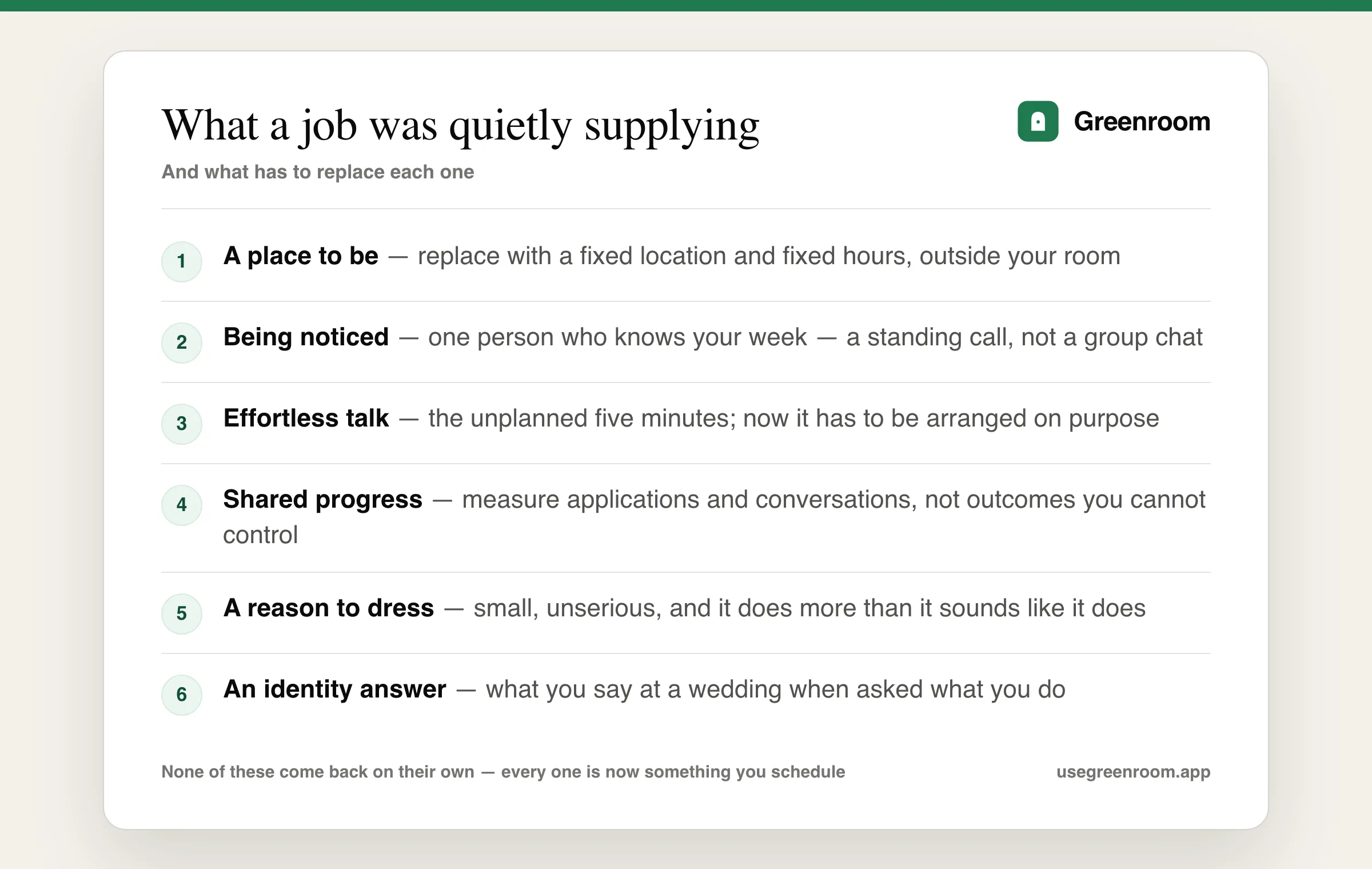
Loneliness during a job search is not a personality flaw and it is not weakness. It is what happens when four supports disappear simultaneously:
A reason to leave the house. Not a metaphor. A physical destination sets your sleep, your meals and your day. Without one, days lose edges and start blurring together — which is also why you cannot remember what you did last Tuesday.
People who notice whether you showed up. The specific, underrated experience of being mildly missed. A job means several people would notice your absence by 11am. Unemployment can mean nobody would notice for a fortnight, and knowing that is corrosive in a way that is hard to describe to someone employed.
Conversation that required no arranging. This is the big one. Almost all adult social contact is a by-product of proximity — the walk to the coffee machine, the five minutes before a meeting. Remove the proximity and every conversation becomes something you have to initiate, which is exactly the activity that gets hardest when you are already low.
A shared sense of progress. Work supplies small, frequent evidence that effort produces something. A job search supplies silence for weeks and then a rejection, which our how to handle interview rejection guide covers at more length.
What actually helps
Not "stay positive". These are structural replacements, roughly in order of how much they return per unit of effort.
Leave the house at a fixed time, to a fixed place. A library, a café, a co-working desk, a friend's flat. It matters far less where than that it is *out* and that it is *the same time daily*. This single change tends to do more than the rest of this list combined, because it restores the anchor everything else was hanging on.
Arrange one standing conversation a week. One person, same day, same time, who knows what your week contains. A friend, a former colleague, a sibling. Not a group chat — those give the appearance of contact without the substance of being known.
Keep one thing where you are competent. Football, a choir, a class, a side project with other people in it. Job searching is months of being evaluated and found wanting; you need at least one arena where you are simply fine at something and nobody is deciding about you.
Count inputs, not outcomes. Applications sent, conversations had, problems practised. You do not control who replies. Measuring yourself on outcomes you do not control is a reliable way to feel worse while working hard.
Tell a few people the truth. Not everyone — a handful. Concealing a job search is exhausting and it removes precisely the people who might help. Our how to ask for a referral guide covers the version of this that is also useful, and how to message a recruiter on LinkedIn covers the colder end.
Put a hard stop on the day. Searching expands to fill all available hours and then contaminates the evening, so you end up neither working nor resting. Stop at six. The listings will still be there.
On networking advice, honestly
The standard prescription for job-search isolation is "network more", which asks someone already depleted to perform enthusiasm at strangers. It is not wrong, exactly, and it is badly ordered.
Contact with people who already know you is cheaper, warmer and more likely to produce an actual referral. Start with the twenty people who would recognise your name, not with two hundred who would not. Networking with strangers works considerably better once you are not lonely, rather than as the cure for being lonely.
If it is worse than this
There is a real difference between the flat, structural loneliness described here and something heavier — not sleeping, not eating, not being able to start anything at all, weeks of feeling nothing much. That is not a scheduling problem and this article will not fix it.
If that is closer to your experience, talk to a doctor or a mental health professional. That is not an escalation or an admission of anything; it is the appropriate tool, in the way that a lawyer is the appropriate tool for a contract. Long job searches are genuinely hard, and being unemployed is one of the more reliably difficult things that happens to people. Getting help with it is ordinary.
Where the usual advice comes up short
"Stay positive." Costs the speaker nothing, transfers the entire burden to you, and treats a structural problem as an attitude.
"Network more." Right eventually, wrong first. See above.
LinkedIn. Simultaneously the place your search happens and an unbroken feed of other people's announcements. Useful in short, scheduled doses; corrosive as an all-day companion. Our LinkedIn profile tips guide covers making the profile work so you can close the tab.
Job-seeker forums. Genuinely helpful for practical information and for feeling less singular. Worth watching whether a particular one leaves you calmer or more frightened, because both exist.
Greenroom. One honest limit first: a mock interview is not company, and using practice software to replace human contact would be a bad trade. What it does address is narrower — after weeks without conversation, the first real interview is rough simply because you are out of practice at talking. Ari, the AI interviewer puts reps back in before the interview that matters. That is a fluency problem, not a loneliness cure, and it is worth being clear about the difference.
The one-line version
Leave the house at the same time every day to the same place, arrange one standing conversation a week with someone who knows your week, keep one activity where you are already competent, count applications rather than offers, and stop at six — because what you lost was scaffolding, not willpower, and scaffolding can be rebuilt.
Frequently asked questions
Why is job searching so lonely?
Because employment quietly supplies most adult social contact and removes it all at once when it ends. A job provides a place you are expected to be, people who would notice your absence, conversation that happens by proximity rather than by arrangement, and regular evidence that effort produces results. A job search removes all four simultaneously, so the isolation is structural rather than a failure of attitude. That is also why encouragement rarely helps and rebuilding routine does.
How do I stay social while unemployed?
Prioritise structural replacements over motivation. Leave the house at a fixed time to a fixed place such as a library or café, which restores the anchor your sleep and meals were hanging on. Arrange one standing weekly conversation with a specific person rather than relying on group chats. Keep one activity where you are already competent, so that not every hour involves being evaluated. Tell a handful of people the truth about your search, since concealing it is exhausting and removes the people most likely to help.
Is it normal to feel depressed during a long job search?
Low mood during an extended search is extremely common, and unemployment is reliably one of the harder things people go through. There is a meaningful difference between flat, structural loneliness and something heavier — persistent sleep or appetite disruption, being unable to start anything, or weeks of feeling very little. The second is not a scheduling problem, and speaking to a doctor or a mental health professional is the appropriate step rather than an escalation.
Does networking help with job search loneliness?
Eventually, though it is usually prescribed in the wrong order. Asking someone already depleted to approach strangers enthusiastically is demanding, and it tends to work far better once the isolation has eased rather than as the cure for it. Starting with people who already know you — former colleagues, classmates, anyone who would recognise your name — is warmer, less costly and more likely to produce a genuine referral than beginning with people who have no context for you at all.
How do I structure my day when I am not working?
Give the day edges. Set a fixed start with a physical destination outside your home, decide in advance what counts as the day's work, and set a hard stop in the early evening, because an open-ended search expands to fill every hour and then ruins the rest of the day too. Measure inputs you control such as applications sent, conversations held and problems practised, rather than outcomes such as replies and offers, which are determined by other people and make effort feel worthless.
Should I tell people I am looking for a job?
Telling a selected few is usually worth it. Concealing a search takes continuous effort, adds a layer of performance to ordinary conversations, and cuts off exactly the people who might introduce you to something. You do not owe everyone the information, and choosing a handful who will be practical rather than pitying tends to work better than either broadcasting it or carrying it alone.