The meeting was fourteen minutes long. There was a slide. Someone from HR he had never met used the phrase "impacted population," and by lunchtime his laptop was in a courier bag and his Slack was gone. The strangest part, he said later, was that the afternoon was completely empty — the first empty afternoon he'd had in four years, and he spent all of it refreshing LinkedIn.
A layoff is a financial event and an identity event arriving at the same time, and most advice only addresses one. This guide is a practical plan for what to do after a layoff: the money and paperwork that are genuinely urgent, the search that should not start on day one, and how to talk about it in interviews without apologising for something that was not your decision.
Week 1: money and paperwork, not applications
The instinct is to apply everywhere immediately. Resist it for a few days — applications sent in the first 48 hours are usually the worst ones you will send, and the urgent work is elsewhere:
- Read the separation agreement before signing. Check the severance amount and payment date, notice pay, whether unused leave is encashed, when insurance ends, and any non-compete or non-disparagement clause. Ask for time to review; that request is normal.
- Get your documents while people still answer. Relieving letter, experience letter, last payslips, Form 16. Chasing these six months later from a company that has just had layoffs is genuinely hard, and Indian background verification will want them.
- Sort health insurance. Employer cover usually ends on the last working day or shortly after. If you have dependents, a personal policy is urgent, not optional.
- Do the runway arithmetic. Savings plus severance, divided by monthly essentials. Knowing you have five months rather than an undefined amount of dread changes how you interview — desperation is audible.
- Trim the obvious. Pause subscriptions and discretionary spend now rather than in month three.
In India also check your PF — you can leave it, transfer it to the next employer via UAN, or withdraw, and transferring is usually better for continuity of service. Ask HR about gratuity if you have completed five years.
Week 2: your story and your materials
Before applying, fix the two things that everything else depends on.
The story. Write two or three sentences you can say without flinching: "My team was cut in a company-wide restructuring in March — around 15% of the org, including the whole platform group. I'm looking for a backend role where I can keep working on payments infrastructure." Factual, brief, forward-looking. Then say it aloud until it sounds ordinary, because the discomfort in your voice is what interviewers notice, not the layoff itself.
Three rules for that story: do not apologise, do not badmouth the company, and do not over-explain. A layoff is a business decision that happened to a lot of competent people, and interviewers in 2026 have seen many. Our career gap guide covers the same skill for the months that follow.
The materials. Update your résumé with outcomes rather than duties, and get numbers into it — latency reduced, revenue affected, users served. Update LinkedIn honestly; the "Open to work" banner is a genuine judgment call, and the honest summary is that it increases recruiter inbound and some people find it uncomfortable. Our ATS résumé guide covers the format that actually parses.
Week 3: targeted outreach beats mass applications
Volume feels productive and converts badly. A hundred cold applications typically produce fewer interviews than fifteen warm ones.
- Start with people who have seen you work. Former colleagues, managers and skip-levels. A short specific message — "I was affected by the layoffs at X, I'm looking for backend roles, is your team hiring or do you know someone?" — is easy to answer and often does.
- Tell people the specific thing you want. "Any leads?" is unanswerable. "Backend roles in fintech, Bengaluru or remote" gives someone something to match against.
- Use the fact that others were laid off with you. Colleagues who land somewhere first are the strongest referral network you will ever have.
- Apply where you have a genuine angle — a referral, relevant domain experience, a real interest you can articulate — and treat mass applications as the low-yield background activity they are.
Also: recruiters who contacted you in the past year are worth an email. They already screened you once.
Week 4: interview readiness and a routine
By now interviews should be starting, and two things matter.
First, get sharp before the interviews that count, not during them. If you have been in one job for years, your interviewing muscles have atrophied even though your engineering has not — you know your system deeply and have not explained it to a stranger in four years. Run mock interviews, out loud, before the round you care about. Our interview preparation guide covers the plan.
Second, build a structure for your days. Unemployment's real damage is often psychological, and shapeless days make it worse. A workable pattern: mornings for focused work (preparation, one substantial application, one outreach message), afternoons for admin and learning, and a genuine stop time. Keep exercise and sleep, because interviewing tired is a measurable disadvantage.
Expect the emotional part to be non-linear, and to be worse than you expect on quiet days. That is normal and it is not a signal about your prospects. Our staying motivated during a long job search and handling rejection guides cover the parts nobody plans for.
Talking about it in interviews
The question comes in a few forms — "why did you leave?", "tell me about the gap", "what happened at X?" — and they all want the same short answer. Deliver the two-sentence version, then stop talking. The pause afterwards will feel enormous to you and completely normal to them.
Specific situations:
- If the whole team went, say so — it makes it visibly structural.
- If it was performance-adjacent, be honest but brief: what happened, what you learned, what you would do differently. Do not volunteer more than asked.
- If there is now a gap of several months, give it shape — a course, a project, contract work, caregiving. "I've been interviewing selectively and shipping a side project" is a complete answer.
- If asked why you have not found anything yet, the confident answer is that you are being selective rather than that nobody wants you — and it is usually true.
Do not lie about being currently employed. It surfaces in verification and turns a normal situation into a disqualifying one.
LinkedIn, communities, ChatGPT — where each fits
- Former colleagues — the highest-yield channel by a wide margin, and the one people avoid out of embarrassment.
- Layoff lists and alumni communities — several exist for major layoff events and companies actively recruit from them.
- LinkedIn — good for recruiter inbound and reconnecting; bad for your mental health if you scroll it all day. Our doomscrolling and your job search guide covers that trap.
- Recruiters who contacted you before — warm, fast, and already familiar with your profile.
- A financial adviser or a spreadsheet — whichever gets you an actual runway number.
- ChatGPT — useful for rewriting a résumé bullet or drafting outreach. It will not notice that your voice tightens when you say the word "restructuring."
- Greenroom — the spoken layer. Ari, the AI interviewer, rehearses the layoff question and full technical rounds out loud, so the first time you say it is not in the interview that matters. Fair tradeoff: Ari cannot make referrals.
The 30-day plan, condensed
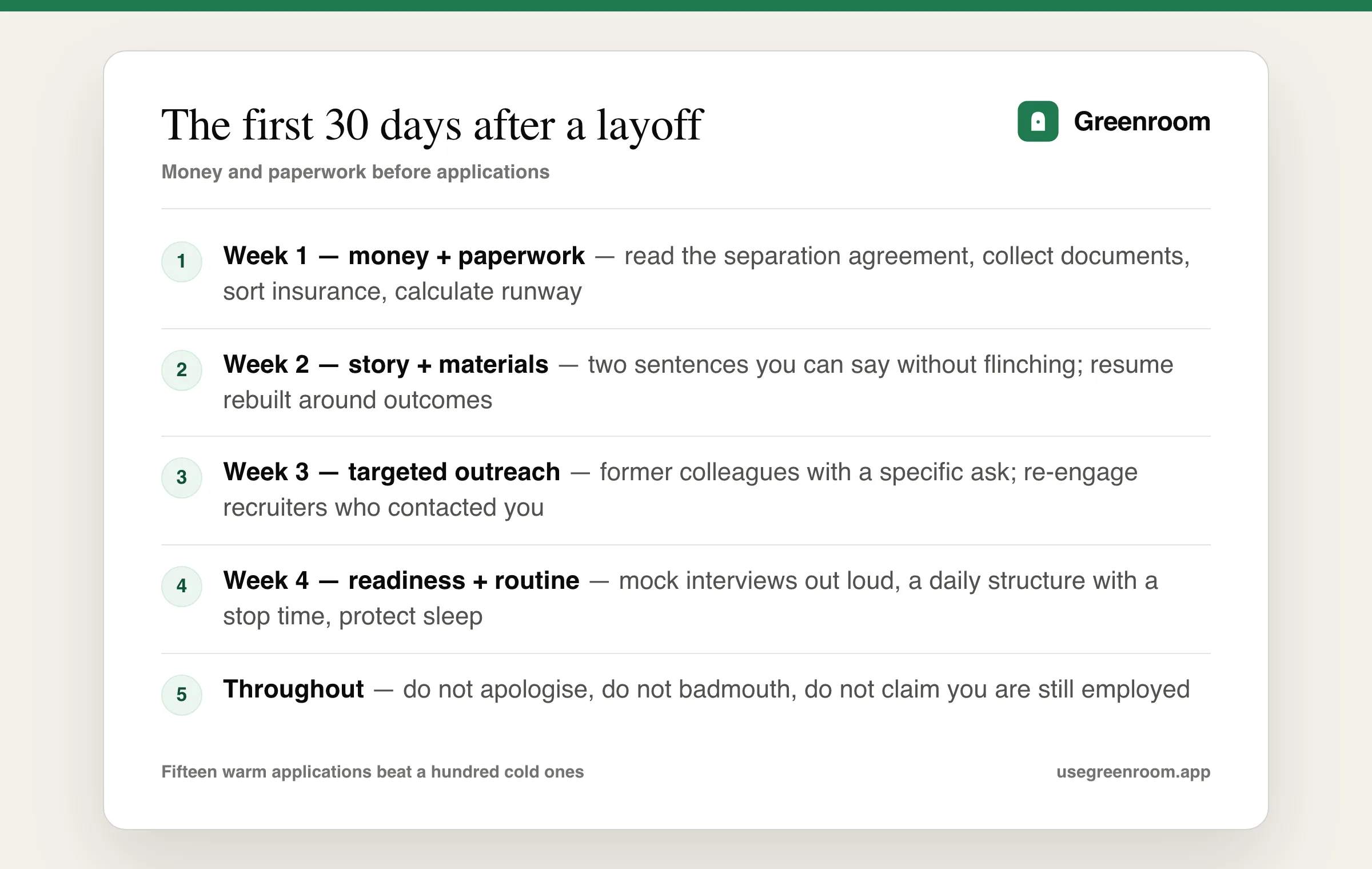
- Days 1–7: review the separation agreement, collect every document, sort insurance, calculate runway, pause discretionary spending.
- Days 8–14: write and rehearse the two-sentence story, rebuild the résumé around outcomes, update LinkedIn.
- Days 15–21: contact twenty former colleagues with a specific ask, re-engage past recruiters, apply only where you have an angle.
- Days 22–30: mock interviews out loud before the real ones, establish a daily structure with a stop time, and protect sleep and exercise.
Also useful: our career gap guide, the getting hired without direct experience guide, and the background verification guide for the paperwork your next employer will ask about.
If you were let go rather than made redundant, the answer is different: our how to explain being fired in an interview guide covers the three-sentence version.
Frequently asked questions
What should you do first after a layoff?
Handle money and paperwork before applications. Read the separation agreement carefully before signing, checking severance, notice pay, leave encashment, insurance end date and any non-compete clause. Collect your relieving letter, experience letter, payslips and Form 16 while people still answer your emails. Sort health insurance, then calculate your runway in months so you know exactly how much time you have, because financial uncertainty makes interviews harder.
How do you explain a layoff in an interview?
Use two or three factual, forward-looking sentences: what happened, its scale, and what you are looking for now. For example, that your team was cut in a company-wide restructuring affecting around 15% of the organisation, and you are now looking for a backend role in a specific area. Do not apologise, do not criticise the company, and do not over-explain. Then stop talking — the pause feels long to you and normal to them.
Should you use the LinkedIn Open to Work banner after a layoff?
It is a genuine judgment call rather than a clear yes or no. The banner measurably increases recruiter inbound and signals availability to your network, which matters most when you need volume of opportunities. Some people find it uncomfortable or worry it signals desperation to hiring managers. A reasonable middle path is enabling the recruiter-only visibility setting, which surfaces you in recruiter searches without the public photo frame.
How long does it take to find a job after a layoff?
It varies widely by role, seniority and market conditions, and senior roles typically take longer because there are fewer of them. Rather than anchoring on an average, calculate your own runway in months and plan the search to fit comfortably inside it. Expect the emotional experience to be non-linear, with quiet days feeling worse than busy ones, which is normal and not a signal about your actual prospects.
Should you apply to jobs immediately after being laid off?
Not in the first few days. Applications sent in the first 48 hours are usually the weakest ones you will send, because your résumé is not updated and you have not yet rehearsed how you talk about the layoff. Spend the first week on money and paperwork, the second on your story and materials, and then start applying — prioritising fifteen warm, referred applications over a hundred cold ones.
Does being laid off hurt your chances in background verification?
No. Background verification confirms your employment dates and designation, not the reason you left, and many employers will not disclose a reason at all. A layoff is not a failure condition. What does cause problems is concealment — claiming you are still employed, stretching your end date to hide a gap, or omitting the job entirely. Report exact dates from your relieving letter and explain the situation honestly in interviews.