He designed the catalogue search well. Elasticsearch cluster, a cache layer, a read replica, a reranking service. The interviewer nodded through all of it and then asked what it would cost per month at their traffic. He had never once been asked that in an interview. The answer, when they worked it out together, was more than the gross margin on a meaningful slice of the orders it would serve.
That question is the thing that makes Meesho backend interview questions distinctive. Meesho's model is high volume at very thin margins across price-sensitive users in tier-2 and tier-3 India, which means an architecture that is technically excellent and expensive is simply wrong. The loop is otherwise a conventional Indian product-company shape — DSA, low-level design, system design, hiring manager — but cost and pragmatism run through all of it. I built Greenroom after freezing in an interview I had prepared hard for, so this guide covers each round.
The Meesho backend engineer interview process
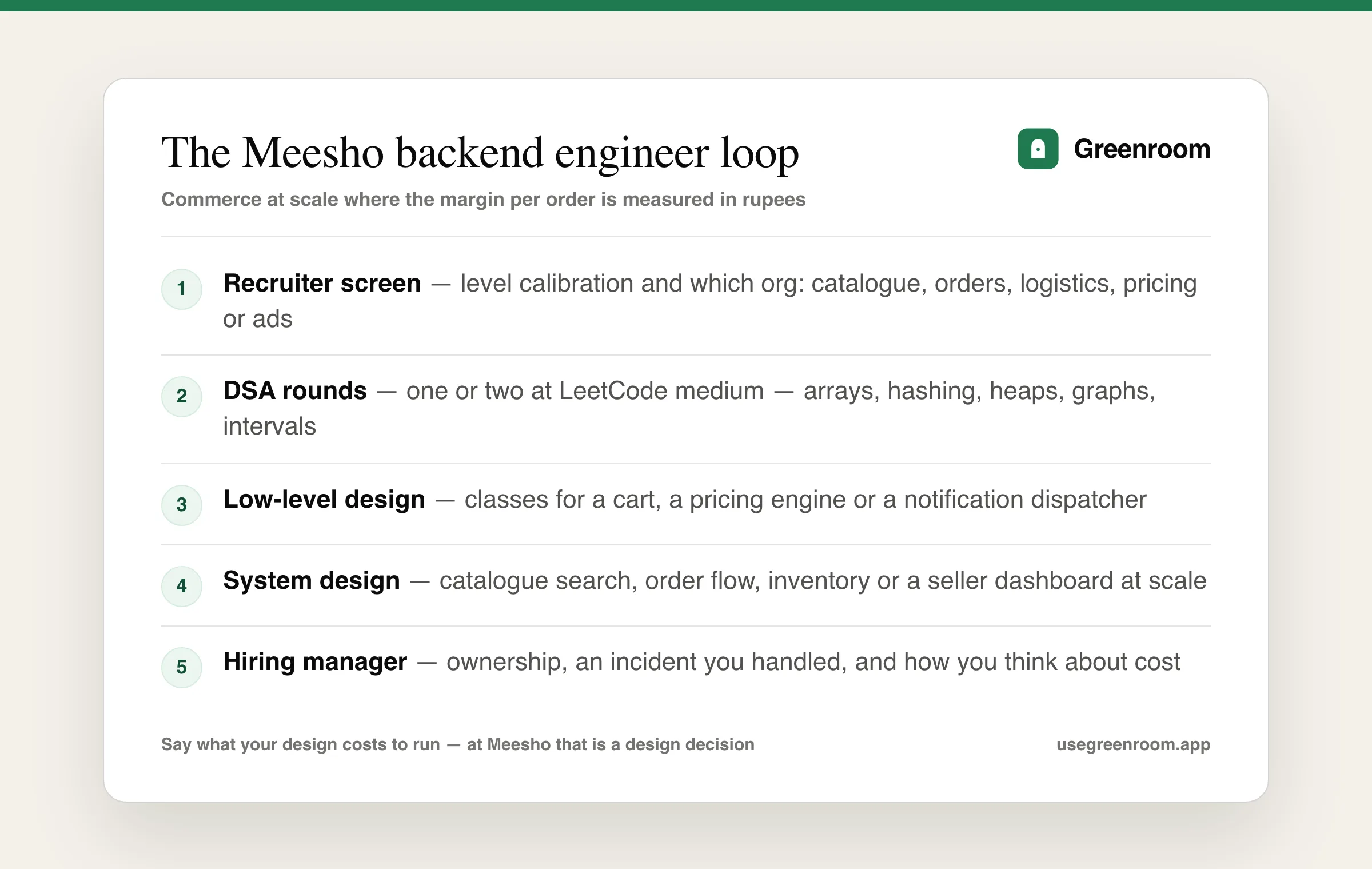
- Recruiter screen — level calibration and org: catalogue, orders, logistics, pricing, seller tools or ads.
- DSA rounds — one or two at LeetCode medium: arrays and hashing, heaps and top-K, graphs, intervals, sliding window, binary search.
- Low-level design round — class design for something concrete, extended live.
- System design round — catalogue search, the order flow, inventory, or a seller-facing dashboard.
- Hiring manager round — ownership, incidents, and how you reason about tradeoffs including cost.
Our Meesho interview questions guide covers the company-wide process and the Meesho frontend engineer guide covers the client side.
The DSA rounds
Standard medium difficulty, with a commerce flavour to the framing: top-K sellers by rating, merging price ranges, finding the cheapest combination under a constraint, deduplicating a product catalogue.
Practise stating complexity precisely and finishing each problem with a production follow-up spoken aloud — what if this is a stream, what if it does not fit in memory, what if it runs on every page load. Our DSA coding interview preparation guide covers the list.
The low-level design round
Prompts are concrete: a shopping cart with promotions, a pricing engine where rules change weekly, a notification dispatcher across SMS, WhatsApp and push, or an order state machine.
- Interfaces before implementations. A rule or strategy interface is usually most of the answer.
- Extensibility under a live change. They will add a requirement halfway — a new promotion type, a new channel, a new order state. If you must rewrite, you designed too concretely.
- State machines done explicitly. The order lifecycle — created, confirmed, packed, shipped, delivered, returned, refunded — with legal transitions declared rather than implied by scattered if-statements. This is asked often and answered badly.
- Idempotency, because every downstream call gets retried.
- Testability without standing up the whole system.
Our design patterns interview questions guide covers the patterns that actually recur.
System design, with cost as a constraint
- Numbers first, and include the money. Orders per day, peak-to-average around sale events, catalogue size, requests per second, and then — the Meesho-specific move — an order-of-magnitude estimate of what the design costs to run.
- Catalogue and search. Millions of listings, heavy read traffic, and search quality that has to work with sparse, inconsistent seller-written text. Discuss indexing strategy, denormalisation for read speed, and how the index stays fresh when sellers edit listings.
- Cache aggressively, and say what happens on a miss storm. With thin margins, a cache hit ratio is a cost lever, not just a latency one. Say "thundering herd" and describe request coalescing. Our caching strategies interview questions guide covers the patterns.
- The order flow. Placement, payment, inventory reservation, seller notification, and the compensating actions when any step fails. Do not draw two writes without a plan — a single transaction where possible, a saga with compensations where not.
- Inventory correctness. Overselling is a real business problem; reservation with a timeout and explicit release is the expected answer.
- Read-heavy versus write-heavy. Browsing is overwhelmingly read; ordering is write. Design them differently and say so.
- Cheap over clever. A simpler design that costs a quarter as much is a legitimate and well-received answer here, provided you name what you gave up.
- Failure isolation. What the app shows when recommendations are down versus when checkout is down. Degrade the first, protect the second.
Our system design interview guide covers the vocabulary and distributed systems interview questions covers the failure modes.
Backend fundamentals they probe
- Databases — index selection, why a query ignored your index, isolation levels, and when to denormalise. Our DBMS interview questions guide covers it.
- Queues — consumer lag, back-pressure, ordering guarantees you actually get, and what happens when a consumer falls behind during a sale. Our Kafka interview questions guide covers this.
- Concurrency — races on inventory, optimistic versus pessimistic locking, and safe retries.
- APIs — pagination for very large catalogues, versioning, and error contracts. Our REST API interview questions guide covers the standard set.
The hiring manager round
Expect an incident you owned, a time you shipped something that broke, a disagreement with a product manager, and a decision where you chose the pragmatic option over the elegant one. That last question is close to a Meesho signature — be ready with a real example where you deliberately shipped something simpler and can explain the reasoning and what you would revisit.
Be precise about the scale you have actually operated. Inflated numbers get probed with follow-ups about your real p99 and peak QPS. Our behavioral interview questions guide covers the structure.
Where each prep option actually helps
- LeetCode — mediums, each closed out with a production follow-up spoken aloud.
- Designing Data-Intensive Applications — the consistency and failure vocabulary the design round rewards.
- Cloud pricing pages — genuinely useful and almost nobody does it. Knowing roughly what a managed cache, a search cluster or egress costs lets you answer the question that ends most candidates.
- Low-level design practice — design a cart, a pricing engine and an order state machine as real code, then have someone add a requirement mid-way.
- ChatGPT — good for generating mid-design requirement changes to test your abstractions. It will not ask what your architecture costs per month.
- Greenroom — the spoken layer. Ari, the AI interviewer runs the design round out loud and pushes on tradeoffs. Honest tradeoff: Ari will not price your architecture, so do that arithmetic yourself.
How to prepare for the Meesho backend interview
- Week 1 — LeetCode mediums with commerce framing, complexity spoken every time.
- Week 2 — three low-level designs written as code, each followed by an unplanned requirement change.
- Week 3 — design catalogue search, the order flow and inventory out loud, each with a rough monthly cost and a cheaper alternative.
- Final week — five behavioral stories including one where you chose the pragmatic option, plus two full spoken mocks.
Interviewing across comparable loops? The Flipkart backend engineer guide covers the machine coding format, the Zomato backend engineer guide covers real-time logistics, and the Swiggy backend engineer guide covers dispatch systems.
Frequently asked questions
What is the Meesho backend engineer interview process?
Candidates report a recruiter screen for level and org calibration, one or two DSA rounds at LeetCode medium, a low-level design round where you write class structures and extend them live, a system design round covering catalogue search, the order flow or inventory, and a hiring manager round on ownership and tradeoffs. The structure is conventional for an Indian product company; the distinguishing emphasis is cost and pragmatism running through the design rounds.
What system design questions does Meesho ask?
Prompts are commerce-shaped: catalogue search across millions of listings, the order placement flow, inventory management, or a seller-facing dashboard. Strong answers begin with numbers including peak-to-average around sale events, then cover read-heavy browsing versus write-heavy ordering, aggressive caching with a stampede plan, inventory reservation with timeouts to prevent overselling, compensating actions when a step in the order flow fails, and an explicit order-of-magnitude estimate of what the design costs to run.
Why does Meesho ask about infrastructure cost in interviews?
Because the business model is high volume at very thin margins serving price-sensitive users, so an architecture that is technically excellent and expensive is simply the wrong answer. Volunteering a rough monthly cost and a cheaper alternative — while naming what you gave up — consistently scores better than proposing a more sophisticated design with no number attached. Reading cloud pricing pages before the interview is unusually high-yield preparation.
What is asked in Meesho's low-level design round?
Concrete prompts such as a shopping cart with promotions, a pricing engine whose rules change weekly, a multi-channel notification dispatcher, or an order state machine. You are graded on defining interfaces before implementations, on whether your design survives a requirement added mid-round, on modelling the order lifecycle as an explicit state machine with declared legal transitions rather than scattered conditionals, on idempotency for retried downstream calls, and on testability in isolation.
How hard is the Meesho DSA round?
It sits at LeetCode medium and covers arrays and hashing, heaps and top-K, graphs, intervals, sliding window and binary search, often framed in commerce terms such as top-K sellers by rating or merging price ranges. Stating complexity precisely and closing each problem with a production follow-up — what if this is a stream, what if it does not fit in memory — is what raises the score beyond simply solving it.
What does the Meesho hiring manager round ask?
Expect an incident you owned end to end, something you shipped that broke, a disagreement with a product manager, and a decision where you deliberately chose the pragmatic option over the elegant one. That last question is close to a signature for this loop, so have a real example ready where you shipped something simpler on purpose, with the reasoning and what you would revisit later.