A candidate I'll call Ritika designed a clean hotel-booking system in her MakeMyTrip system design round: a bookings table, an availability check, a straightforward confirm flow. The interviewer's follow-up: "two customers click 'book' on the last available room within 200 milliseconds of each other, and your availability data came from a third-party supplier's API that's already 30 seconds stale. Who gets the room, and what does the other customer see?" Ritika's design assumed her own database was the source of truth. MakeMyTrip's actual problem (aggregating and selling inventory it doesn't fully control, from suppliers whose data is never perfectly fresh) meant her design had a correctness gap she hadn't considered.
That's the real shape of MakeMyTrip interview questions: the DSA and machine-coding rounds are familiar if you've prepped for any e-commerce-scale Indian product company, but the system design round is specifically about a problem most system design prep doesn't cover well — staying consistent and honest with customers when your own inventory data is sourced from multiple external suppliers with different freshness guarantees. I built Greenroom after freezing in exactly this kind of interview, where the "obvious" design misses a subtlety the interviewer clearly cares about. This guide covers the real MakeMyTrip interview process, the questions that come up, and where multi-supplier inventory design catches people off guard.
The MakeMyTrip interview process
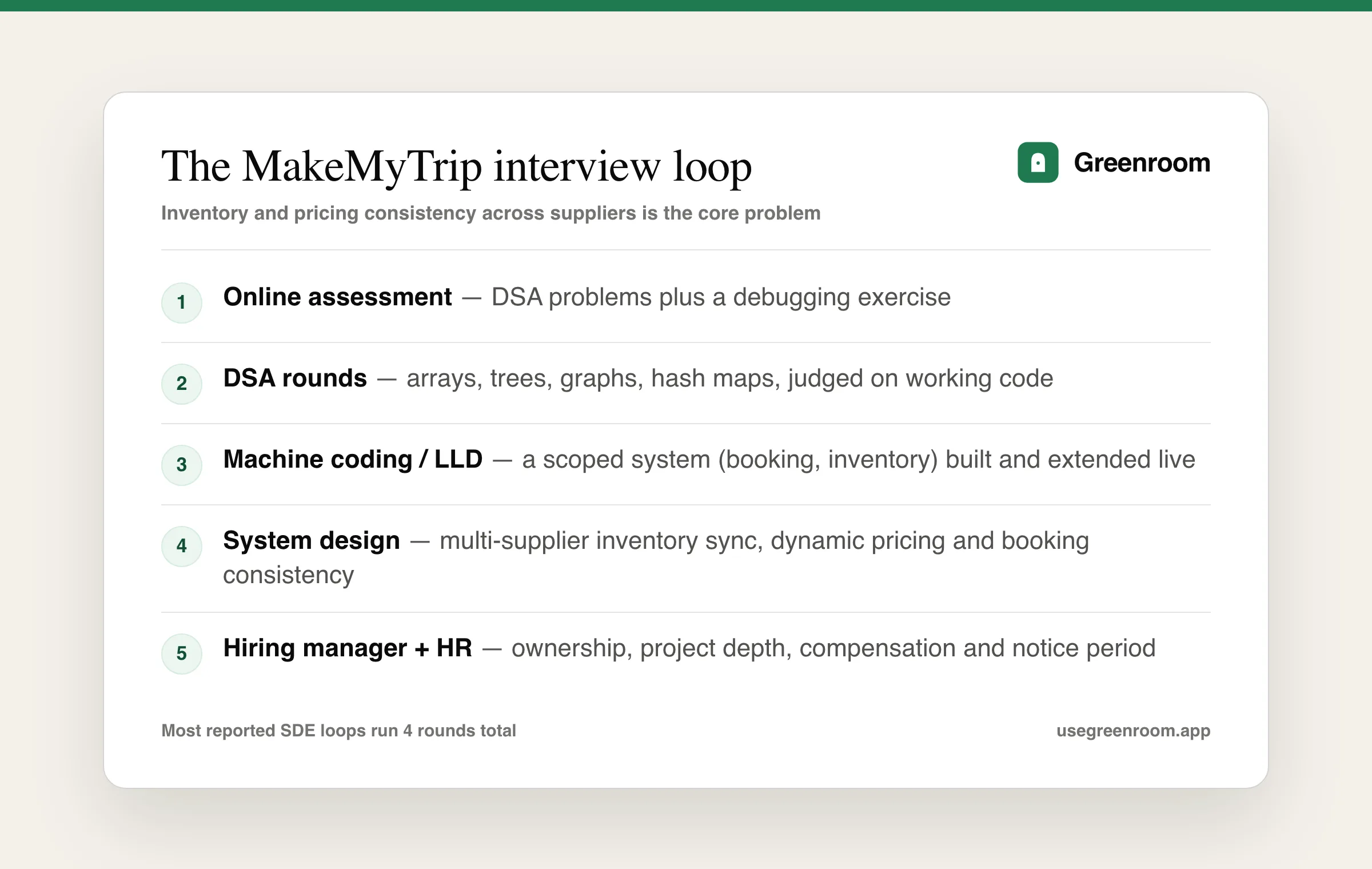
Candidates consistently report a loop shaped like this:
- Online assessment, DSA problems plus a debugging exercise.
- DSA rounds: arrays, trees, graphs, hash maps, judged on working code.
- Machine coding / low-level design round — a scoped system (booking, inventory) built and extended live under a new constraint.
- System design round — multi-supplier inventory sync, dynamic pricing and booking consistency.
- Hiring manager + HR: ownership, project depth, compensation and notice period.
Most reported loops run 4 rounds total. The detail that catches candidates off guard: a technically correct booking-confirmation flow can still be wrong if it doesn't account for the reality that your inventory data isn't fully owned or fully fresh. It's aggregated from hotel and airline partners whose own systems have their own latency and consistency guarantees.
DSA and coding questions
Core data structures and algorithms, with a practical, backend-flavored lean:
- Given a stream of price updates from multiple suppliers for the same hotel room, return the current lowest valid price.
- Design a data structure that supports fast range queries for available dates across a large inventory.
- Find the shortest/cheapest combination of flight legs given a graph of routes and prices.
- Reverse a linked list in groups of K.
The machine-coding round
A scoped system, built and then extended live when the interviewer adds a new requirement mid-round:
- Design a booking system that prevents two customers from double-booking the last available room.
- Build a price-comparison engine that merges quotes from multiple suppliers for the same product.
- Design a cancellation/refund system that stays consistent even if a supplier's cancellation API is slow or fails.
Interviewers grade extensibility and correctness under a live-changing spec more than algorithmic cleverness — can your class hierarchy absorb "now also support partial refunds" or "now handle a supplier that doesn't confirm cancellations synchronously" without a rewrite.
System design questions, multi-supplier inventory and pricing
This is MakeMyTrip's signature round. Expect design prompts pulled from the real messiness of selling inventory you don't fully control:
- Design an inventory system that aggregates room or seat availability from multiple suppliers with different data-freshness guarantees.
- How would you design a booking flow that avoids double-selling the last unit of inventory under concurrent requests?
- Design a dynamic pricing system that reflects real-time demand without showing customers a price the supplier can't actually honor.
- What happens to your design when a supplier's API is slow or briefly unavailable during checkout, how does the system degrade instead of failing silently?
Ritika's mistake wasn't her booking flow: it was assuming her own system was the single source of truth for availability, when a real travel-aggregation platform has to reason honestly about staleness and conflicting supplier data as a first-class design constraint, not an edge case. Our system design interview guide covers the general framework; MakeMyTrip's version demands you design for uncertainty in your own inventory data.
Behavioral and hiring-manager questions
The hiring manager round leans into ownership and reasoning under real-world ambiguity:
- Tell me about a time you had to design something around data you didn't fully control or trust.
- Walk me through a project where you had to make a trade-off between showing users fresh data and showing them consistent data.
- Describe a time you debugged a production incident caused by a third-party dependency, not your own code.
Our behavioral interview questions and answers guide covers structuring these with STAR without sounding rehearsed.
LeetCode, GeeksforGeeks, ChatGPT, where each fits
- LeetCode, right for the DSA gate rounds; wrong as the main event, since multi-supplier inventory design is what actually separates candidates.
- GeeksforGeeks interview experiences — useful for calibrating what past candidates were asked; treat as anecdotes, not a syllabus, since accuracy and recency vary post to post.
- A general system design course (necessary groundwork, but most courses assume your own database is the source of truth) you'll need to adapt the framework for third-party-sourced inventory.
- ChatGPT — solid for generating practice inventory-design prompts and sanity-checking a written design; it won't push back on your staleness assumption the way a real interviewer defending a genuine aggregation problem will.
- Greenroom, the spoken layer. Ari, the AI interviewer, runs a mock system-design round out loud and pushes the "your data is 30 seconds stale" follow-up Ritika got caught on, scoring how clearly you reason through supplier-data uncertainty rather than assuming a clean, fully-owned data model.
How to prepare for the MakeMyTrip interview
- Week 1: core DSA (arrays, trees, hash maps, graphs) practiced with an eye toward pricing- and availability-flavored problems.
- Week 2: machine coding: pick three prompts (booking system, price-comparison engine, cancellation flow) and build each with clean, extensible classes in a timed window.
- Week 3: multi-supplier system design (inventory aggregation, dynamic pricing, degraded-supplier handling) worked through out loud, explicitly reasoning about data staleness and conflicting sources.
- Final week: one spoken mock where the interviewer pushes a "your inventory data is stale" follow-up on your booking design, plus a third-party-dependency-focused behavioral pass.
If MakeMyTrip is one of several e-commerce or marketplace companies you're targeting, the shape rhymes but the constraint shifts: our Flipkart interview questions guide covers a similar machine-coding-plus-DSA loop at e-commerce scale without the multi-supplier complexity, our Cars24 interview questions guide covers a related loop where the hard problem is generating a trustworthy price algorithmically instead of syncing supplier inventory, and the general system design interview guide covers the framework every one of these loops assumes.
Frequently asked questions
What questions does MakeMyTrip ask in a technical interview?
Expect DSA and coding (arrays, graphs, hash maps), a machine-coding round building a scoped system like a booking or price-comparison engine with clean, extensible code, system design questions about multi-supplier inventory sync and dynamic pricing consistency, and behavioral questions about reasoning through third-party data dependencies.
How many rounds are in the MakeMyTrip interview process?
Typically an online assessment (DSA plus debugging), DSA rounds, a machine-coding/low-level design round, a system design round, and a hiring manager/HR round, 4 rounds total in most reported cases.
What makes MakeMyTrip's system design round different?
It's specifically about staying consistent and honest with customers when inventory and pricing data comes from multiple external suppliers with different freshness guarantees, rather than assuming your own database is the single source of truth. Interviewers want you to design explicitly for data staleness and conflicting supplier data.
Is the MakeMyTrip interview process the same for every role?
The DSA-plus-machine-coding-plus-inventory-design shape is the default for backend and fullstack roles; frontend roles keep the same DSA and machine-coding structure with JavaScript, framework and performance depth layered on for the design round instead of inventory logic.
How hard is the MakeMyTrip interview?
It's a consistently high bar rather than a trick-question gauntlet. The part most candidates underprepare for isn't the DSA round. It's realizing that a technically correct booking flow can still fail if it doesn't account for the reality that inventory data is sourced from suppliers, not owned outright.
How is MakeMyTrip's interview different from Flipkart's or other e-commerce companies?
Flipkart's inventory is largely owned or seller-fulfilled within a platform MakeMyTrip's isn't, and reasoning about staleness across many independent external suppliers with varying data-freshness guarantees is a distinct, additional layer of complexity that MakeMyTrip's system design round specifically probes.