A candidate I'll call Karan designed a driver-assignment system in his Porter interview that matched the nearest available truck to a booking — clean, fast, obviously correct for a two-wheeler food order. The interviewer's follow-up: "this is a 14-foot truck moving furniture across the city. The 'nearest' truck is stuck in traffic on a route that won't clear for 40 minutes. The second-nearest truck is empty and free right now. Which one do you dispatch, and how does your system know the first one is stuck?" Karan's design assumed distance was the whole signal. Porter's actual problem — moving large cargo across a city, not a 10-minute food delivery — meant distance without real-time route and traffic awareness was close to useless.
That's the real shape of Porter interview questions: the DSA and machine-coding rounds are familiar if you've prepped for any logistics-heavy Indian product company, but the system design round is specifically about intercity and intracity freight — driver-partner matching, route optimization, and ETA prediction for large vehicles moving real cargo, not two-wheelers moving small packages. I built Greenroom after freezing in exactly this kind of interview, where a design that would work for a different company's problem quietly fails for this one. This guide covers the real Porter interview process, the questions that come up, and where freight-scale matching catches people off guard.
The Porter interview process
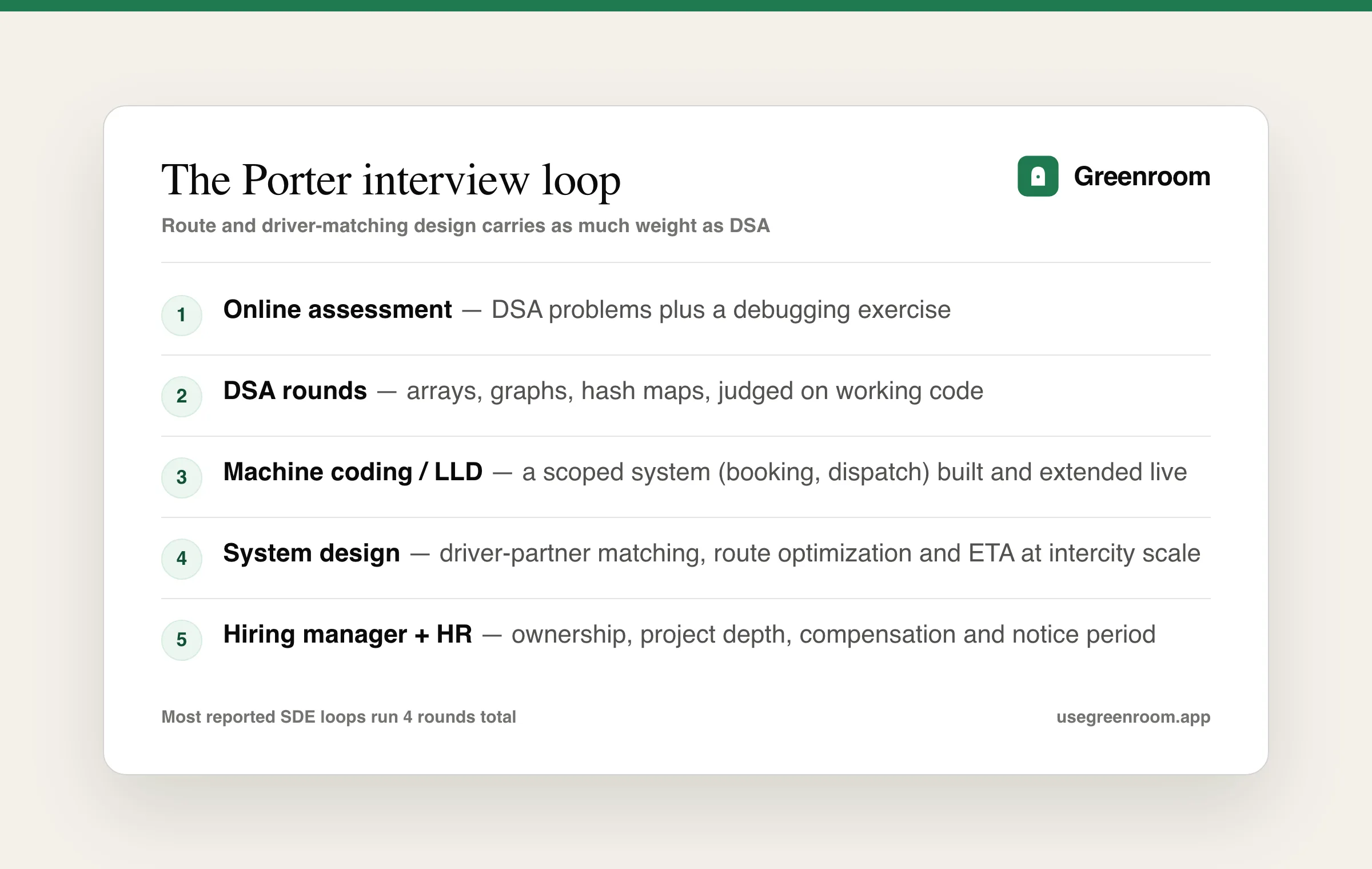
Candidates consistently report a loop shaped like this:
- Online assessment — DSA problems plus a debugging exercise.
- DSA rounds — arrays, graphs, hash maps, judged on working code.
- Machine coding / low-level design round — a scoped system (booking, dispatch) built and extended live under a new constraint.
- System design round — driver-partner matching, route optimization and ETA at intercity scale.
- Hiring manager + HR — ownership, project depth, compensation and notice period.
Most reported loops run 4 rounds total. The detail that catches candidates off guard: Porter's matching problem isn't the same shape as a food-delivery or ride-hailing problem — vehicles vary by size and capacity, routes span much longer distances, and "nearest" is a far weaker signal than it is for a 10-minute delivery.
DSA and coding questions
Core data structures and algorithms, with a practical, logistics-flavored lean:
- Given a list of drivers with location, vehicle type and availability, find the best match for a booking requiring a specific vehicle size.
- Find the shortest path in a weighted graph representing a road network — explain when Dijkstra breaks down and what you'd use instead for real-time traffic.
- Design a data structure that supports fast insert, delete, and nearest-neighbor lookup for moving entities.
- Given a stream of location updates, detect which drivers have gone offline or stopped moving unexpectedly.
The machine-coding round
A scoped system, built and then extended live when the interviewer adds a new requirement mid-round:
- Design a dispatch system that assigns a booking to an available driver based on vehicle type and location.
- Build a simple ETA-estimation system that accounts for distance and a traffic multiplier.
- Design a system that reassigns a booking if the originally matched driver cancels or goes offline.
Interviewers grade extensibility over cleverness — can your class hierarchy absorb "now also account for driver ratings" or "now support multi-stop bookings" without a rewrite.
System design questions — freight-scale matching
This is Porter's signature round. Expect design prompts pulled from the real messiness of matching freight bookings to the right vehicle and driver across a city or between cities:
- Design a driver-matching system that accounts for vehicle capacity, current load, and route direction, not just proximity.
- How would you design real-time ETA prediction that adjusts as traffic conditions change mid-trip?
- Design a system that handles a driver going offline mid-route — does it reassign the booking, and how does it decide?
- How would you design surge or dynamic pricing for freight bookings during a high-demand window?
Karan's mistake wasn't the data model — it was treating this as a smaller version of a food-delivery matching problem, when Porter's actual constraint set (vehicle size, cargo capacity, longer routes, real-time traffic) makes "nearest available" a much weaker signal than it would be for a two-wheeler order. Our system design interview guide covers the general framework; Porter's version demands you reason about vehicle-and-route constraints most e-commerce matching prompts don't have.
Behavioral and hiring-manager questions
The hiring manager round leans into ownership and reasoning under real-world operational messiness:
- Tell me about a time you had to design something that had to work across multiple, very different real-world conditions.
- Walk me through a project where you had to reason about a system with imperfect, delayed, or noisy data (like live location updates).
- Describe a time you debugged a production incident that involved real-world edge cases, not just code bugs.
Our behavioral interview questions and answers guide covers structuring these with STAR without sounding rehearsed.
LeetCode, GeeksforGeeks, ChatGPT — where each fits
- LeetCode — right for the DSA gate rounds; wrong as the main event, since freight-matching and routing design is what actually separates candidates.
- GeeksforGeeks interview experiences — useful for calibrating what past candidates were asked; treat as anecdotes, not a syllabus, since accuracy and recency vary post to post.
- A general system design course — necessary groundwork, but most courses design for one-to-one matching at consumer scale, not vehicle-capacity-constrained freight matching — you'll need to adapt the framework.
- ChatGPT — solid for generating practice matching-system prompts and sanity-checking a written design; it won't push back on your vehicle-capacity trade-off the way a real interviewer defending a genuine logistics problem will.
- Greenroom — the spoken layer. Ari, the AI interviewer, runs a mock system-design round out loud and pushes the "why nearest isn't enough" follow-up Karan got caught on, scoring how clearly you reason through a genuine logistics constraint rather than defaulting to a consumer-app matching pattern.
How to prepare for the Porter interview
- Week 1: core DSA — arrays, graphs, hash maps — practiced with an eye toward location- and routing-flavored problems.
- Week 2: machine coding — pick three prompts (dispatch system, ETA estimator, reassignment logic) and build each with clean, extensible classes in a timed window.
- Week 3: freight-scale system design — driver matching with vehicle constraints, real-time ETA, mid-route reassignment — worked through out loud with the vehicle-and-route constraints as first-class, not an afterthought.
- Final week: one spoken mock where the interviewer pushes a "why nearest isn't enough" follow-up on your matching design, plus an operational-messiness behavioral pass.
If Porter is one of several logistics or mobility companies you're targeting, the shape rhymes but the constraint shifts — our Urban Company interview questions guide covers a similar two-sided matching loop for service professionals instead of freight, and the general system design interview guide covers the framework every one of these loops assumes.
Frequently asked questions
What questions does Porter ask in a technical interview?
Expect DSA and coding (arrays, graphs, hash maps), a machine-coding round building a scoped system like a dispatch or ETA-estimation system with clean, extensible code, system design questions about driver-partner matching and route optimization at intercity freight scale, and behavioral questions about reasoning through real-world operational messiness.
How many rounds are in the Porter interview process?
Typically an online assessment (DSA plus debugging), DSA rounds, a machine-coding/low-level design round, a system design round, and a hiring manager/HR round — 4 rounds total in most reported cases.
What makes Porter's system design round different?
It's specifically about freight-scale matching — accounting for vehicle capacity, cargo size, longer routes and real-time traffic — rather than a simpler nearest-available-driver pattern that works for smaller, faster deliveries. Interviewers want you to explain why proximity alone isn't a sufficient matching signal here.
Is the Porter interview process the same for every role?
The DSA-plus-machine-coding-plus-matching-design shape is the default for backend and fullstack roles; frontend roles keep the same DSA and machine-coding structure with JavaScript, framework and performance depth layered on for the design round instead of matching logic.
How hard is the Porter interview?
It's a consistently high bar rather than a trick-question gauntlet. The part most candidates underprepare for isn't the DSA round — it's realizing that a matching design copied from a food-delivery or ride-hailing mental model doesn't transfer cleanly to freight, where vehicle capacity and route constraints matter as much as distance.
How is Porter's interview different from Urban Company's or a ride-hailing company's?
All three test two-sided matching design, but Porter's matching problem is constrained by vehicle type, cargo capacity and much longer routes than a ride-hailing or hyperlocal-services match, so its design round probes route optimization and vehicle-constraint reasoning that those other loops don't emphasize as heavily.