A candidate I'll call Deepak designed a clean car-listing system in his Cars24 system design round: a listings table, a price field, a straightforward search and filter flow. The interviewer's follow-up: "a car just got inspected. It has 40,000 km, a minor scratch on the rear bumper, and the seller wants a quote in the next five minutes while they're standing at the inspection center. Your listing table doesn't have a price yet — where does the number actually come from, and what happens if the seller haggles?" Deepak's design assumed price was an input, something a seller typed in. Cars24's actual product (instant, algorithmic valuation of a used car based on inspection data, market comps, and depreciation curves, delivered while the seller waits) meant his design had no engine to generate the one number the entire business runs on.
That's the real shape of Cars24 interview questions: the DSA and machine-coding rounds are familiar if you've prepped for any e-commerce-scale Indian product company, but the system design round is specifically about a problem most system design prep skips entirely: a real-time pricing/valuation engine, tightly coupled to an inspection-to-listing workflow that has to produce a trustworthy number in minutes, not a static price field a seller fills in. I built Greenroom after freezing in exactly this kind of interview, where the "obvious" e-commerce design misses the one component the business is actually built on. This guide covers the real Cars24 interview process, the questions that come up, and where pricing-engine design catches people off guard.
The Cars24 interview process
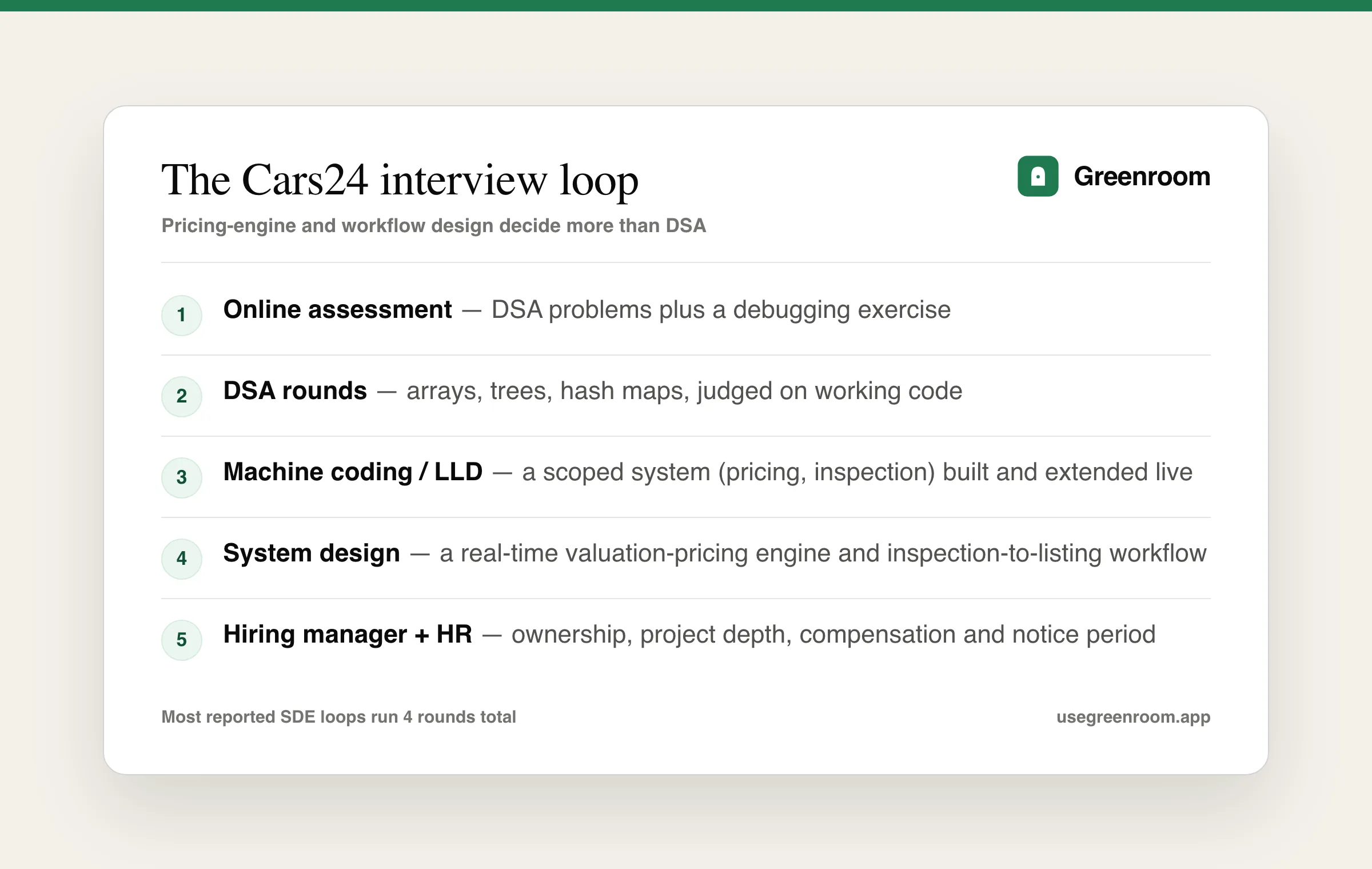
Candidates report a loop shaped like this:
- Online assessment, DSA problems plus a debugging exercise.
- DSA rounds: arrays, trees, hash maps, judged on working code.
- Machine coding / low-level design round — a scoped system (pricing, inspection) built and extended live under a new constraint.
- System design round, a real-time valuation-pricing engine and inspection-to-listing workflow.
- Hiring manager + HR: ownership, project depth, compensation and notice period.
Most reported loops run 4 rounds total. The detail that catches candidates off guard: a listing-and-search design that would work fine for a normal e-commerce catalog misses the actual hard problem: generating a defensible, near-instant price for a unique, physically-inspected asset (a specific used car with its own condition, mileage, and history), not selling a mass-produced SKU with a fixed catalog price.
DSA and coding questions
Core data structures and algorithms, with a practical, backend-flavored lean:
- Given a set of comparable car sales (make, model, year, mileage, condition), design an efficient lookup for the closest comparable transactions.
- Design a data structure that supports fast range queries for cars matching a price and mileage band.
- Given a stream of inspection-report events, detect anomalies (e.g., a mileage reading that's inconsistent with the vehicle's age).
- Implement a scoring function that weighs multiple condition factors (mileage, accident history, wear) into a single adjustment score.
The machine-coding round
A scoped system, built and then extended live when the interviewer adds a new requirement mid-round:
- Design a pricing-adjustment system that takes a base valuation and applies condition-based deductions from an inspection report.
- Build a simple inspection-to-listing pipeline that takes raw inspection data and produces a publishable listing with a price.
- Design a system that flags a listing for manual review if the algorithmic price deviates significantly from recent comparable sales.
Interviewers grade extensibility and correctness under a live-changing spec more than algorithmic cleverness — can your class hierarchy absorb "now also factor in regional demand" without a rewrite.
System design questions, the pricing engine
This is Cars24's signature round. Expect design prompts pulled from the real messiness of pricing a unique, physically-inspected asset quickly and defensibly:
- Design a real-time valuation engine that produces a price for a used car within minutes of inspection completion, using comparable sales and condition data.
- How would you design the system so a price stays consistent and explainable even as market comps and depreciation assumptions change daily?
- Design a system that handles disagreement between the algorithmic price and a human inspector's judgment — whose number wins, and how is that logged?
- What happens to your design when there aren't enough recent comparable sales for a rare make/model, how does the system degrade instead of returning an unreliable price?
Deepak's mistake wasn't the listing schema: it was treating price as data instead of as the output of a real algorithmic system that has to balance speed (the seller is waiting), accuracy (a wrong price costs real money), and explainability (someone has to be able to justify the number). Our system design interview guide covers the general framework; Cars24's version demands you design the pricing engine itself as the central system, not a side detail.
Behavioral and hiring-manager questions
The hiring manager round leans into ownership and reasoning under real-world business pressure:
- Tell me about a time you built something that had to produce a trustworthy number quickly, with imperfect data.
- Walk me through a project where you had to balance algorithmic output against human judgment.
- Describe a time you debugged a production incident that affected pricing or another business-critical calculation.
Our behavioral interview questions and answers guide covers structuring these with STAR without sounding rehearsed.
LeetCode, GeeksforGeeks, ChatGPT, where each fits
- LeetCode, right for the DSA gate rounds; wrong as the main event, since pricing-engine design is what actually separates candidates.
- GeeksforGeeks interview experiences (thin for Cars24 specifically, since it's a more specialized product than a household e-commerce brand) treat any single report as one data point.
- A general system design course (necessary groundwork, but most courses assume price is a static input) you'll need to adapt the framework for a real-time, comp-based pricing engine.
- ChatGPT — solid for generating practice valuation-engine design prompts and sanity-checking a written design; it won't push back on your pricing-explainability gap the way a real interviewer defending a genuine used-car marketplace will.
- Greenroom, the spoken layer. Ari, the AI interviewer, runs a mock system-design round out loud and pushes the "where does the price actually come from" follow-up Deepak got caught on, scoring how clearly you reason through a real pricing engine, not just a listing catalog.
How to prepare for the Cars24 interview
- Week 1: core DSA (arrays, trees, hash maps, graphs) practiced with an eye toward comparison- and scoring-flavored problems.
- Week 2: machine coding: pick three prompts (pricing-adjustment system, inspection pipeline, anomaly-flagging logic) and build each with clean, extensible classes in a timed window.
- Week 3: pricing-engine system design (comp-based valuation, condition-adjustment scoring, degraded-data handling) worked through out loud, explicitly reasoning about speed, accuracy, and explainability together.
- Final week: one spoken mock where the interviewer pushes a "where does this number come from" follow-up on your pricing design, plus a business-pressure-focused behavioral pass.
If Cars24 is one of several marketplace or e-commerce companies you're targeting, the shape rhymes but the constraint shifts — our Nykaa interview questions guide covers a related catalog-complexity problem for beauty e-commerce instead of algorithmic pricing, and the general system design interview guide covers the framework every one of these loops assumes.
Frequently asked questions
What questions does Cars24 ask in a technical interview?
Expect DSA and coding (arrays, graphs, hash maps), a machine-coding round building a scoped system like a pricing-adjustment or inspection pipeline with clean, extensible code, system design questions about a real-time comp-based valuation engine, and behavioral questions about producing trustworthy numbers quickly with imperfect data.
How many rounds are in the Cars24 interview process?
Typically an online assessment (DSA plus debugging), DSA rounds, a machine-coding/low-level design round, a system design round, and a hiring manager/HR round, 4 rounds total in most reported cases.
What makes Cars24's system design round different?
It's specifically about designing a real-time pricing/valuation engine for a unique, physically-inspected asset —a used car with its own mileage and condition— rather than a static catalog price. Interviewers want you to explain how the price is generated, kept explainable, and degrades gracefully when data is sparse.
Is the Cars24 interview process the same for every role?
The DSA-plus-machine-coding-plus-pricing-engine-design shape is the default for backend and fullstack roles; frontend roles keep the same DSA and machine-coding structure with JavaScript, framework and performance depth layered on for the design round instead of pricing logic.
How hard is the Cars24 interview?
It's a consistently high bar rather than a trick-question gauntlet. The part most candidates underprepare for isn't the DSA round. It's realizing that a design which treats price as a simple data field misses the actual hard problem: generating that price algorithmically, quickly, and defensibly.
How is Cars24's interview different from other e-commerce marketplaces?
Most e-commerce marketplaces sell items at prices sellers set or that come from a fixed catalog; Cars24's core product is generating the price itself, in real time, for a unique physical asset based on inspection data and market comparables, a fundamentally different design problem its system design round specifically probes.