He had a plan. Two hours every evening after work, six days a week, for a month. He managed it on Monday. On Tuesday there was a production issue. On Wednesday he opened his notes at 10:40pm, read the same page about consistent hashing he had read on Monday, understood it exactly as well as he had on Monday, and went to bed feeling like he had prepared. Four weeks later he had done that nineteen times and had still never said a single answer out loud.
If you are trying to work out how to prepare for interviews while working full time, the useful thing to understand first is that you probably do not have a time problem. You have a fragmentation problem. Five hours a week is genuinely enough to change an interview outcome. But the five hours you have are chopped into shapes that suit reading — and reading is the one activity that does almost nothing for you.
I built Greenroom after freezing in an interview I had prepared hard for, and this specific failure is the one I recognise most: not laziness, not lack of time. Doing the wrong task with the time available, because the wrong task is the one that fits.
Why evenings produce so little
Three things are working against you, and only one of them is the clock.
You are cognitively spent. After a full day of engineering decisions, the capacity you need for hard retrieval is gone. What is left is enough for reading, which is why reading is what you do. Reading feels like progress and produces very little — our Make It Stick summary guide covers the research on why re-reading creates an illusion of mastery.
The blocks are the wrong shape. A twenty-minute gap is fine for recall practice and useless for a mock interview. Most people have plenty of fragments and one or two real blocks a week — and then spend the real block reading and the fragments doing nothing.
Nobody is watching. At home, alone, tired, you will not voluntarily say an answer out loud to an empty room. So the only skill the interview actually tests — speaking under pressure — is the only one that never gets rehearsed. This is the whole problem in one sentence.
The five-hour week
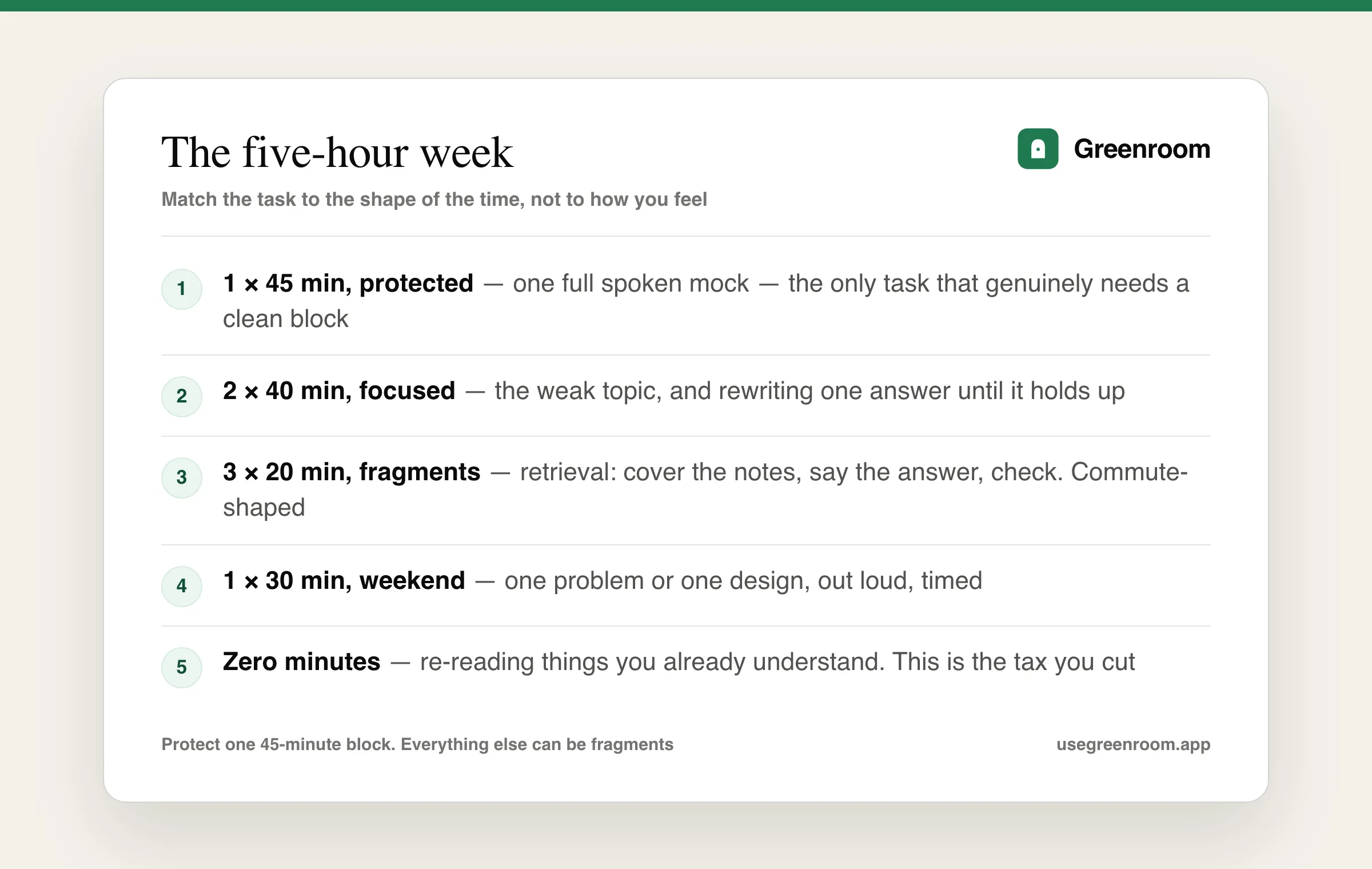
The principle: match the task to the shape of the time, not to how you feel.
One protected 45-minute block. One full spoken mock, start to finish, no stopping to fix things. This is the only task that genuinely requires an uninterrupted block, so it gets the best slot you own — usually a weekend morning or a lunch hour with a door. If you do exactly one thing on this list, do this.
Two 40-minute focused blocks. One on your single weakest topic. One on rewriting one answer until it survives two follow-ups. Not four topics. One.
Three 20-minute fragments. Retrieval practice: cover the notes, say the answer out loud from memory, check what you missed. This works in a commute, a coffee queue, a gap between meetings. Spoken, quietly, but spoken.
One 30-minute weekend slot. One coding problem or one design problem, out loud, on a timer.
Zero minutes re-reading things you already understand. This is where the hours go, and cutting it is what makes five hours enough.
The rules that make it survive a real job
- Protect one block, let everything else float. A plan that requires six consecutive good days dies on Tuesday. A plan with one non-negotiable block and four flexible ones survives a bad week.
- Prepare in the morning if you possibly can. Thirty minutes before work beats ninety minutes at 11pm, and it is not close. If you have children, this may be the only clean time that exists.
- Use the commute for speaking, not listening. Podcasts are consumption. Saying your "tell me about yourself" answer aloud in the car is the actual work.
- Never open a new resource. The urge to buy another course when you are behind is procrastination wearing a productivity costume. Finish the one list you have.
- Track sessions, not hours. "Four sessions this week" is a real measure. "About eight hours, I think" is a story you tell yourself.
- Take the interviews early. Do not prepare for three months and then start applying. Interview at your third-choice companies first — one real interview teaches you more about your gaps than two weeks of study, and it is free.
Fitting it around the job itself
- Interview slots. Early morning, lunch, or late afternoon. Take leave for a full onsite loop rather than trying to hide four hours. Our how to reschedule an interview politely guide covers moving one without damage when work collides.
- A quiet room. Book a meeting room, use your car, or take the call from home. Do not take a technical interview from an open floor — the audio alone can cost you.
- Keep it private. Do not tell colleagues, do not update LinkedIn to "open to work" while employed unless you have thought it through, and do not use your work laptop or work email for any of it.
- Notice periods change your timeline. In Indian IT a sixty to ninety day notice affects when companies want to start the process at all. Raise it early rather than at offer stage — our notice period negotiation in India guide covers it.
What to cut when the week collapses
Some weeks you will get one hour total. Here is the priority order, which is worth deciding now rather than at 11pm on a Thursday:
1. The spoken mock. Always. If you get sixty minutes this week, spend forty-five here.
2. Your weakest topic, out loud, not read.
3. The answer you keep fumbling. One answer, said five times.
4. Everything else.
Notice that reading appears nowhere until the list runs out. That ordering is the entire method.
How long this takes, realistically
- A targeted switch — you know the companies and the role is close to your current one: four to six weeks at five hours.
- A level jump or a domain change — three to four months, because you are building capability rather than rehearsing it.
- A FAANG-style loop from scratch — three to six months, and the honest version is that this is hard alongside a demanding job. Our how many mock interviews before the real one guide gives numbers by scenario.
The trap is doing a diluted version of all three for eight months. Pick one, and let the other two go.
Where each option actually helps
- LeetCode and question banks — good for the fragments, useless as an evening ritual you do while exhausted.
- A friend who will actually mock you — the best option if they exist and will follow up rather than reassure. Most will not do it weekly for six weeks.
- A paid human mock — genuinely useful once or twice, for calibration, and too expensive to be the weekly habit.
- ChatGPT — good for generating questions from a job description in a ten-minute gap. Its weakness is that it will happily let you type answers at 11pm, which trains reading and not speaking — exactly the failure this whole post is about.
- Greenroom — the spoken layer, and specifically the reason the protected block is realistic. Ari, the AI interviewer runs a full round out loud whenever the block happens to land, and asks the follow-up. Honest tradeoff: it will not teach you a topic you have never studied, and it cannot give you the hour — only your calendar can.
The one thing worth being blunt about, because it is the whole argument of this post: the hour you protect should be spoken, not read. Everything else is negotiable.
Frequently asked questions
How many hours a week do you need to prepare for interviews while working?
Around five hours a week is enough to change an outcome for a targeted switch, provided they are spent correctly. The common failure is not a shortage of hours but their shape — evenings after work suit reading, and reading is the activity that produces least. A workable split is one protected 45-minute spoken mock, two 40-minute focused blocks, three 20-minute retrieval fragments, and one 30-minute weekend problem, with zero minutes spent re-reading material you already understand.
When is the best time to prepare for interviews if you have a job?
Mornings, if they exist for you. Thirty minutes before work beats ninety minutes at 11pm by a wide margin, because hard retrieval practice needs cognitive capacity that a full working day has already consumed. Commutes are best used for speaking answers aloud rather than listening to podcasts, since consumption feels productive and rehearses nothing that an interview actually tests.
How do you take interview calls while working full time?
Use early morning, lunch, or late-afternoon slots, and take leave for a full onsite loop rather than trying to conceal several hours. Book a meeting room, use your car, or take the call from home — never from an open floor, where audio quality alone can cost you a technical round. Keep the search private, and do not use a work laptop or work email for any part of it.
What should you cut when you only get one hour of prep in a week?
Decide the order in advance rather than at 11pm on a Thursday. Spend it on a spoken mock first, then your weakest topic said out loud rather than read, then the single answer you keep fumbling repeated five times. Reading does not appear on the list until everything else is done, and that ordering is the method rather than an afterthought.
How long does it take to prepare for interviews with a full-time job?
Roughly four to six weeks at five hours a week for a targeted switch where the role resembles your current one, three to four months for a level jump or domain change because you are building capability rather than rehearsing it, and three to six months for a FAANG-style loop from scratch. The common trap is attempting a diluted version of all three for eight months, which is why choosing one and dropping the others matters more than the total hours.
Should you apply before you feel ready?
Yes, and earlier than feels comfortable. One real interview reveals more about your actual gaps than two weeks of study, and it costs nothing. Start with third-choice companies so that the expensive learning happens where the stakes are low, then move to the roles you actually want once you know which parts of your preparation were wrong.