He resigned on a Monday. By Wednesday his manager had come back with a 32% increase, a promotion at the next cycle, and a move to the team he had been asking about for a year. He accepted, because it was everything he had wanted. Eleven months later he was looking again — the promotion had slipped, the team move had happened and then partially unhappened during a reorg, and the manager who had made all three promises had left in March.
That story is common enough to have made "never accept a counter-offer" into standard advice. But that advice is mostly repeated by recruiters, who have an obvious interest in it, and it is too absolute to be useful. Counter-offers are not automatically a trap. They are just a fix aimed at one specific thing — the number — and the number is usually not why you left.
Here is how to work out which situation you are in.
The test
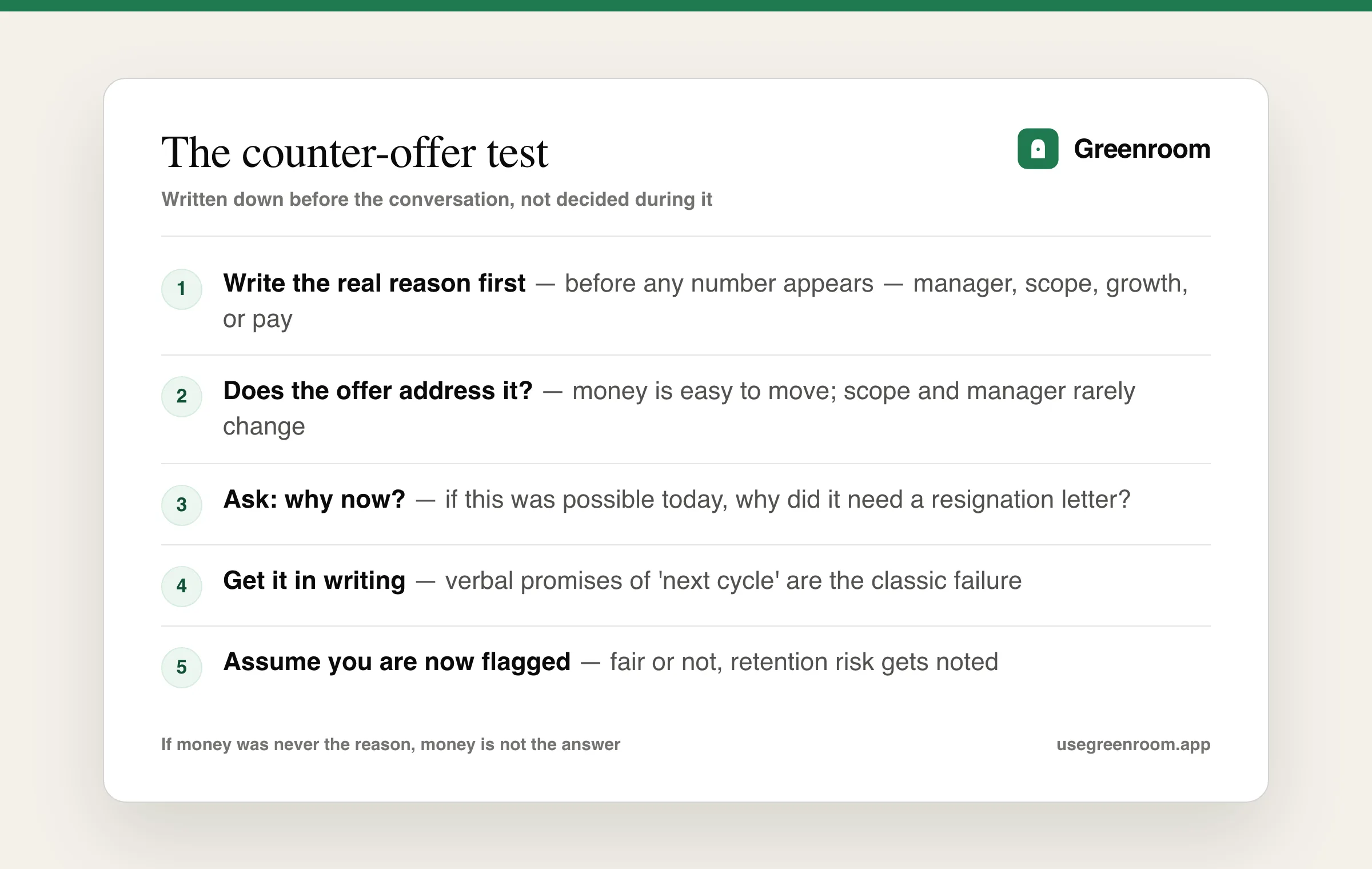
Step one, and do it before the conversation: write down why you actually started looking. Not the polished version you gave the recruiter. The real one. It is almost always one of:
- Compensation
- Your manager
- Scope, or the absence of it
- Growth and learning stalling
- Workload, or the commute, or the office policy
- The company's direction or stability
Step two: check whether the counter-offer addresses that reason. This is the whole decision. Money is the easiest thing for a company to move quickly — a budget approval takes a day. A manager, a team, a scope change, or a company's trajectory take months, or do not happen. If your reason was on the second list and the counter-offer is on the first, they have solved a problem you did not have.
Step three: ask the uncomfortable question. *"If this was possible now, what made it not possible six months ago when I asked?"*
There are good answers to this. "The budget cycle genuinely closed in April and this is the first window" is real, and it happens. "We didn't realise you were unhappy" is also real, and it is partly your fault if you never said so. What you are listening for is whether the constraint was structural or whether you simply had to threaten to leave to be taken seriously — because if it is the second, the same thing will be true next year.
When accepting genuinely makes sense
The blanket "never accept" advice is wrong in at least four situations:
- Compensation genuinely was the only issue, you were demonstrably underpaid against market, and the counter-offer closes that gap properly rather than partially. This happens, particularly in Indian IT where internal increments lag lateral moves badly. Our how much hike to ask when changing jobs guide covers checking whether the corrected number is actually market.
- The counter includes a real structural change — a different team, a different manager, a defined scope — that is documented and starts immediately rather than "after the current project".
- You had doubts about the new role anyway. If the resignation was partly a test of your own conviction and you find yourself relieved to have a reason to stay, listen to that. It is information.
- Your personal circumstances changed between accepting and resigning — a health issue, a family situation, something that makes stability worth more than progression right now.
When to decline
- The reason was your manager, and your manager is making the offer. This resolves itself in exactly one direction.
- The promise is future-tense. "Promotion at the next cycle", "we'll look at the team move after this release", "there's a plan". Cycles slip and plans change with the people who made them.
- Nothing is in writing. A verbal counter-offer is a conversation, not a compensation revision. Ask for the revised letter before you withdraw from anything.
- You are being asked to decide today. Urgency here is a pressure tactic. Ask for two days; a genuine offer survives two days.
- You already know you will be looking again in a year. You will just be doing it from a worse position, having burned the process you were in.
What usually happens afterwards
Honest, hedged, because this is where the topic attracts a lot of confidently-stated statistics with weak sourcing. You will see claims that most people who accept a counter-offer leave within six to twelve months. Those figures circulate widely and are largely traceable to recruitment firms, so treat them as directional at best rather than as fact.
What is more reliably true, and worth planning for:
- You are now marked as a retention risk. Fair or not, it gets noted. It can affect what you are staffed on and how you are considered in the next reorg.
- The reason usually returns. If it was structural, the underlying condition has not changed.
- Your leverage is spent. You cannot run the same play again in eight months.
- The relationship with the company you declined is damaged, sometimes permanently — which removes an option you may want later. Our how to decline a job offer politely guide covers withdrawing without burning it completely.
None of that means never accept. It means accept with your eyes open, and only when the counter addresses the actual reason.
How to handle the conversation
- Do not negotiate a counter-offer. If you start bargaining upward, you have converted your resignation into a salary negotiation and everyone will know it. Either the counter addresses the reason or it does not.
- Ask for two days. "I appreciate this and I want to give it proper thought rather than answer in the room" is entirely reasonable.
- Ask for it in writing, including any structural elements — the team, the title, the date.
- Do not reveal the other company's full offer details. You are not obliged to, and it invites a bidding conversation rather than a decision.
- Decide against your written reason, not against the number in front of you. This is why step one happens before the conversation — the number is designed to be persuasive in the moment.
- If you decline, decline cleanly and once. Thank them, be specific about what you appreciated, and hold the line. Repeated approaches are common in Indian IT and a wavering no invites three more conversations.
Telling the other company
If you accept the counter, tell the company you were joining immediately — the same day. Do not go quiet. Our how to decline a job offer politely guide has the exact wording, and doing this well is the difference between a door that stays open and one that does not.
If you decline the counter, tell your manager clearly and give a real reason without relitigating it. Then serve your notice properly — our notice period negotiation in India guide covers buyouts and early release, and our what to do after accepting a job offer before joining guide covers the documents you must collect on the way out.
The version of this that avoids the whole problem
The cleanest way to never face a bad counter-offer decision is to raise the issue *before* you interview. Tell your manager what you want — the scope, the number, the team — and give them a real window to act on it. Many will not. But if they do, you get the improvement without spending your leverage, and if they do not, you leave with a much clearer conscience and a much easier answer when the counter-offer arrives.
Most people skip this because the conversation is uncomfortable, which is understandable, and it is also the same skill the interviews themselves require: saying a specific thing you want, out loud, to someone who might say no. That is what Ari, the AI interviewer is for rehearsing. Honest tradeoff: it cannot have the conversation with your manager for you, and the manager conversation is the one that actually pays.
Frequently asked questions
Should you accept a counter-offer?
It depends entirely on whether the counter-offer addresses the reason you started looking. Write that reason down before the conversation, then check what is actually being fixed: money moves quickly because a budget approval takes a day, while a manager, a team, a scope change or a company's direction take months or never happen. If your reason was on the second list and the counter is on the first, they have solved a problem you did not have.
When is accepting a counter-offer a good idea?
In four situations. When compensation genuinely was the only issue, you were demonstrably below market, and the counter closes that gap fully rather than partially — which happens often in Indian IT where internal increments lag lateral moves. When the counter includes a documented structural change such as a different team or defined scope starting immediately. When you had real doubts about the new role and feel relieved to have a reason to stay. And when your personal circumstances have changed since accepting.
When should you decline a counter-offer?
When your reason for leaving was your manager and your manager is the one making the offer, since that resolves in only one direction. When the promise is future-tense — a promotion next cycle, a team move after this release — because cycles slip and plans leave with the people who made them. When nothing is in writing. When you are pressured to decide the same day. And when you already know you will be looking again within a year.
What question should you ask when given a counter-offer?
Ask why it was not possible earlier: if this increase or this team move is available now, what made it unavailable six months ago when you raised it. There are legitimate answers, such as a budget cycle that genuinely only just opened, and there are revealing ones. What you are listening for is whether the constraint was structural or whether you simply had to threaten to leave to be taken seriously, because the second condition will still be true next year.
Do people who accept counter-offers leave anyway?
You will see widely-quoted figures claiming most do within six to twelve months, but those numbers largely originate from recruitment firms with an obvious interest in the conclusion, so treat them as directional rather than factual. What is more reliably true is that you are subsequently noted as a retention risk, the original reason returns if it was structural, your leverage is spent so the same approach will not work again soon, and your relationship with the company you declined is damaged.
How do you handle the counter-offer conversation?
Do not negotiate it upward, because bargaining converts your resignation into a salary negotiation and everyone recognises it. Ask for two days to think rather than answering in the room, request everything in writing including any team, title or date commitments, and avoid disclosing the full details of the other offer. Decide against the reason you wrote down beforehand rather than against the number in front of you, since the number is designed to be persuasive in the moment.