He knew on Tuesday. He wrote the email on Tuesday. He did not send it on Tuesday, because it felt rude, so he waited until it felt less rude, which is a thing that never happens. He sent it eleven days later, by which point the recruiter had turned down their second-choice candidate, told the team the role was closed, and had to reopen a search she had already celebrated finishing.
Declining an offer is not the awkward part. Delaying it is. And the reason it matters is entirely practical: recruiters move between companies, hiring managers remember names, and the Indian tech market is smaller than it looks — the person you decline this year may be interviewing you in three. Here is how to say no in under a hundred words, with templates.
Why declining well is worth the four minutes
- Recruiters have a shortlist. Your no lets them move to the next candidate while that person is still available. That is a real favour and it is remembered.
- You may want them later. Roles reopen, teams change, and returning to a company you declined gracefully is entirely normal. Returning to one you ghosted is not.
- Recruiters change companies constantly. The person you decline is disproportionately likely to be the person screening you somewhere else.
- It is a small industry. Especially within a city, and especially within a domain like fintech or quick commerce.
The four-part structure
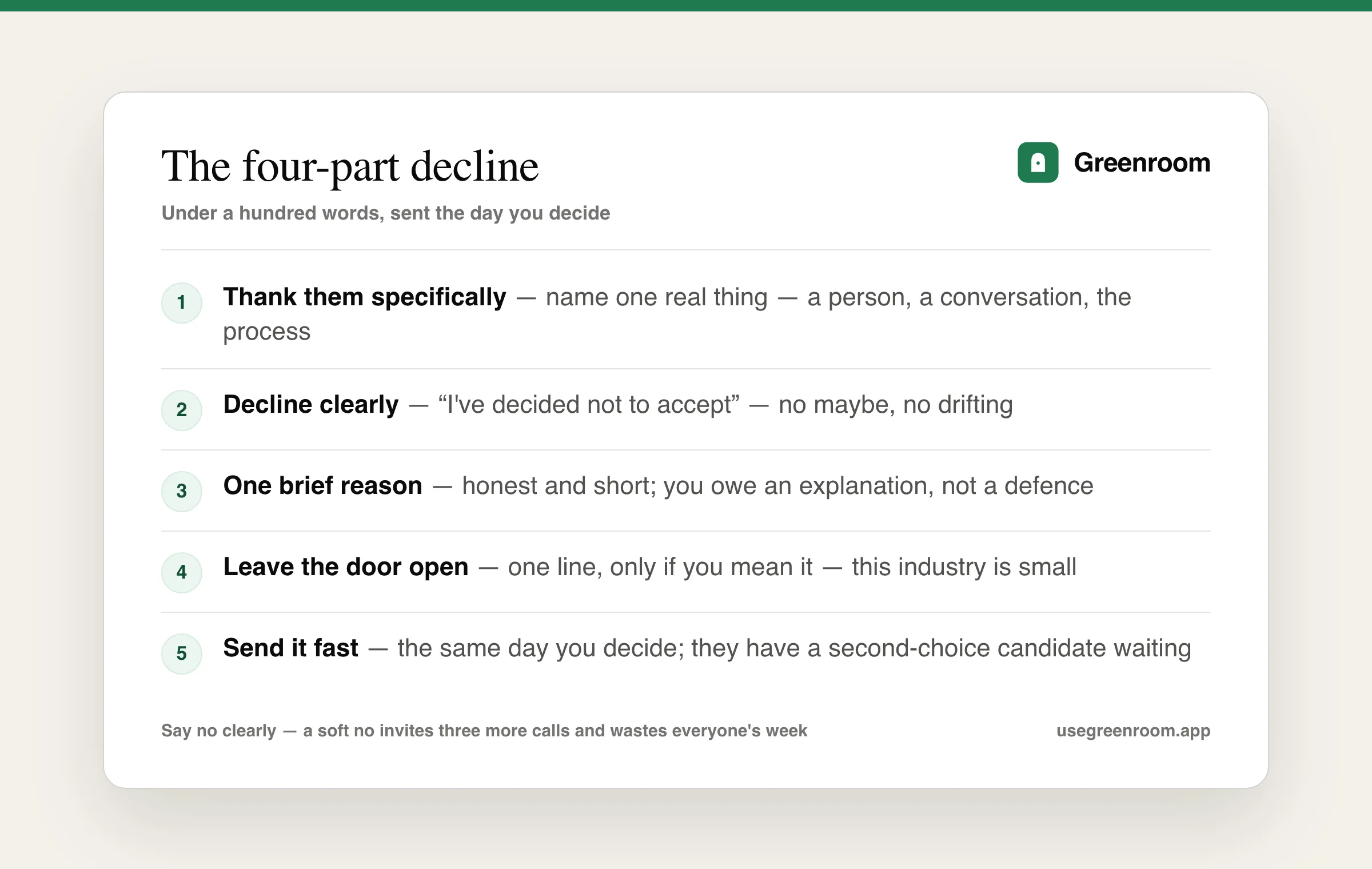
One — thank them specifically. Not "thank you for the opportunity", which reads as a template. Name something real: a person you enjoyed talking to, the technical round, how quickly they moved.
Two — decline clearly. "After a lot of thought, I've decided not to accept the offer." No "I'm leaning towards", no "unfortunately at this time it may not be". A soft no invites three follow-up calls and wastes a week for both of you.
Three — one brief reason. You owe an explanation, not a defence. One clause is enough: another role was a closer fit, the scope was different from what you are looking for, you decided to stay where you are. Honest and short.
Four — leave the door open, if you mean it. One line. Do not write it if it is not true; recruiters can tell, and an insincere version is worse than a clean close.
Send it the same day you decide, by email — so it is on record — and reply to the recruiter's existing thread rather than starting a new one.
Templates
You took another offer:
Subject: Re: Offer — [Role]
Hi [Name],
Thank you for the offer, and for how straightforward you made the whole process — the conversation with [interviewer] about [topic] was genuinely one of the better technical discussions I've had.
After a lot of thought, I've decided to accept another offer that's a closer fit for the direction I want to take my work.
I really appreciate the time your team put in, and I'd be glad to stay in touch.
Best, [Name]
You are staying at your current company:
Hi [Name],
Thank you for the offer — I appreciate the team taking the time, particularly [interviewer].
After discussing it internally, I've decided to stay in my current role, where I've been given the scope I was looking for. It was a genuinely difficult decision.
Thanks again, and I hope we can stay in touch.
[Name]
Compensation was the issue, and you want the door open:
Hi [Name],
Thank you for the offer and for working with me on it. I've decided not to accept — the compensation is below what I need at this stage, and I know you've already stretched what was available for the level.
I liked the team and the problem a lot, so if something opens up at a different level in future, I'd genuinely like to hear about it.
Best, [Name]
You already accepted and now need to withdraw — the hardest one, and it needs a phone call first, followed by an email:
Hi [Name],
Thank you for taking my call earlier. Confirming in writing: I'm withdrawing from the [Role] offer I accepted on [date].
I know this creates real disruption and I'm sorry for it. Circumstances changed after I accepted, and I did not want to start somewhere I could not fully commit to.
I appreciate the time your team invested and I'm sorry to end it this way.
[Name]
That last situation genuinely damages the relationship and sometimes ends it, which is the honest reason to be certain before you accept. Our what to do after accepting a job offer before joining guide covers the window where this most often arises.
What not to do
- Do not ghost. The single most damaging option, and unfortunately common. Silence is remembered far longer than a no.
- Do not over-explain. Four paragraphs of justification reads as guilt and invites negotiation.
- Do not criticise. Even when your reason is that the interview process was chaotic or a manager seemed difficult. If you genuinely want to give that feedback, keep it to one neutral sentence and only if asked.
- Do not lie about the reason. "I got a much better offer" when you did not is easy to unpick, and unnecessary.
- Do not name the exact competing offer amount unless you want to trigger a counter you have already decided to refuse.
- Do not decline by WhatsApp if the whole process was on email. Match the channel, and use email for the record.
Handling the pushback
Recruiters will often come back once — that is their job, not disrespect.
If you are genuinely open to a counter, say what would change your mind, precisely: "If the fixed component were at ₹X and the level were adjusted, I'd reconsider." Vagueness here wastes another week.
If you are not open, close it warmly and finally: "I appreciate you asking, but the decision is made — it's about the scope rather than the number, so I don't think there's a version of this that changes it." Then stop replying to negotiations while continuing to reply to human messages.
If they ask what the other offer was, you are not obliged to say. "I'd rather not share the details, but I'm happy to say it was primarily about scope" is a complete answer. Our how to negotiate multiple offers guide covers running the endgame.
The India-specific notes
- Declining a campus offer is different — many colleges have one-offer policies and declining can have placement-cell consequences. Talk to the cell before you do anything.
- Counter-offers from your current employer are common and often successful in the short term. Whether to take one is a separate decision, but if you do, tell the new company immediately rather than going quiet.
- Some recruiters will call repeatedly. One warm, final message plus not re-engaging on the number is the right response; you do not owe a fifth conversation.
- Keep the written record. If you declined after accepting, having the exchange in email protects everyone.
Where each option actually helps
- Email, not a call, for a standard decline — it is on record and it does not put you on the spot. Call first only if you are withdrawing after accepting.
- The recruiter, not the hiring manager — they own the process. Copying the hiring manager is a courtesy, not a requirement.
- ChatGPT — fine for drafting, though it will write you 250 words when 80 is better. Cut it hard.
- Greenroom — not for this, honestly. Declining is a two-minute email. Ari is for the interviews that got you the offer, and for the next ones.
Frequently asked questions
How do you politely decline a job offer?
Use four parts and keep it under about a hundred words: thank them for something specific rather than generically, decline clearly with no hedging, give one brief honest reason, and leave the door open only if you genuinely mean it. Send it by email the same day you decide, replying to the recruiter's existing thread. Almost all the damage in declining comes from delay rather than from the decline itself.
Should you tell a company why you are declining their offer?
Give one short reason — that another role was a closer fit, that the scope was different from what you are looking for, or that you decided to stay where you are. You owe an explanation, not a defence, so a single clause is enough. Avoid criticising the process or the people even when the criticism is fair, and do not invent a reason such as a much better offer if that is not what happened.
Is it OK to decline a job offer after accepting it?
It is possible but genuinely damaging, and it should be handled with a phone call followed by a written confirmation. Acknowledge the disruption plainly, apologise once without over-explaining, and keep it brief. Because this often ends the relationship with that company, the practical lesson is to be certain before accepting — particularly in India, where you may already have resigned from your current role.
How do you respond when a recruiter pushes back on your decline?
Expect one attempt, because that is their job. If you are genuinely open to a counter, state precisely what would change your mind — a specific fixed compensation figure and a level adjustment, for example — because vagueness costs everyone another week. If you are not open, close it warmly and finally by saying the decision is about scope rather than the number, then stop engaging with negotiations while still replying to human messages.
Should you decline a job offer by email or phone?
Email is right for a standard decline: it is on record, it does not put you on the spot, and it matches the channel most offers are made on. Reply to the recruiter's existing thread rather than starting a new one. The exception is withdrawing after you have already accepted, which warrants a phone call first followed by a written confirmation of what was said.
Will declining an offer hurt your chances of applying there later?
A polite, prompt decline usually does not — reapplying to a company you declined gracefully is entirely normal, and roles reopen constantly. What does hurt is ghosting, a decline that arrives two weeks after you decided, or withdrawing after acceptance. Recruiters also move between companies frequently, so the person you decline well is disproportionately likely to be screening you somewhere else later.