A candidate I'll call Aakash designed a clean CRM ticketing schema in his Freshworks system design round — customers, tickets, agents, a straightforward assignment flow. The interviewer's follow-up: "one of your customers is a 5,000-agent enterprise running a Black Friday support surge. Another customer on the same shared database is a 3-person startup. The enterprise customer's load just made every query on the platform slow — including the startup's. What actually breaks, and how does your design prevent it?" Aakash's design had one schema, shared by everyone. It didn't have a mechanism that stopped one customer's load from becoming every other customer's problem — and for a multi-tenant SaaS company selling to thousands of businesses on shared infrastructure, that gap is the whole interview.
That's the real shape of Freshworks interview questions: DSA is the entry fee, but the system design round is relentlessly focused on multi-tenant architecture — how you isolate one customer's data and load from another's on shared infrastructure, and what happens when a "noisy neighbor" customer threatens to degrade everyone else's experience. I built Greenroom after freezing in exactly this kind of interview, where "it works for one customer" is the least interesting part of the answer. This guide covers the real Freshworks interview process, the questions that come up, and where multi-tenant design catches people off guard.
The Freshworks interview process
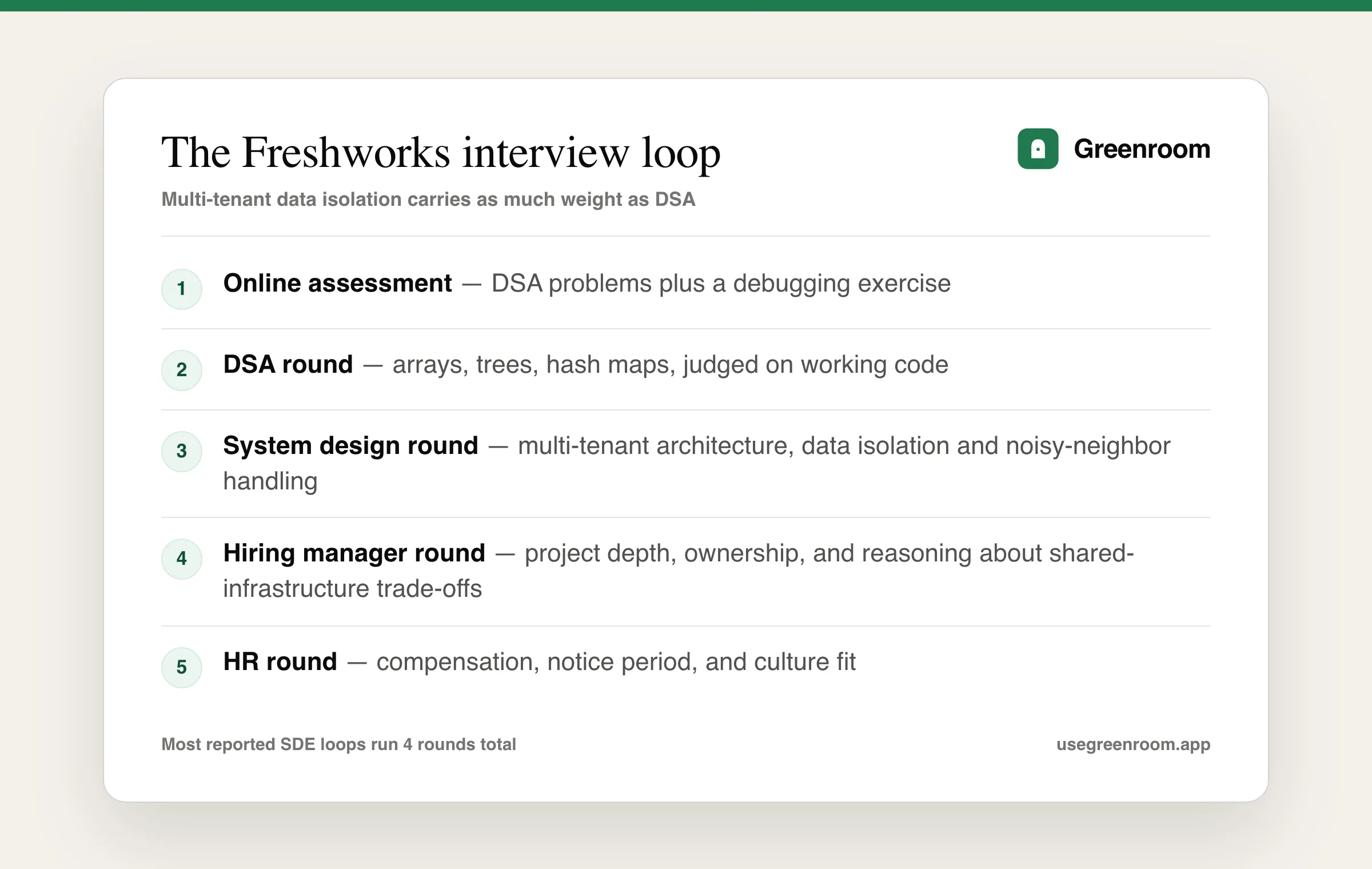
Candidates report a loop shaped like this:
- Online assessment — DSA problems plus a debugging exercise.
- DSA round — arrays, trees, hash maps, judged on working code.
- System design round — multi-tenant architecture, data isolation and noisy-neighbor handling.
- Hiring manager round — project depth, ownership, and reasoning about shared-infrastructure trade-offs.
- HR round — compensation, notice period, and culture fit.
Most reported loops run 4 rounds total. The detail that catches people off guard: the system design round isn't a generic scale-focused prompt — nearly every design question gets pushed until you're forced to explain exactly how one customer's data, load, or configuration stays isolated from every other customer sharing the same underlying infrastructure.
DSA and coding questions
Standard data structures and algorithms, judged with an eye toward practical, backend-flavored reasoning:
- Given a stream of API requests tagged by customer ID, detect which customer is consuming a disproportionate share of resources.
- Design a data structure that supports fast lookup and update for per-tenant configuration and feature flags.
- Implement a rate limiter that enforces a fair quota per customer, not globally across all customers.
- Find the shortest path in a weighted graph — a standard fundamentals check, less central to this loop than the design round.
Multi-tenant architecture — the round every design question leads to
This is Freshworks's signature focus. Expect design prompts and follow-ups that keep circling back to the same underlying question: how do you share infrastructure across thousands of customers without letting them interfere with each other?
- How would you design data isolation for a multi-tenant CRM so one customer's data can never be queried or leaked by another customer's request?
- Design a system that prevents a high-usage "noisy neighbor" customer from degrading query performance for every other customer on shared infrastructure.
- How would you design per-tenant rate limiting and quotas that stay fair even as customer sizes vary from 3-person startups to 5,000-agent enterprises?
- Walk through how you'd migrate one customer's data to dedicated infrastructure without downtime, while thousands of other customers keep using the shared platform.
Aakash's mistake wasn't the schema — it was treating "multi-tenant" as a marketing term instead of a hard architectural constraint that has to be enforced at the database, query, and infrastructure layers simultaneously, not just checked at the application layer with a tenant_id column. Our system design interview guide covers the general framework; Freshworks's version demands tenant isolation as a first-class design element in every answer, not an afterthought.
System design questions
Beyond the core multi-tenancy questions, expect broader systems questions grounded in Freshworks's actual domain — SaaS products serving many businesses at once:
- Design a search system for a helpdesk product that stays fast per-tenant even as the total ticket volume across all tenants grows into the billions.
- How would you design a webhook/integration system that lets each customer configure their own third-party integrations without customers interfering with each other's configs?
- Design a system that handles a customer upgrading their plan mid-cycle, with their data and permissions updating consistently across every service.
Work these through the standard skeleton — clarify requirements, propose a data model, pick an isolation and scaling strategy, close with failure modes — but keep the tenant-isolation lens active throughout, since that's what Freshworks's interviewers are actually listening for.
Behavioral and hiring-manager questions
The hiring manager round weighs ownership and precision in reasoning about shared-infrastructure trade-offs:
- Tell me about a time you found and fixed a bug that could have caused one customer's data to leak into another's view.
- Walk me through a project where you had to design for a failure mode caused by one user's behavior affecting everyone else.
- Describe a time you had to balance a feature request from one large customer against the experience of many smaller customers.
Our behavioral interview questions and answers guide covers structuring these with STAR without sounding rehearsed.
LeetCode, GeeksforGeeks, ChatGPT — where each fits
- LeetCode — right for the DSA round; wrong as the main event, since multi-tenant architecture carries the real weight in this loop.
- GeeksforGeeks interview experiences — useful for calibrating what past candidates were asked; treat as anecdotes, not a syllabus, since accuracy and recency vary post to post.
- A multi-tenant SaaS architecture resource — genuinely necessary here; study tenant isolation patterns (schema-per-tenant vs. shared-schema with tenant IDs vs. database-per-tenant), noisy-neighbor mitigation, and per-tenant rate limiting specifically, since that's the actual syllabus.
- ChatGPT — solid for generating practice multi-tenant design prompts and sanity-checking a written design; it won't push back on your isolation gap the way a real Freshworks engineer who's shipped multi-tenant infrastructure will.
- Greenroom — the spoken layer. Ari, the AI interviewer, runs a mock system-design round out loud and pushes the "what happens when one customer's load degrades everyone else's" follow-up Aakash got caught on, scoring how rigorously you reason about tenant isolation.
How to prepare for the Freshworks interview
- Week 1: core DSA — arrays, trees, hash maps — enough to clear the gate round comfortably.
- Week 2: multi-tenant system design — data isolation strategies, per-tenant rate limiting, noisy-neighbor mitigation — worked through out loud, always asking "how does this stay isolated per customer."
- Week 3: broader SaaS-platform design — per-tenant search, integrations, plan upgrades — each explained in under ninety seconds.
- Final week: one spoken mock where the interviewer pushes a "what if one customer's load affects everyone else" follow-up on every design choice, plus a shared-infrastructure-focused behavioral pass.
If Freshworks is one of several B2B SaaS companies you're targeting, the underlying skill transfers — our Chargebee interview questions guide covers a similarly correctness-focused loop for recurring billing instead of tenant isolation, and the general system design interview guide covers the framework both loops assume.
Frequently asked questions
What questions does Freshworks ask in a technical interview?
Expect DSA and coding fundamentals, a system design round focused almost entirely on multi-tenant architecture (data isolation, noisy-neighbor handling, per-tenant rate limiting), broader questions about per-tenant search and integrations, and behavioral questions about catching data-isolation bugs.
How many rounds are in the Freshworks interview process?
Typically an online assessment (DSA plus debugging), a DSA round, a system design round, a hiring manager round, and an HR round — 4 rounds total in most reported cases.
What does Freshworks's system design round actually test?
Whether you treat tenant data isolation and load isolation as first-class design constraints from the start. Nearly every design prompt gets pushed until you have to explain exactly how one customer's data or usage stays isolated from every other customer sharing the same infrastructure.
Do I need SaaS-architecture knowledge for a Freshworks interview?
Yes, specifically around multi-tenancy patterns. General system design knowledge (scale, caching, databases) is necessary but not sufficient — Freshworks's interviewers probe tenant-isolation patterns more deeply than a typical system design round that treats "one customer" as the default case.
How hard is the Freshworks interview?
It's a consistently high bar rather than a trick-question gauntlet. The part most candidates underprepare for isn't the DSA round — it's realizing that a design which works cleanly for one customer can still be wrong if it doesn't explicitly isolate that customer from every other tenant on shared infrastructure.
How is Freshworks's interview different from consumer product companies?
Consumer product interviews (Swiggy, Zomato) test system design for one large user base; Freshworks's loop tests design for many independent customer organizations sharing the same infrastructure, where a bug isn't just a performance issue — it can mean one company seeing another company's data.