A candidate I'll call Rohan answered a BrowserStack DSA question well, then hit a systems question he genuinely hadn't rehearsed: "we run real browsers on real virtual machines across thousands of device-and-OS combinations — how would you design the scheduler that decides which physical machine runs your test next, and what happens when one machine dies mid-test?" It wasn't a distributed-systems-textbook question with a clean answer. It was BrowserStack's actual job, described out loud, and Rohan's system design prep, mostly built around "design Twitter"-style prompts, hadn't prepared him to reason about VMs, device farms, and browser automation as first-class infrastructure problems.
That's the real shape of BrowserStack interview questions: DSA is the entry fee, but the systems and infra-design rounds are unusually specific to BrowserStack's actual product —running and orchestrating real browsers across a genuinely enormous device-and-OS matrix— which means generic system design prep only gets you partway there. I built Greenroom after freezing in exactly this kind of interview, where the questions are grounded in infrastructure most candidates have used but never had to build. This guide covers the real BrowserStack interview process, the questions that come up, and where the infra-specific depth catches people off guard.
The BrowserStack interview process
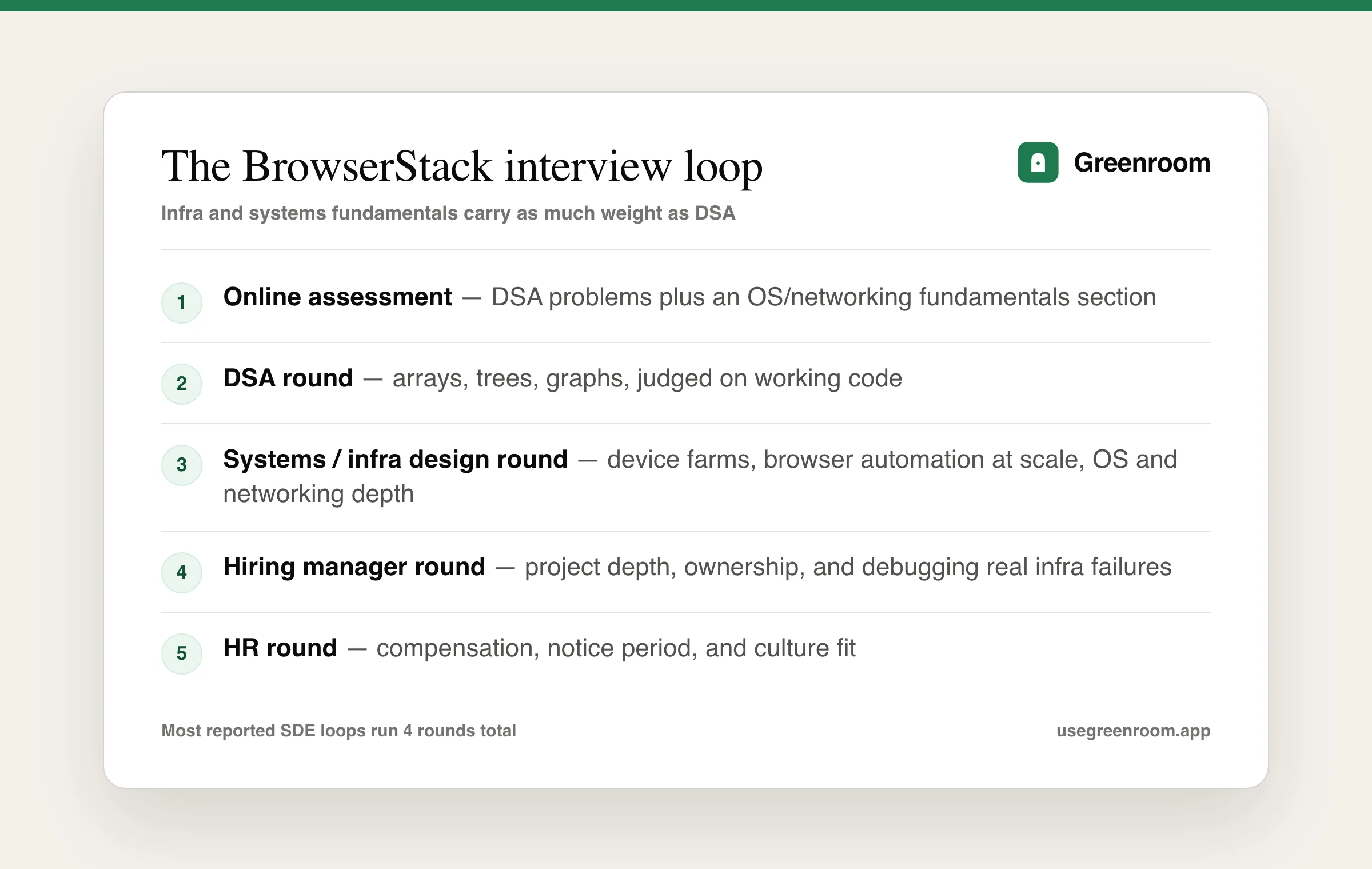
Candidates report a loop with a heavier-than-usual fundamentals component:
- Online assessment, DSA problems plus an OS/networking fundamentals section.
- DSA round: arrays, trees, graphs, judged on working code.
- Systems / infra design round: device farms, browser automation at scale, OS and networking depth.
- Hiring manager round: project depth, ownership, and debugging real infra failures.
- HR round: compensation, notice period, and culture fit.
Most reported loops run 4 rounds total. The detail that catches people off guard: the OS and networking fundamentals aren't a separate "CS basics" checkbox: they're treated as directly relevant working knowledge, since BrowserStack's core product is built on virtualization, networking, and low-level device orchestration.
DSA and coding questions
Standard data structures and algorithms, judged with an eye toward practical, systems-adjacent reasoning:
- Given a stream of events, return the top-K most frequent items in a sliding window.
- Design a data structure for an LRU cache with O(1) operations.
- Find the shortest path in a weighted graph, explain when Dijkstra breaks down.
- Design a task scheduler that assigns jobs to a limited pool of workers, respecting priority.
OS, networking and infra fundamentals
This is where BrowserStack's loop diverges from a typical product-company interview. Expect fundamentals questions to come up as live, applied reasoning, not textbook recall:
- How does a virtual machine actually isolate processes from the host. And what's the performance cost of that isolation?
- Walk through what happens at the network level when a browser establishes a WebSocket connection through a proxy.
- What happens to a TCP connection when the underlying VM it's running on gets rescheduled or migrated?
- How would you design a system to detect that a remote browser session has silently hung, not just crashed?
Our operating system interview questions guide and computer networks interview questions guide cover the fundamentals in depth: at BrowserStack, treat them as live ammunition for the infra-design round, not a separate study track.
Systems and infra design questions
Expect design prompts pulled directly from BrowserStack's actual product surface — real constraints an interviewer can push on for twenty minutes:
- Design a scheduler that assigns incoming test jobs to a pool of physical machines running virtualized browser instances.
- How would you design a system to detect and recover from a machine failing mid-test, without losing the test result?
- Design a system that keeps a large matrix of browser/OS/device combinations up to date as new versions release.
- How would you design network-level debugging tools (like BrowserStack's own) that capture traffic without breaking the page under test?
Work these through the standard skeleton (clarify scale and reliability constraints, propose an architecture, pick a failure-handling strategy) but be ready to go a layer deeper than usual into VM/container orchestration and network-level behavior, since that's the actual domain being tested.
Behavioral and hiring-manager questions
The hiring manager round weighs debugging instinct and ownership of infra problems:
- Tell me about a time you debugged a production incident that turned out to be an infrastructure issue, not application code.
- Walk me through a project where you had to reason about a system you didn't have full visibility into.
- Describe a time you improved the reliability of something without a clear spec for what "reliable" meant.
Our behavioral interview questions and answers guide covers structuring these with STAR without sounding rehearsed.
LeetCode, GeeksforGeeks, ChatGPT, where each fits
- LeetCode, right for the DSA round; wrong as the main event, since the infra-design round tests knowledge LeetCode doesn't touch at all.
- GeeksforGeeks interview experiences — useful for the DSA and general-process questions; thinner on BrowserStack's infra-specific rounds, since fewer candidates write those up in detail.
- An OS/networking textbook, revisited — genuinely necessary here in a way it isn't for most product-company interviews; brush up on virtualization, process isolation, and TCP/WebSocket behavior specifically.
- ChatGPT — solid for generating practice infra-design prompts and sanity-checking your understanding of a networking concept; it won't push you the way a real BrowserStack engineer who's debugged this exact class of problem will.
- Greenroom, the spoken layer. Ari, the AI interviewer, runs a mock systems round out loud and pushes OS/networking follow-ups the way Rohan's interviewer did, scoring how concretely you can reason about infrastructure you've used but maybe never had to build.
How to prepare for the BrowserStack interview
- Week 1: core DSA (arrays, trees, hash maps, graphs) enough to clear the gate round comfortably.
- Week 2: OS and networking fundamentals as spoken answers (virtualization, process isolation, TCP/WebSocket behavior, DNS resolution) each explained in under ninety seconds.
- Week 3: infra-specific system design (device/browser scheduling, failure recovery, network-level debugging tooling) worked through out loud, not just diagrammed.
- Final week: one spoken mock chaining a systems question into an OS/networking follow-up, plus a debugging-focused behavioral pass.
If BrowserStack is one of several infra or dev-tools companies you're targeting, the emphasis rhymes but the domain shifts — our Postman interview questions guide covers a similar fundamentals-heavy loop with an API-design focus instead of infra, and the general operating system interview questions guide covers the fundamentals both loops assume.
Frequently asked questions
What questions does BrowserStack ask in a technical interview?
Expect DSA and coding fundamentals, OS and networking questions treated as applied working knowledge (virtualization, TCP behavior, DNS), a systems/infra design round covering device and browser scheduling at scale, and behavioral questions about debugging real infrastructure incidents.
How many rounds are in the BrowserStack interview process?
Typically an online assessment (DSA plus OS/networking fundamentals), a DSA round, a systems/infra design round, a hiring manager round, and an HR round, 4 rounds total in most reported cases.
Does BrowserStack ask CS fundamentals questions like OS and networking?
Yes, more heavily than most product companies. Since BrowserStack's core product runs on virtualization and device orchestration, OS and networking questions (process isolation, TCP connection behavior, DNS resolution) are treated as directly relevant working knowledge, not a separate fundamentals checkbox.
What makes BrowserStack's system design round different?
Design prompts are pulled directly from BrowserStack's actual infrastructure (scheduling test jobs across a real device-and-browser matrix, recovering from a machine failure mid-test) rather than generic scale-focused prompts like "design Twitter," so generic system design prep only gets you partway there.
How hard is the BrowserStack interview?
It's a consistently high bar, and the difficulty is concentrated in the systems round: most candidates can clear the DSA gate, but reasoning concretely about virtualization and device orchestration under follow-up questions is a narrower, less-practiced skill.
How is BrowserStack's interview different from other infra/dev-tools companies?
Postman's loop tests API and HTTP design depth as its specialty; BrowserStack's tests OS, networking and virtualization depth as its specialty. Both share a DSA-plus-domain-specific-systems-round shape, but the domain each digs into reflects what the company actually builds.