A candidate I'll call Devika breezed through her Postman DSA round and relaxed into what she expected to be a standard system design conversation. Instead the interviewer opened a blank doc and asked: "design the API for a collaborative document editor — not the database, not the servers, just the API surface. Walk me through every endpoint and why it's shaped that way." No system diagram to lean on, no boxes and arrows — just raw API design, defended sentence by sentence. She realized halfway through that she'd never actually been asked to design an API in isolation before; she'd always designed it as a byproduct of a bigger system.
That's the real shape of Postman interview questions: DSA is the entry fee, same as anywhere, but Postman — a company whose entire product is the tool developers use to build and test APIs — tests API design and HTTP fundamentals as a first-class skill, not a side effect of a system design answer. I built Greenroom after freezing in exactly this kind of interview, where the thing being tested is narrower and deeper than you expect. This guide covers the real Postman interview process, the questions that come up, and where the API-design depth catches people off guard.
The Postman interview process
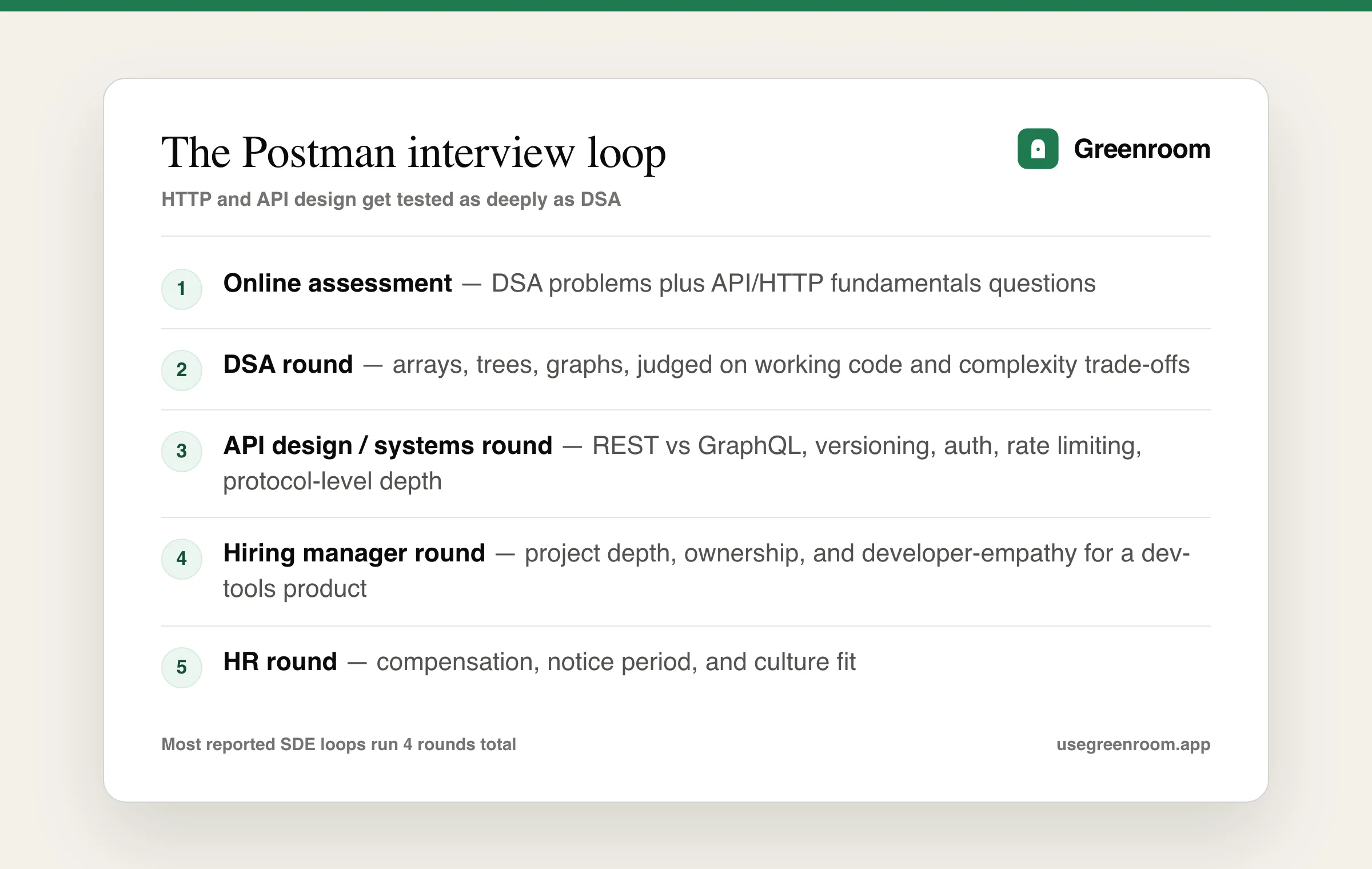
Candidates report a loop shaped like this:
- Online assessment — DSA problems plus questions on API and HTTP fundamentals.
- DSA round — arrays, trees, graphs, judged on working code and complexity trade-offs.
- API design / systems round — REST vs. GraphQL, versioning, auth, rate limiting, argued at the protocol level.
- Hiring manager round — project depth, ownership, and developer-empathy, since the product is built for developers.
- HR round — compensation, notice period, and culture fit.
Most reported loops run 4 rounds total. The detail that surprises candidates: the API design round isn't folded into a broader system design prompt the way it is at most companies — it's often its own dedicated round, judged on protocol-level correctness (status codes, idempotent verbs, versioning strategy) as much as on high-level architecture.
DSA and coding questions
Standard data-structure fundamentals, with less emphasis on exotic algorithms than a pure competitive-programming loop:
- Given a stream of events, return the top-K most frequent items in a sliding window.
- Design a data structure that supports insert, delete, and getRandom in O(1).
- Implement an LRU cache from scratch.
- Reverse a linked list in groups of K.
API design and HTTP fundamentals — the round that surprises people
This is Postman's signature round, and it rewards protocol-level precision most candidates haven't rehearsed:
- Design the REST API for a collaborative document editor — every endpoint, every verb, every status code.
- When would you choose PUT over PATCH, and what does idempotency actually mean for each verb?
- Design a versioning strategy for a public API that can't break existing integrations.
- How would you design rate limiting that's fair to a small developer while still protecting the platform from abuse?
- Explain the trade-offs between REST, GraphQL, and gRPC for a specific use case — not in the abstract, for this one.
Devika's mistake wasn't a knowledge gap — she knew REST conventions cold in the abstract. What she hadn't practiced was defending API-surface decisions in isolation, with no system diagram to hide behind, under real-time follow-up questions about edge cases (what happens on a conflicting concurrent edit, what status code, what does the client do next).
System and architecture questions
Beyond pure API design, expect broader systems questions grounded in Postman's actual domain — API tooling at scale:
- Design a system that can execute millions of scheduled API test runs reliably across regions.
- How would you design a webhook delivery system that guarantees at-least-once delivery with retries and backoff?
- Design a rate-limiting and quota system for a multi-tenant API platform.
Work these through the standard skeleton — clarify scale and reliability requirements, propose a data model, pick a queueing/retry strategy, close with failure modes — but keep circling back to the API contract itself, since that's the layer Postman's interviewers care most about getting right.
Behavioral and hiring-manager questions
The hiring manager round weighs developer empathy specifically, since Postman's own users are developers:
- Tell me about a time you had to design something for other engineers to use, not end users.
- Describe a piece of documentation or tooling you built that others actually adopted — why did it work?
- Walk me through a technical decision you made that you'd reverse if you could.
Our behavioral interview questions and answers guide covers structuring these with STAR without sounding rehearsed.
LeetCode, GeeksforGeeks, ChatGPT — where each fits
- LeetCode — right for the DSA round; wrong as the main event, since API design carries real, separate weight here.
- GeeksforGeeks interview experiences — useful for calibrating what's been asked, though Postman-specific reports are sparser than for older, larger companies — treat them as a starting point, not a syllabus.
- The official REST/HTTP specs (MDN, RFC docs) — genuinely worth reading closely for this loop specifically; most candidates know REST "well enough" for other companies but not precisely enough for this one.
- ChatGPT — solid for drafting practice API-design prompts and sanity-checking a proposed endpoint shape; it won't argue back on your status-code choice the way a real interviewer defending their own product's design conventions will.
- Greenroom — the spoken layer. Ari, the AI interviewer, runs a mock API-design round out loud and pushes the "why this verb, why this status code" follow-ups Devika got caught on, scoring precision and clarity in your explanation, not just whether the final design was reasonable.
How to prepare for the Postman interview
- Week 1: core DSA — arrays, trees, hash maps, graphs — enough to clear the gate round comfortably.
- Week 2: API design specifically — design 3–4 REST APIs from scratch (a document editor, a booking system, a notification service), narrating every endpoint, verb and status code out loud.
- Week 3: HTTP and protocol fundamentals at depth — idempotency, caching headers, versioning strategies, auth patterns (OAuth, API keys, JWT) — each explained in under ninety seconds.
- Final week: one spoken mock focused entirely on defending an API design under live follow-up questions, plus a broader system design pass for the platform-scale round.
If you're preparing for API-heavy or dev-tools interviews more broadly, our REST API interview questions guide covers the fundamentals this loop assumes, and the general system design interview guide covers the framework for the platform-scale questions.
Frequently asked questions
What questions does Postman ask in a technical interview?
Expect DSA and coding fundamentals, a dedicated API design round covering REST conventions, HTTP verbs, versioning and rate limiting at a protocol level, broader systems questions about API-platform reliability (webhook delivery, test-run scheduling), and behavioral questions about designing for other developers.
How many rounds are in the Postman interview process?
Typically an online assessment (DSA plus API/HTTP fundamentals), a DSA round, a dedicated API design/systems round, a hiring manager round, and an HR round — 4 rounds total in most reported cases.
What is Postman's API design round?
A round where you design a REST API's surface — endpoints, HTTP verbs, status codes, versioning — from scratch, without a broader system diagram to lean on, and defend every choice under live follow-up questions about edge cases. It's judged on protocol-level correctness, not just high-level structure.
Do I need deep REST/HTTP knowledge for a Postman interview?
Yes, more than for most companies. Postman's product is an API client and testing platform, so interviewers probe HTTP semantics (idempotency, status codes, caching) and REST conventions more precisely than a typical system-design round that treats the API as a minor detail of a bigger architecture.
How hard is the Postman interview?
It's a consistently high bar, and the difficulty is narrower than most candidates expect — less about breadth of system design knowledge, more about precision in API and protocol design, an area most interview prep treats as a footnote rather than a dedicated skill.
What's the most common mistake candidates make in a Postman interview?
Treating API design as a side effect of a broader system design answer instead of practicing it as its own skill — being unable to defend a specific HTTP verb, status code, or versioning choice in isolation when pushed on it, because they've only ever designed APIs as part of a bigger diagram.