Ari — Greenroom's AI interviewer — does not blindly escalate every answer into a harder problem. It reads the quality, clarity, and confidence of each response and decides whether to probe deeper, clarify, or move on. Done well, this feels like a good human interviewer who knows when to push and when to give you a foothold. Done badly, adaptive difficulty turns into either a flat quiz or a relentless pile-on. This is how we keep it the former.
Why adaptation matters at all
A fixed question list has a structural problem: it's calibrated for an imaginary median candidate who doesn't exist. For a strong candidate, a fixed list is too easy — they sail through and you learn nothing about their ceiling. For someone struggling, the same list is demoralizing and equally uninformative, because once they're underwater, every further question just measures how underwater they are.
The interesting signal lives at the edge of what a candidate can do. Adaptive difficulty is simply the mechanism for finding that edge quickly and then staying near it, where every answer is actually telling you something.
What Ari is actually reading
After each answer, Ari evaluates a few things before choosing its next move:
- Completeness. Did the answer cover the core of the question, or just the surface? A complete answer earns a deeper probe; a partial one earns a targeted clarification.
- Correctness and precision. Vague-but-right is different from specific-and-right. Specificity invites trade-off questions ("when would that not hold?"); vagueness invites a request to make it concrete.
- Confidence vs. competence. Confident and correct moves up. Confident and wrong is the most important case — Ari probes gently to see whether it's a slip or a genuine gap, without humiliating the candidate.
- Recovery. When someone stumbles and then self-corrects, that's a strong signal in its own right, and Ari weights it accordingly.
How it escalates — and de-escalates
Adaptation runs in both directions, which is the part most "adaptive" systems get wrong.
When you're doing well, Ari escalates by depth, not volume. It doesn't just ask another question of the same kind; it pushes into trade-offs, edge cases, and "what would you change at 10× the scale?" The aim is a realistic stretch — the moment where a confident candidate has to actually think.
When you're struggling, Ari de-escalates. Like a good human interviewer, it simplifies, offers a foothold, or moves to an adjacent area to find what you do know. A session that is wall-to-wall failure teaches the candidate nothing and tells us nothing we didn't already know after the first miss. De-escalation isn't going easy — it's relocating the question to where signal still exists.
Grounding questions in your real work
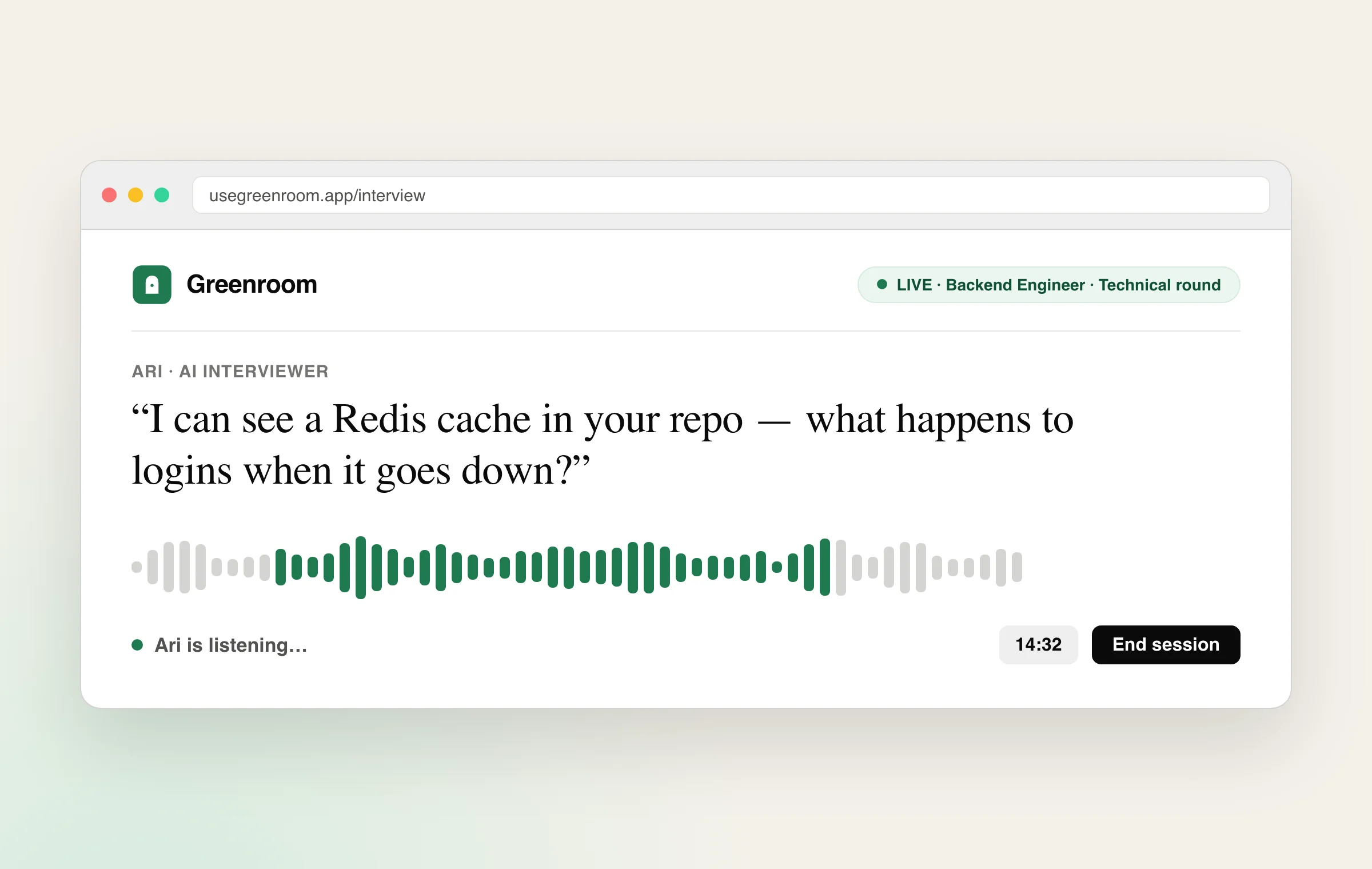
Calibration gets sharper when the questions are about something the candidate genuinely knows. Before a session, Ari can read your public GitHub and generate questions from your own code — a design decision you actually made, a trade-off in a repo you actually shipped. That matters for difficulty calibration specifically: it's much easier to find the edge of someone's understanding on a system they built than on a generic toy problem, because they can't hide behind rehearsed answers and they have real depth to reveal.
The hard part: keeping it from feeling arbitrary
The failure mode we worried about most isn't "too hard" or "too easy" — it's "incoherent." If difficulty lurches around with no apparent logic, the interview stops feeling like a conversation and starts feeling like a slot machine. Two design rules keep it coherent:
- One thread at a time. A follow-up sharpens the current answer before opening a new topic. The best next question is usually the one that deepens what you just said, not a non-sequitur that shows off range.
- Change one variable, not three. Ari adjusts depth in measured steps so the candidate can feel the interview responding to them, rather than being yanked between extremes.
Does adaptive difficulty break comparability?
A fair concern: if two candidates take different paths through the interview, how can their scores be compared? The answer is that difficulty calibration changes the path, not the rubric. Scoring is anchored to a fixed competency rubric — what a strong answer looks like for each competency — not to which specific questions got asked. The adaptive layer decides how to surface evidence; the rubric decides how that evidence is graded. This is the same principle behind structured interviewing: the conversation can flex while the measurement stays constant.
The product principle
We optimize for interviews that feel intentional. The best follow-up is often the one that sharpens the current answer, not the one that shows off the model. Adaptive difficulty, done right, should be nearly invisible — the candidate just feels like they were met where they are, pushed where it counted, and given a foothold where they needed one. That's the whole job.
Frequently asked questions
How does Ari decide how hard the next question should be?
Ari tracks how completely and confidently you answered, then adjusts follow-up depth: strong answers earn harder probes into trade-offs and edge cases, while struggling answers get scaffolding rather than a pile-on. The goal is a realistic stretch, not chaos.
Will Ari keep grilling me if I'm doing badly?
No. Like a good human interviewer, Ari de-escalates: it simplifies, offers a foothold, and moves to a different area to find what you do know. A session that's all failure teaches nothing.
Does adaptive difficulty make scores incomparable between sessions?
No — scoring is anchored to a rubric, not to the question sequence. Difficulty calibration changes the path through the interview, while the rubric keeps the grading consistent.